

Delhi High Court: Indian Courts Lack Supervisory Jurisdiction Over Foreign Seated Arbitrations Irrespective Of Any Connections With India
The Delhi High Court said that the juridical seat of arbitration determines the curial law and the Court vested with supervisory authority.
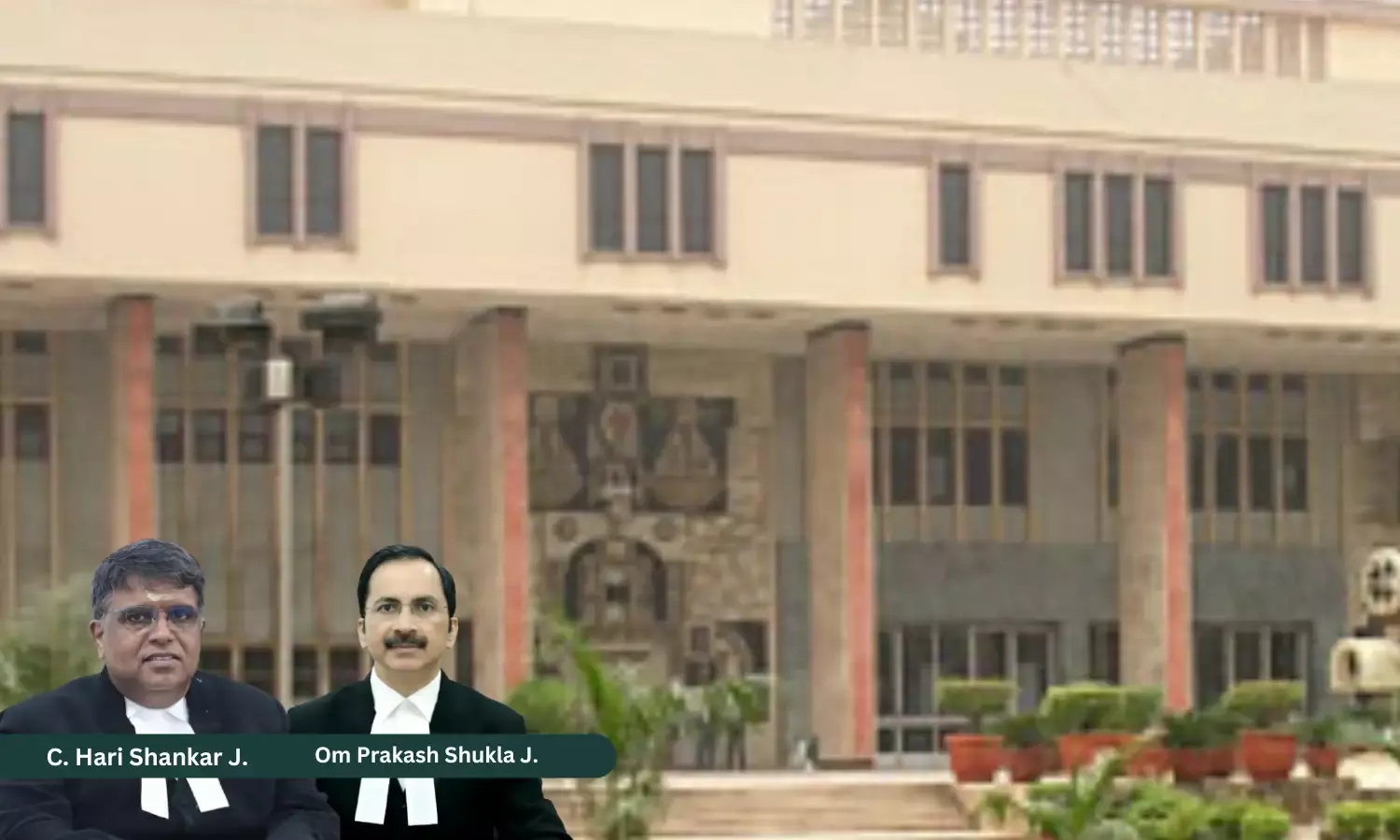
Justice C. Hari Shankar, Justice Om Prakash Shukla, Delhi High Court
The Delhi High Court reiterated that the Indian Courts lack supervisory jurisdiction over foreign seated arbitrations, irrespective of any contractual, commercial or territorial connections with India.
The Court was hearing an Appeal filed under Section 37(1)(c) of the Arbitration and Conciliation Act, 1996 (A&C Act), read with Section 13 of the Commercial Courts Act, 2015, challenging the Order of the Single Judge.
A Division Bench comprising Justice C. Hari Shankar and Justice Om Prakash Shukla observed, “Once the seat is identified, courts at the seat alone exercise supervisory jurisdiction. As held in BGS SOMA (supra), applying the Shashoua principle, the designation of a place as the “venue” of arbitration ordinarily constitutes the seat in the absence of contrary indicia. This position has been reaffirmed in Arif Azim (supra), which clarifies that Indian courts lack supervisory jurisdiction over foreign seated arbitrations, irrespective of any contractual, commercial or territorial connections with India, does not alter this legal position. This settled position of law must guide the adjudication of the present case, leaving no scope for deviation based on obsolete doctrines or misconceived assertions of jurisdiction.”
The Bench said that the juridical seat of arbitration determines the curial law and the Court vested with supervisory authority.
Advocate Anirudh Bakhru appeared for the Appellant, while Advocate Shantanu Tyagi appeared for the Respondents.
Facts of the Case
The Appellant company-Delhi Airport Metro Express Private Limited was duly incorporated and registered under the provisions of the Companies Act, 1956 and the Respondent was a foreign company. The Respondent company and Reliance Infrastructure Limited (RIL) had jointly participated in the bid for the Airport Metro Express Line Project, which connects the Indira Gandhi International Airport, New Delhi with the city of New Delhi. In this regard, they entered into a Memorandum of Understanding (MoU) followed by a Consortium Agreement. Their bid was successful, and consequently, the Delhi Metro Rail Corporation (DMRC) awarded the project to the consortium vide a Letter of Acceptance. Subsequently, they incorporated the Appellant company as a Special Purpose Vehicle (SPV) for the partial implementation and subsequent operation of the project.
RIL held 95% of the equity shares in the SPV-Appellant company, while Respondent held the remaining 5%. The Appellant and Respondent entered into two agreements and thereafter, the Respondent issued a Performance Bank Guarantee in favour of the Appellant, in furtherance of the contractual arrangements between the parties. However, during the performance of the contract, certain difficulties arose, leading to disputes between the parties due to some technicalities. Aggrieved by the initiation of the arbitral proceedings, the Appellant filed an anti-arbitration Injunction suit before the High Court, seeking a stay of the arbitration proceedings pending in London. The Single Judge dismissed the Section 34 Petition on the ground of lack of jurisdiction, holding that Part I of the A&C was inapplicable.
Reasoning
The High Court in view of the above facts, noted, “From the foregoing analysis of statutory provisions and binding judicial precedents, it emerges with unmistakable clarity that the supervisory jurisdiction over arbitral proceedings under the Act is exclusively seat centric. … Part I of the Act applies only where the seat is situated in India; for foreign seated arbitrations, Part I is excluded, save for the limited statutory exceptions under the proviso to Section 2(2). Further, the doctrine of concurrent jurisdiction stands conclusively rejected.”
The Court remarked that where neither the arbitration agreement nor the substantive contract specifies a governing law, the law having the closest and most real connection with the arbitration agreement would apply.
“Therefore, in the light of the various aforesaid judicial pronouncements and settled legal principles, the framework is now firmly established for examining the facts of the present case. It is well settled that the juridical seat of arbitration determines the court which exercises supervisory jurisdiction over the arbitral proceedings and the applicability of Part I of the Act”, it further reiterated.
The Court said that the seat of arbitration, the governing law of the substantive contract, and the procedural framework are clearly and unequivocally defined.
“The express use of the term ‘seat’ Clause 22.3, which is akin to jurisdiction, leaves no scope for interpreting London as a mere venue. A holistic reading of the supply contract reveals no reference to any alternative place or venue for arbitration proceedings. Also, there is nothing to suggest that London was intended merely as a convenient location for hearings”, it added.
The Court was of the view that the parties’ intention to designate London as the juridical seat is explicit and unambiguous, and there exists no “contrary indicia’ to suggest otherwise.
“However, it is now well settled under Indian law that the governing law of the contract does not ipso facto determine the lex arbitri or the supervisory jurisdiction over the arbitral proceedings. The distinction between lex contractus, lex arbitri, and lex fori has been consistently recognized by the Apex Court, and parties are free by virtue of party autonomy to choose different laws governing these aspects of their arbitration of their agreement”, it observed.
The Court held that the parties have made a deliberate choice in selecting London as the ‘place’ of arbitration, invoking the procedural rules of ICC and by incorporating Clause 14.4 of the MSA.
“We find that jurisdiction cannot be conferred by consent, acquiescence, or conduct. In our view, Section 42 is attracted only when the initial application is filed before a court having jurisdiction in law. This position has been authoritatively settled in BGS SGS Soma (supra), wherein it was held that supervisory jurisdiction vests exclusively in the courts of the seat of arbitration”, it further said.
The Court also reiterated that the Court must ascertain and give effect to the intention of the parties as expressed in the contract and the language of the contract must be construed in its natural and ordinary meaning.
“Where different clauses appear to be inconsistent, the court must adopt an interpretation that advances the purpose of the contract and reject one that defeats its existence. The contract documents must be read harmoniously and conjointly, keeping in view the “party autonomy” and the consistent intention of the parties to get resolved their issues through alternative dispute resolution mechanism of arbitration”, it added.
Conclusion
Moreover, the Court noted that since the seat of the arbitration is admittedly outside India, the Court lacks jurisdiction under Section 2(2) of the Act and the Single Judge was correct in holding that Part-I of the Act is not applicable to the facts of the case.
“In light of the foregoing analysis, we conclude that the parties have made a deliberate and informed choice in selecting London as the “place” of arbitration, invoking the procedural rules of the International Chamber of Commerce (ICC), and incorporating Clause 14.4 of the MSA. These decisions clearly reflect the intent of the parties to exclude the provisions of Part I of the Arbitration and Conciliation Act, 1996, (“Act”) and no contrary indicia or evidence has been presented to suggest a different interpretation”, it added.
The Court, therefore, concluded that the inclusion of ICC rules and the determination of London as the seat are not mere formalities but fundamental aspects of the parties’ agreement, designed to ensure a neutral, well established procedural framework.
Accordingly, the High Court dismissed the Appeal and upheld the impugned Order.
Cause Title- Delhi Airport Metro Express Private Limited (India) v. Construcciones Y Auxiliar De Ferrocarriles & Anr. (Neutral Citation: 2025:DHC:11887-DB)
Appearance:
Appellant: Advocates Anirudh Bakhru, Rishi Agarwal, Tarini Khurana, and Shruti Arora.
Respondents: Advocates Shantanu Tyagi, Aishani Das, and Balapragatha Moorthy.
