

Section 91 CrPC Cannot Be Used to Compel Accused to Create Evidence Against Himself: Delhi High Court In Matter Against Ex-Judge
FIR was registered against retired judges, Justice I M Quddusi and Justice Shri Narayan Shukla and others

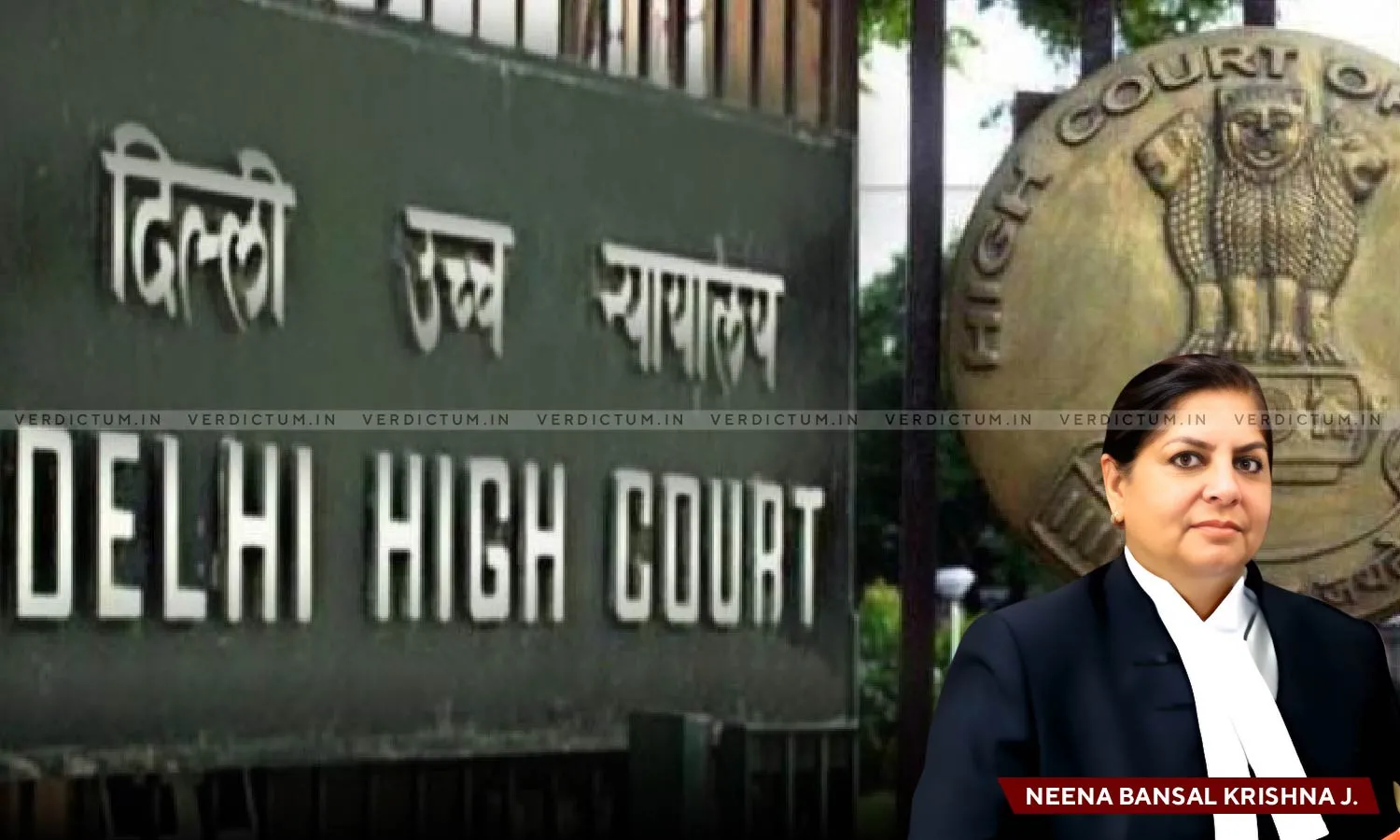
Justice Neena Bansal Krishna, Delhi High Court
The Delhi High Court has dismissed a petition filed by the Central Bureau of Investigation (CBI) challenging the setting aside of a notice issued under Section 91 of the Code of Criminal Procedure, 1973 (CrPC) to a former High Court judge. The Court held that the provision cannot be used to compel an accused to furnish information based on personal knowledge, as it would violate the constitutional protection against self-incrimination under Article 20(3) of the Constitution of India.
In the present matter an FIR was registered against Justice I M Quddusi a retired Judge of the High Court of Chhattisgarh, along with Justice Shri Narayan Shukla (Judge of the Allahabad High Court, Lucknow Bench), and others, and also an Education Trust for securing a favourable judicial order for a private medical college allegedly in exchange for illegal gratification. It was filed under Section 120-B of the IPC read with Sections 7, 8, 12, and 13(2) read with 13(1)(d) of the Prevention of Corruption Act, 1988.
Accordingly, a bench of Justice Neena Bansal Krishna, observed, “The protection under Section 91 does not handicap the investigation. As observed by the Supreme Court, the police officer has ample powers under Section 165 Cr.P.C. to search for documents or things necessary for the investigation. The details of bank accounts can be obtained from bankers under the Bankers‟ Books Evidence Act; call records can be obtained from service providers. The Petitioner cannot use Section 91 as a shortcut to compel the accused to assist in building the case against himself when the agency has the statutory power to collect this evidence from independent sources”.
On the demand to identify and list the mobile numbers used by him, bank accounts held by him, and drivers/servants employed by him as per the notice under S.91 CrPC, dated 11-02-2020, the bench further noted, “…This is not a demand for the mere production of a physical object already identified by the police (like a weapon or stolen property). It is a demand for the accused to apply his mind, search his memory, and compile information based on his personal knowledge. By providing a list of “drivers employed,” the accused is making a testimonial statement acknowledging an employer-employee relationship, which could be a vital link in the chain of conspiracy alleged by the CBI. Compelling the accused to provide this information is forcing him to create evidence against himself, which is strictly prohibited”.
Advocate Atul Guleria appeared for the petitioner, Advocate Prashant Chari appeared for the respondent.
The present matter arises out of a CBI investigation registered in December 2019 alleging a criminal conspiracy involving retired Justice I.M. Quddusi, Justice Narayan Shukla (former judge of the Allahabad High Court), and others, in connection with securing a favourable judicial order for a private medical college allegedly in exchange for illegal gratification.
During investigation, the CBI issued a notice under Section 91 CrPC directing Justice Quddusi to furnish details of mobile numbers used by him, bank accounts held during a specified period, and particulars of drivers and servants employed by him.
The respondent challenged the notice before the Special Judge, contending that Section 91 CrPC could not be invoked against an accused person and that compelling him to disclose such details amounted to testimonial compulsion.
The Court drew a clear distinction between:
-Mechanical production of material evidence, such as fingerprints or specimen handwriting (permissible), and;
-Imparting personal knowledge, which constitutes testimonial evidence and is protected by Article 20(3) of the Constitution of India.
Relying extensively on the Constitution Bench judgments in The State of Bombay v. Kathi Kalu Oghad and Ors. (AIR 1961 SC 1808) and State of Gujarat v. Shyamlal Mohanlal Choksi, (AIR 1965 SC 1251), the Court held that while investigative agencies have wide powers to collect evidence, Section 91 cannot be used as a shortcut to bypass interrogation safeguards or to compel the accused to assist in building the prosecution case.
The Court also observed that if the information was genuinely public or documentary, the CBI was free to obtain it directly from banks, telecom service providers, or other authorities, or through lawful interrogation under Section 161 CrPC without compelling the accused to generate evidence against himself.
Consequentially, the Court upheld the order of the Special CBI Court which had quashed the Section 91 CrPC notice, observing that the investigating agency had impermissibly attempted to convert a demand for information into a demand for “production of documents”.
Cause Title: CBI v. I M Quddusi [Neutral Citation: 2026:DHC:226]
Appearances:
Petitioner: Atul Guleria, Aryan Rakesh, Prashant Upadhyay, Advocates.
Respondent: Prashant Chari, Ayush Jindal, Advocates.