

“It Is Never Too Late To Search For Truth”: Delhi High Court Transfers Case Involving Mysterious Death Of 23-Yr-Old Hotel Manager To CBI
The Delhi High Court said that though in this case, the “cause of death”, in all probability, may be ascertained as Asphyxia as a result of antemortem hanging but what is glaringly lacking is the 'reason' for death by suicide.
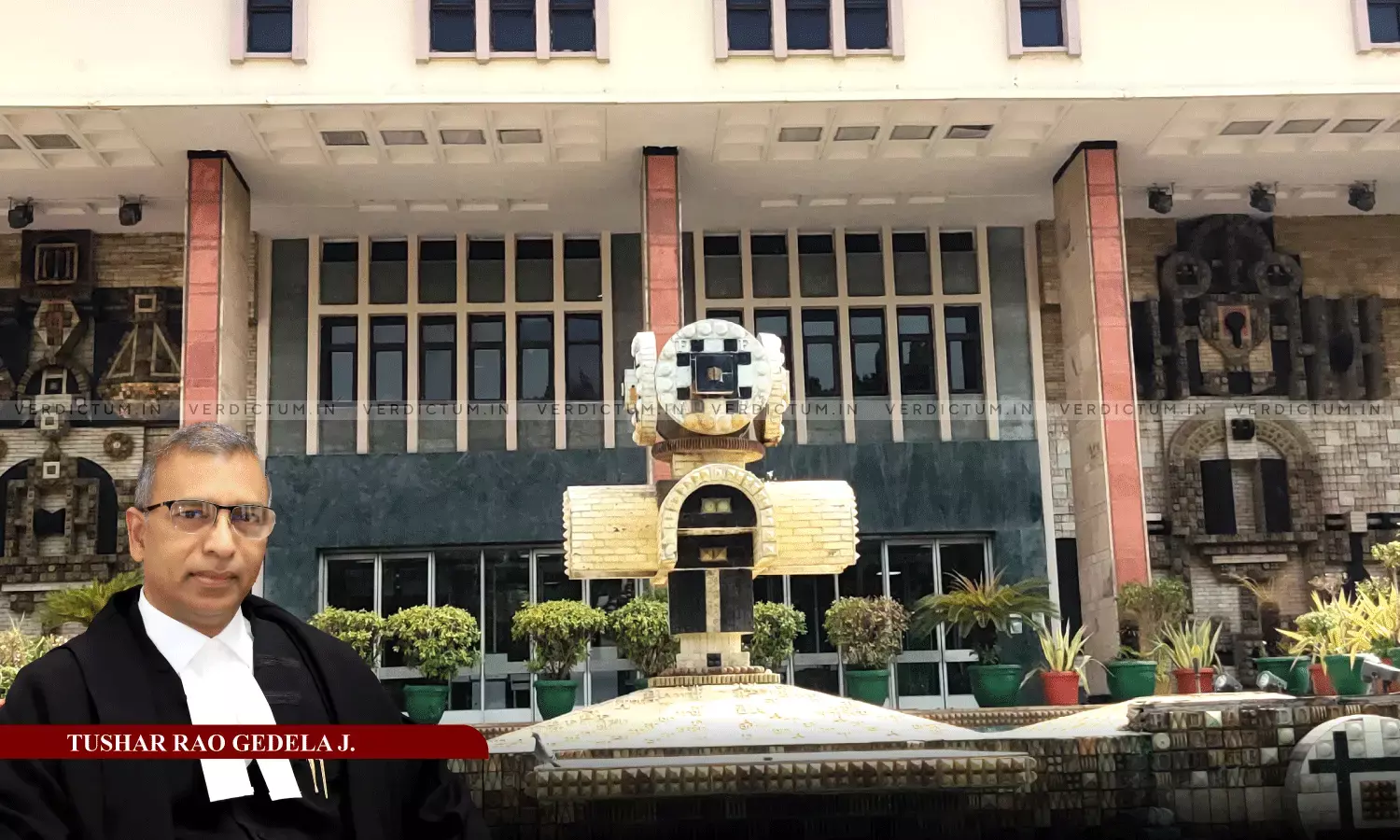
Justice Tushar Rao Gedela, Delhi High Court
The Delhi High Court has transferred a case involving death of a 23-year-old Hotel Manager under mysterious circumstances, to the Central Bureau of Investigation (CBI).
A Writ Petition was filed by the deceased’s mother seeking transfer of an FIR registered under Section 302 of the Indian Penal Code, 1860 (IPC) from Delhi Police to CBI for conducting a fresh/de novo investigation.
A Single Bench of Justice Tushar Rao Gedela remarked, “At times, in order to achieve truth, the lapse of time may not interdict. It has been held in a catena of judgements that stage of the trial is neither a bar nor an impediment for exercising the constitutional power, which is meant to ensure a fair and just investigation. Further, the investigations can be transferred even after filing of the charge sheet or the Closure Report. … Thus, it is never too late to search for truth.”
The Bench said that though in this case, the “cause of death”, in all probability, may be ascertained as Asphyxia as a result of antemortem hanging but what is glaringly lacking is the 'reason' for death by suicide and the prosecution utterly failed to inform the High Court or even the Trial Court of any such reason, particularly when there is no material placed on record to indicate that the deceased was under depression or having suicidal tendencies.
Senior Advocate Siddharth Aggarwal appeared for the Petitioner, while Additional Standing Counsel (ASC) Amol Sinha appeared for the Respondents.
Case Background
The Petitioner was the mother of Arnav Duggal, a 23-year-old hotel management graduate working as Manager, ITC Grand Bharat at the time, who died under mysterious and suspicious circumstances on June 13, 2017, at Flat No. 441, Shakuntalam Apartments, Sector 10, Dwarka, Delhi i.e. the residential house of Megha Tiwary, daughter of R.K. Tiwary. As per the Writ Petition, the deceased and Megha were in a relationship for at least 2-3 years which continued till the day of his death. In the months preceding the alleged murder of the deceased, they visited several places as well as booked hotel rooms to stay together. On June 11, 2017, the deceased and Megha stayed together during the day time in Hotel Radisson Blu, Dwarka and through the night of June 12, 2017, they were partying together at various places along with their friends. After dropping others, on the morning of June 13, 2017, the deceased along with Megha had visited Radisson Hotel, however they decided to go to her flat.
It was alleged that at the said flat, the deceased was murdered and his dead body was found. The police officials present there informed the deceased’s parents that their son had committed suicide by hanging from the ceiling fan and there was nothing to investigate. It was the case of the Petitioner that though the police officials present there informed that their son had committed suicide, they found the room to be dressed up to make a case of suicide and police officials unwilling to further investigate. A complaint was filed before the DCP and thereafter, the investigation was transferred to the Crime Branch, however, the inquiry continued on the theory of suicide and no FIR was registered. Finally, a Petition was filed before the Chief Metropolitan Magistrate (CMM) and the police was directed to file a Status Report. Accordingly, an FIR was registered under Section 302 of IPC. It was the case of the Petitioner that in spite of several observations made by CMM, the pattern of the investigation remained on the same preconceived notion of suicide.
Court’s Observations
The High Court in the above context of the case, observed, “It is not as if this Court is goading or coaxing the prosecution to consider the ingredients of offence under Section 306 IPC, but it is only a pointer as to how the investigations or in other words, the lackadaisical nature in which the investigations have been carried out. It is the bounden duty of the investigating agencies to, at the first instance, rule out or eliminate any offence which may be attracted in given facts and circumstances of a particular case. In the present case, even if one may presume that an offence under Section 302 IPC, in all probability, may not find a foundation but whether the purported suicide is voluntary or there could be an element of abetment, has not at all been looked into by the prosecution. Rather, that aspect was completely ignored, willfully or otherwise.”
The Court said that it is difficult to say with certainty whether the presence of the wine bottle at the place of incident is not a relevant circumstance.
“Another aspect raised by Mr. Aggarwal, learned senior counsel was with respect to the ligature mark on the neck merging with the hairline going to the back of the neck which, according to him, does not conform to the medical toxicology and would therefore raise a suspicion on the cause of death. He contended that in all probability, the death of the deceased may not be by suicide as theorized by the prosecution”, it noted.
The Court added that no effective steps to investigate or eliminate any such possibility were taken by the investigating agencies and standalone, such circumstance by itself may not compel the Court to make any observation as it would tantamount to treading into territory of appreciation of evidence.
“However, despite such an observation on a grave issue being flagged by a Court of law, it is intriguing to note that the same failed to propel the prosecution to investigate and eliminate such possibility. This issue too, when linked to the chain of circumstances as noted above, is a telling aspect on the nature of investigations conducted by the prosecution”, it further said.
The Court also noted that pondering over the possibility of what the Petitioner could undertake as a redressal to the grievances raised in the Petition, the filing of a protest Petition as a possible procedure of amelioration of grievances appeared to be an appropriate alternative.
“After having given deep, anxious and conscious thought to it, this Court is unable to persuade itself to pass such directions. This is for the reason that such procedure may not ultimately prove to be of any benefit inasmuch as even if such a protest petition is filed, the right, authority or jurisdiction to transfer the investigation to CBI is not statutorily available to the learned CMM. At best, learned CMM could, in law, direct only further investigation by the local police or the Crime Branch or SIT etc. In case the learned CMM would come to a conclusion similar to the one this Court has reached, such exercise of power or direction post consideration of the protest petition would be otiose and nugatory. It is also for these compelling circumstances and in order to reach the truth finally, this Court is unable to persuade itself to direct the alternate procedure of filing of the protest petition”, it emphasised.
Conclusion and Directions
Furthermore, the Court observed that the investigations lack bona fide and appear to have been conducted myopically, that too, predicated only on the theory of suicide as stated by Megha without applying its investigative or analytical and scientific mind to the circumstances.
“Ab supra, the said exceptional and compelling circumstances are propelling this Court to exercise the jurisdiction vested in it under Article 226 of the Constitution of India in order to do complete justice. This measure would, in the considered opinion of this Court, align itself with the ratio laid down in the judgements noted above”, it added.
The Court, therefore, directed the CBI to take up fresh investigations into the circumstances under which the death of deceased occurred and take necessary consequential steps in accordance with law.
“The police authorities including any other agency are directed to submit the entire records and the evidence gathered till date to the CBI within 4 weeks from date. The CBI, apart from conducting the aforesaid investigations, would also require to conduct an enquiry into the lapses, if any, by the officers of the Delhi Police conducting the investigations, and if any deliberate act for such omission or commission is revealed, a report be generated and furnished to the learned CMM as also the Commissioner of Police, who may take appropriate disciplinary action, if so required. Needless to state that the police authorities and other investigating agencies shall extend all cooperation to the CBI in respect of any requirement relating to this case. The CBI is directed to complete the investigations with expedition”, it concluded.
Accordingly, the High Court disposed of the Writ Petition and transferred the case to CBI.
Cause Title- Anu Duggal v. State & Ors. (Neutral Citation: 2025:DHC:10526)
Appearance:
Petitioner: Senior Advocate Siddharth Aggarwal, Advocates Nitin Mehta, Sowjanya Shankaran, Siddharth Satija, Arpit Rawat, Chirag Singh, Anuka Bachawat, Chirag Singh, Akash Sachan, and Yukta.
Respondents: ASC Amol Sinha, SPP Anubha Bhardwaj, Advocates Kshitiz Garg, Ashvini Kumar, Manan Wadhwa, Nitish Dhawan, Muskan Narang, and Vijay Misra.
