

Delhi High Court: Writ Courts Must Exhibit Institutional Restraint & Defer To Expert Determinations Unless Vitiated By Manifest Arbitrariness
The Delhi High Court said that administrative decision-making, especially in specialised and safety-critical domains, necessarily involves internal consultations and exchanges.
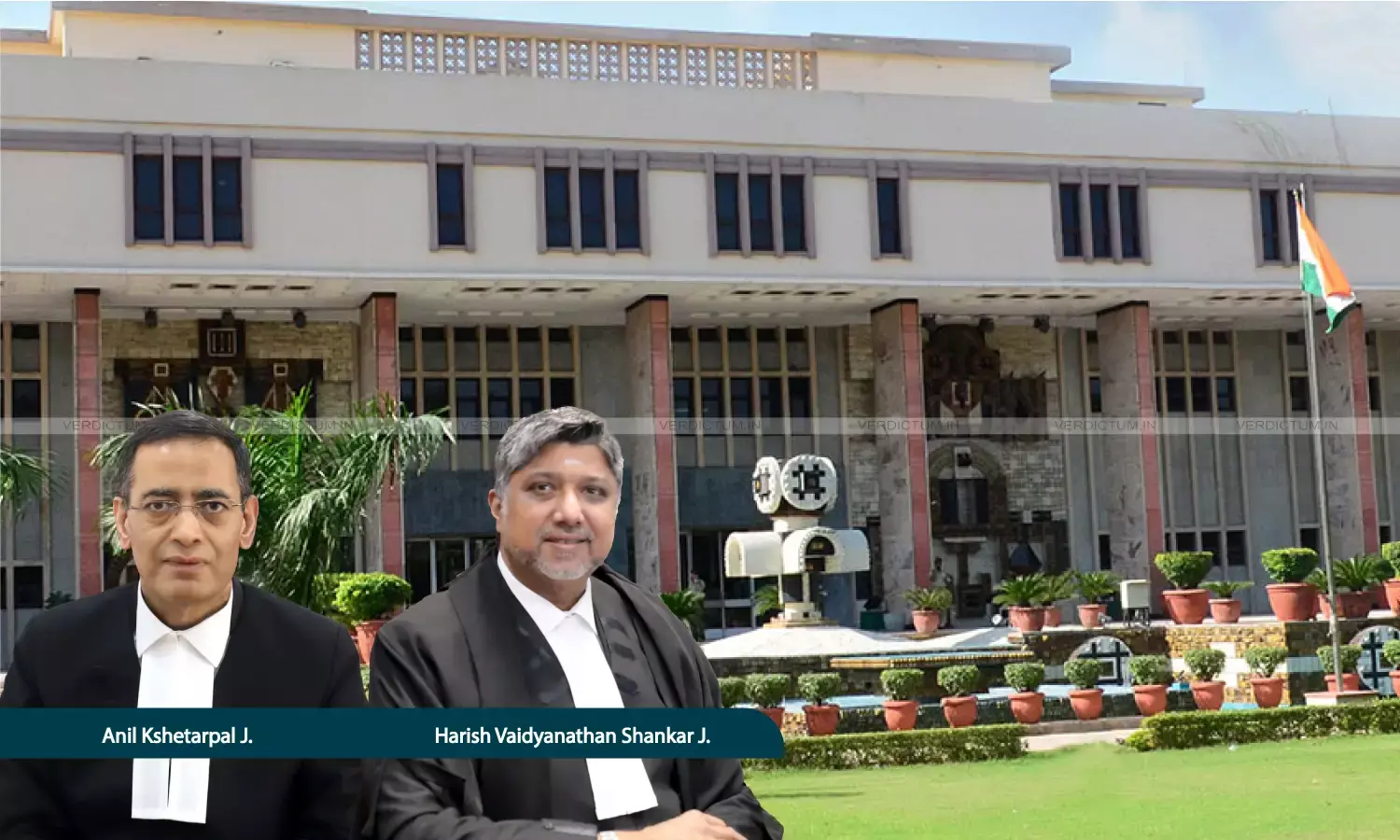
Justice Anil Kshetarpal, Justice Harish Vaidyanathan Shankar, Delhi High Court
The Delhi High Court has observed that the Writ Courts must exhibit institutional restraint and defer to expert determinations unless vitiated by manifest arbitrariness.
The Court observed thus in Letters Patent Appeals (LPAs), arising from the Judgment of the Single Judge in a Writ Petition titled “Shristi Infrastructure Development Corporation Ltd. v. Airports Authority of India & Ors.”.
A Division Bench comprising Justice Anil Kshetarpal and Justice Harish Vaidyanathan Shankar emphasised, “Courts exercising writ jurisdiction must, therefore, exhibit institutional restraint and defer to expert determinations unless vitiated by manifest arbitrariness, mala fides, or patent illegality, none of which is demonstrated in the present case. We accordingly concur with and affirm the findings of the learned Single Judge on these aspects.”
The Bench said that administrative decision-making, especially in specialised and safety-critical domains, necessarily involves internal consultations and exchanges, and such notings cannot be elevated to a status higher than the final, reasoned determination arrived at by the competent authority.
Standing Counsel Digvijay Rai represented the Appellant, while Senior Advocate Arvind Naiyar represented the Respondents.
Facts of the Case
A Writ Petition was instituted by Shristi Infrastructure Development Corporation Ltd. for issuance of appropriate writ for quashing the Communication/Order, whereby the Appellant-Airports Authority of India (AAI) rejected the request of the Shristi Infrastructure Development Corporation Ltd. (Respondent) for the Higher Top Elevation of Tower-II.
Reasoning
The High Court after hearing the contentions of the counsel, noted, “While internal notings may, in appropriate cases, assume probative significance, particularly where they disclose procedural impropriety, suppression of material facts, arbitrariness, or mala fides, they cannot, by their very nature, displace or invalidate a technical decision merely because they form part of the internal deliberative process.”
The Court reiterated that Courts, while exercising judicial review, cannot compel expert authorities to adopt a particular technical course of action, especially where such action may compromise safety norms or undermine established regulatory frameworks. It added that to do so would amount to substituting judicial perception for expert judgment, which is impermissible in law and contrary to the doctrine of separation of powers.
“The rejection of the proposal is founded on considerations of operational feasibility, air-traffic management requirements, and aviation safety, which are quintessentially technical matters”, it said.
The Court remarked that despite being fully cognizant of the regulatory changes and in the absence of any valid or subsisting permission authorising construction beyond the prescribed limits, the Respondent nevertheless proceeded to raise construction in excess of the permissible height, thereby consciously and deliberately assuming the attendant risks and consequences.
“Having elected to act in the face of a changed statutory and regulatory regime, the Petitioner cannot now seek to shift the burden of its own calculated decision onto the authorities. In such circumstances, the authorities cannot be compelled, whether directly or indirectly, to revive, resurrect, or extend benefits flowing from an obsolete regulatory framework, particularly when any such course would be fundamentally inconsistent with, and indeed inimical to, the safety-oriented policies and norms currently governing the field. The plea advanced by the Petitioner, viewed in this backdrop, is not only bereft of legal foundation but is also wholly lacking in equity and merit”, it added.
The Court further said that when a decision is the outcome of a multi-stage evaluative process, the requirement of reasons is satisfied if such reasons are discernible from the record as a whole, even if the final communication itself is brief.
“Significantly, it is not the case of the Petitioner that the authorities failed to apply their mind during the process of re examination. Nor is it contended that the impugned communication dated 08.03.2019 amounted to a sudden, arbitrary, or unilateral rejection without any prior consideration. The initial grievance of the Petitioner was confined solely to the form of the impugned communication, and not to the substance of the technical evaluation that preceded it. This position stands further reinforced by the fact that, in Writ Petition (Civil) No. 11422/2019 before the learned Single Judge, the Petitioner did not seek any relief with respect to the expert report and consciously chose to assail only the communication dated 08.03.2019”, it also observed.
Conclusion
Moreover, the Court noted that this deliberate omission assumes considerable significance, inasmuch as the expert report constituted the very foundation of the impugned decision and despite being fully aware that the expert committee had undertaken a comprehensive examination of all technical aspects of the Respondent’s structure in light of the 2015 Notification, it elected not to seek any relief or challenge in respect thereof.
“The communication dated 08.03.2019 must, therefore, be understood as a formal intimation of the final decision already taken on the strength of expert evaluation, and not as an independent exercise of reasoning or fresh formulation of opinion. … It is well-settled that the doctrine of reasoned decision-making does not mandate prolixity or elaborate narration in every communication, particularly where the decision is founded upon expert technical material already on record. What is required is that the decision should not be arbitrary and that the reasons should be traceable from the record. Both these requirements are fully satisfied in the present case”, it concluded.
Accordingly, the High Court allowed the AAI’s LPA and set aside the Single Judge’s decision.
Cause Title- Airports Authority of India v. Shristi Infrastructure Development Corporation Ltd. & Ors. (Neutral Citation: 2025:DHC:11802-DB)
Appearance:
Appellant: Standing Counsel Digvijay Rai, Advocates Archit Mishra, and Abhishek Singh.
Respondents: Senior Advocate Arvind Naiyar, SPC Rakesh Kumar, Advocates Vijay K. Singh, Kumar Shashwat Singh Sawno, Diksha Dadu, Shubham Pandey, Sanjukta Kashyap, Ankur Mishra, and Sunil.
