

Failure To Furnish Written Grounds Of Arrest Vitiates Remand: Delhi High Court Grants Bail To POCSO Accused
The Court said that once an accused alleges a lack of communication regarding their arrest, the burden of proof shifts to the investigating agency to prove they complied with the law.

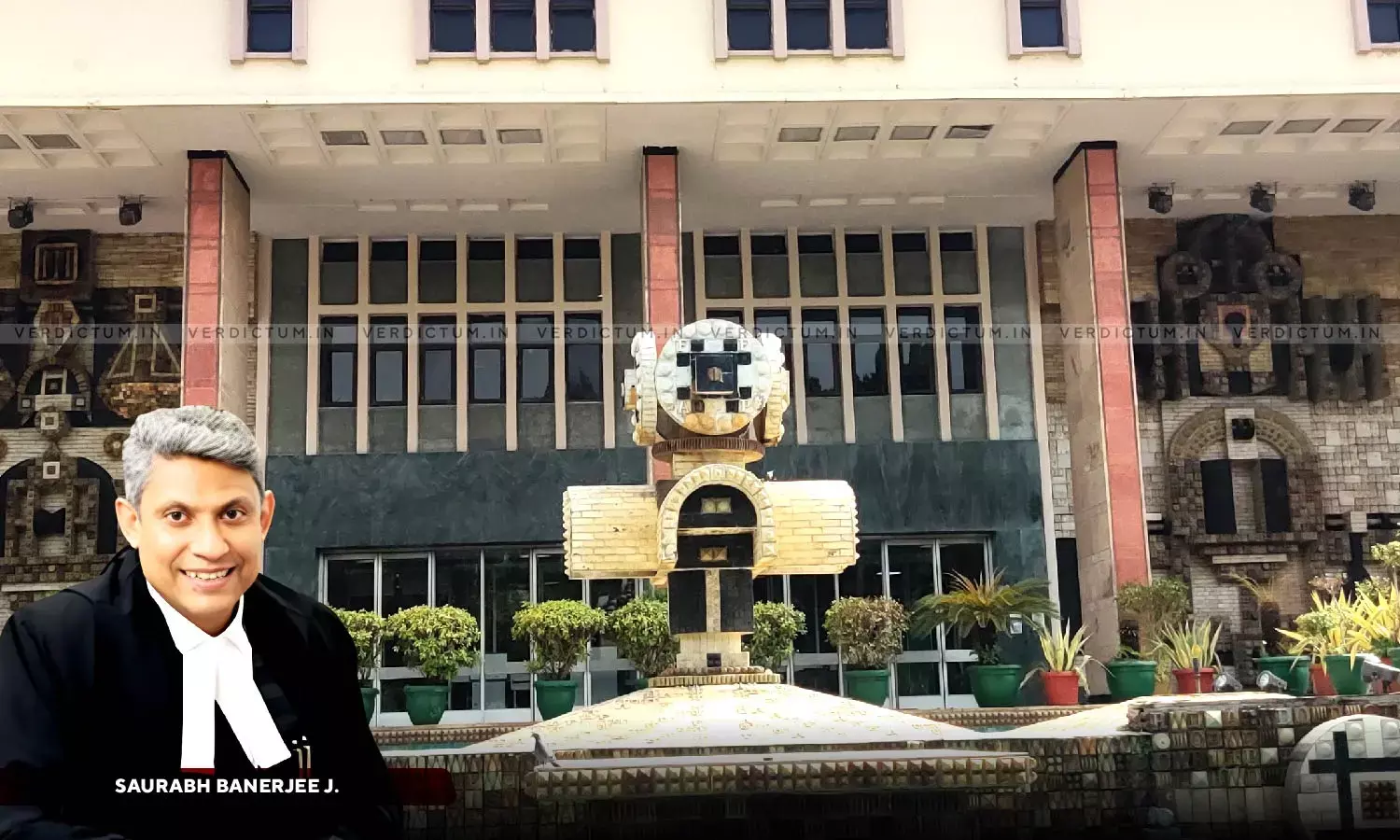
The Delhi High Court has observed that the failure of the investigating agency to communicate the grounds of arrest to the accused at the time of his apprehension rendered the entire process, including his subsequent remand, illegal.
The Court emphasized that once an arrestee challenges the lack of such communication, the burden of proof shifts to the state to prove compliance; since the prosecution admitted that the grounds were only furnished at a much later stage, the Court ruled that this procedural lapse was sufficient to warrant the applicant's release.
The Bench of Justice Saurabh Banerjee observed, “Adverting to the case at hand, the primary case of the applicant is that he was not supplied with grounds of arrest at the time of arrest. Once such an allegation/ contention is raised by the arrestee then the burden, as held by the Hon’ble Supreme Court in Vihaan Kumar (supra), shifts upon the investigating officer/ agency to establish the due compliance thereof. In the present case, since the learned APP for the State fairly admitted that the grounds of arrest were not given to the applicant at the time of arrest or subsequently, rather were furnished at a much later stage, the whole process is rendered ineffective and will serve no purpose.”
Advocate Deeparghya Datta appeared for the Applicant, while APP Meenakshi Dahiya appeared for the Respondents.
Brief Facts of the Case
The Applicant/Accused filed a bail application arising out of an FIR registered at Police Station Kapashera, Delhi, under Section(s) 363/366(A)/370/376/506/120B/34 of the Indian Penal Code, 1860, Section 6 of the Protection of Children from Sexual Offences Act, 20123 and Sections 3/4 of the Immoral Traffic Prevention Act.
The matter began on May 10, 2024, when the mother of the victim reported that her minor daughter was missing. During the investigation, police tracked and recovered the victim from the custody of two co-accused, Rashid and Rimpa Sardar, in Surat, Gujarat. These individuals allegedly lured the girl from her home and held her captive.
On May 24, 2024, the victim provided a formal statement alleging that the applicant, Habibur Molla, arranged their accommodation in Surat. She further claimed that Rashid Sardar assaulted her and forced her into sexual acts with others for money. The police arrested the applicant on May 28, 2024. During questioning, he reportedly confessed to providing a rented room for the co-accused and admitted to assaulting the victim himself. Following the investigation, the authorities filed a chargesheet against him on July 11, 2024.
Contention of the Parties
The counsel argued that the applicant’s arrest violated Article 22(1) of the Constitution and Section 50 CrPC (now Section 47 BNSS) because he was not informed of the grounds of arrest, either orally or in writing. The defence maintained that informing an arrestee of the charges is a mandatory constitutional safeguard, not a mere formality, and its omission rendered the subsequent remand illegal. The applicant claimed he was falsely implicated. He stated he only provided accommodation to the co-accused (his cousins) in good faith, without knowing about any criminal activity. The counsel pointed to the victim's cross-examination, where she initially stated that while the applicant (Sonu) asked for sexual favors, he backed off when she refused and did not force her.
Per Contra, the State argued that the charges—including the sexual assault of a minor and human trafficking—are of a grave nature and have a significant impact on society. The prosecutor highlighted a specific moment during the trial where the victim identified the applicant on screen and explicitly stated, "He also had forced sex with me." The State contended that while an arrestee must be informed of the grounds, the law does not strictly prescribe the mode of communication. They argued that the absence of written grounds does not automatically make an arrest illegal unless it causes "demonstrable prejudice" to the accused.
The State argued that recent Supreme Court rulings regarding the mandatory written communication of arrest grounds (such as the Mihir Shah case) were intended to apply prospectively and should not invalidate this specific arrest.
Observations of the Court
The Court emphasized that the right to life and personal liberty under Article 21 is a sacrosanct guarantee that can only be restricted through the "procedure established by law." Central to this is Article 22(1), which mandates that every arrestee must be informed of the grounds of their arrest. The Court noted that this is not a mere procedural formality but a vital constitutional safeguard that enables a person to effectively defend themselves, seek legal counsel, and challenge police remand.
The Bench observed that the failure to provide written grounds of arrest at the earliest opportunity violates fundamental rights and renders the arrest illegal. The Court clarified that the subsequent filing of a chargesheet does not validate an initially unconstitutional arrest.
The Court said, “Thus, considering that the applicant’s fundamental right under Article(s) 21 and 22(1) of the Constitution has been violated, his arrest and subsequent remand, being illegal, stands vitiated and the same in itself is sufficient to release the applicant on bail, without adverting to the other considerations…Accordingly, the applicant is granted regular bail in FIR No.242/2024 registered at Police Station Kapashera, Delhi, under Section(s) 363/366(A)/370/376/506/120B/34 of the IPC, Section 6 of the POCSO Act, and Section(s) 3/4 of the Immoral Traffic Prevention Act.”
Consequently, the Court allowed the application and granted bail to the Applicant/Accused.
Cause Title: Habibur Molla @ Sonu v. State (Govt. of NCT of Delhi) & Anr. [Neutral Citation: 2026: DHC: 508]
Appearances:
Applicant: Advocate Deeparghya Datta, Advocate Prem Nath Upadhyay, Advocate Akshay Chandra.
Respondents: Additional Public Prosecutor Meenakshi Dahiya, Advocate Vanshika Singh, Advocate Divya Bakshi.