

Right To Education Cannot Be Translated Into Right To Select A Particular School: Delhi High Court
The Court dismissed the appeal after the academic year expired without interim protection.

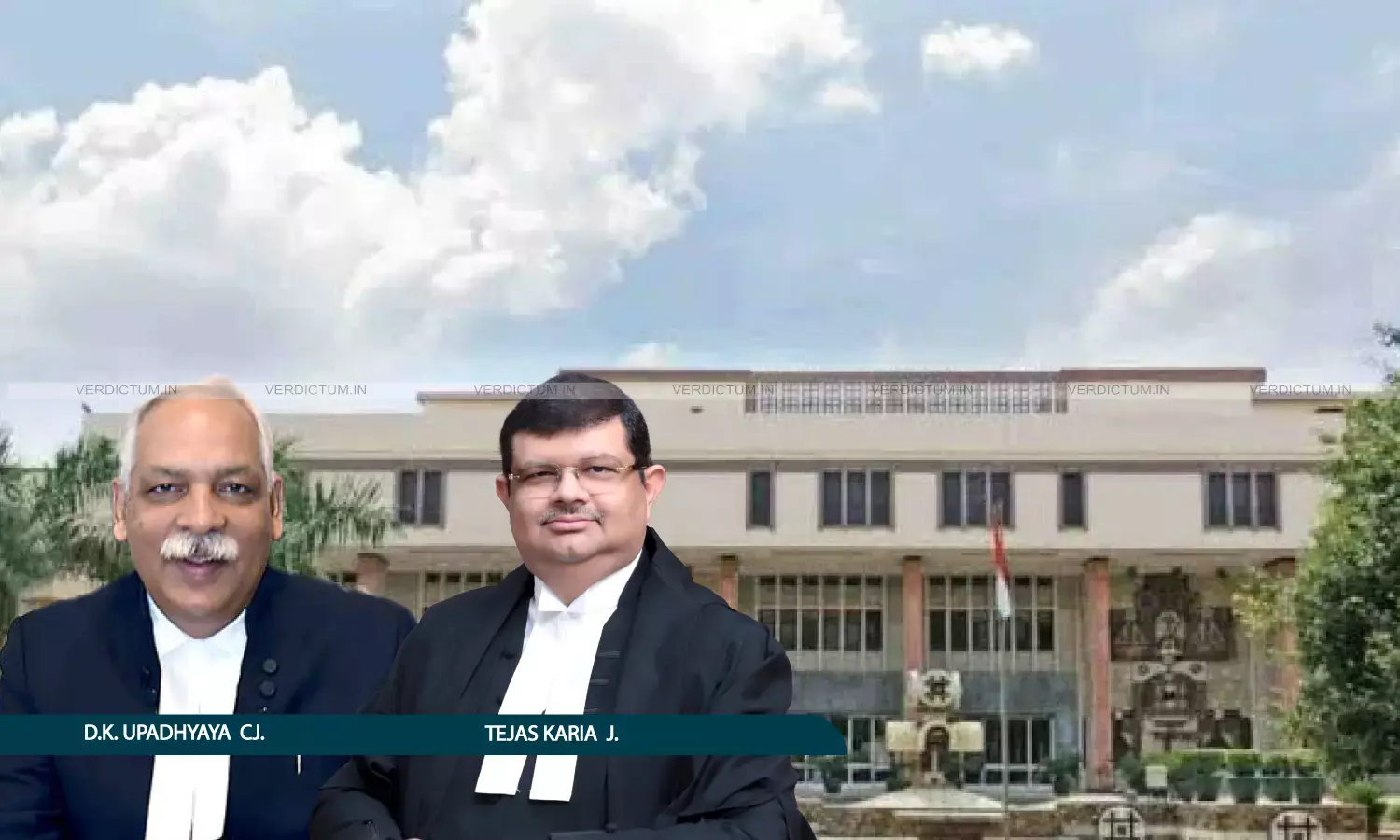
The Delhi High Court affirmed that while the Right of Children to Free and Compulsory Education Act, 2009 (RTE Act) is a beneficial legislation intended to foster social inclusion and eliminate barriers of caste and ethnicity, it does not grant a candidate the absolute right to choose a specific educational institution.
The Bench noted that since the Appellant had failed to secure an interim order for provisional admission or a seat reservation during the pendency of the Writ Petition, her right to the allotted seat perished with the expiration of the academic term.
The Division Bench of Chief Justice Devendra Kumar Upadhyaya and Justice Tejas Karia observed, “There is no cavil that the RTE Act is a beneficial legislation with an objective to achieve social inclusion and to ensure that School becomes a common space for children’s education not differentiated by barriers of caste, ethnic group, or caste lines. However, such a right to education cannot be translated into right to select a particular school.”
Advocate Aayush Agarwala appeared for the Appellant, while Advocates Jyoti Taneja and Dhruv Rohatgi appeared for the Respondents.
Factual Background
The Appellant applied for her ward's admission in the EWS/DG/CWSN category for Class I at Aadharshila Vidyapeeth (Respondent No. 1) for the Academic Year 2023-2024. The ward’s name was selected for admission through a computerized draw of lots conducted by the Directorate of Education (DoE). Upon approaching the school for document verification, the Appellant was denied entry and later informed that admission would only be granted after general category seats were filled.
The Appellant filed a Writ Petition, seeking a direction for the school to grant admission for the Academic Year 2023-2024. While the school initially claimed it had no vacancies, the DoE submitted that vacancies did exist in Class I for that year. The Single Judge dismissed the Writ Petition, noting that while the school lacked a basis for refusal, the Academic Year 2023-2024 had already expired, and no provisional admission order had been passed. In the interim, the DoE had allotted the ward a seat in another preferred school, but the Appellant did not report to that school.
Contentions of the Parties
The Appellant contended that she was unjustly penalized despite filing the petition within the relevant Academic Year. It was argued that the court should mould the relief to grant admission to a higher class (Class II) for the 2024-2025 year due to the pendency of the litigation.
The Respondent School contended that the DoE had erroneously allocated more EWS seats than communicated and that subsequent representations led the DoE to reduce the number of EWS seats available from four to two.
The Directorate of Education (DoE) contended that the Appellant could not object to the alternate school (Spring Field Public School) as it was one of the preferred choices mentioned in her original application. During the hearing, the DoE also offered admission in any Municipal School.
Observations of the Court
“In the facts of the present case, upon failure by Respondent No. 1 –School to grant admission, Respondent No. 2 – DoE accommodated the ward of the Appellant in another School, which was amongst the preferred schools selected by the Appellant at the time of filing up the application form. Although the Appellant was informed that the ward of the Appellant was granted a seat in Respondent No. 1 – School through draw of lots, when Respondent No. 1 – School did not grant admission, the Appellant was given admission in another school in the interest of the education of the ward of the Appellant. However, the Appellant did not accept the admission in Spring Field Public School, Pitampura, Delhi, despite the same being one of the schools selected as preferred school by the Appellant herself and instead filed the Writ Petition specifically seeking admission for Class I in Academic Year 2023-2024”, the Court said.
The Court noted that in the absence of an interim order for provisional admission or a direction to reserve a seat during the pendency of a petition, the right to seek admission in an allotted school perishes once the relevant Academic Year concludes.
It was observed that the relief sought in the Writ Petition was specific to the Academic Year 2023-2024, and since that year had ended, the right to admission stood extinguished.
The Court distinguished the present case from the precedent in S. Krishna Sradha v. State of Andhra Pradesh, noting that the latter involved MBBS admissions and exceptional circumstances where specific time-bound directions were possible.
“The facts of the present case are different as the Academic Year was over by the time the Writ Petition came up for final hearing. Hence, the Court had no ability to grant admission as the Academic Year was already over by then”, the Court said.
The Bench found no infirmity in the Impugned Judgment because the Appellant had already been accommodated in another preferred school by the DoE but had failed to report there.
Consequently, the High Court dismissed the appeal and the pending applications with no order as to costs.
Cause Title: Pooja v. Aadharshila Vidyapeeth and Anr. [Neutral Citation: 2026:DHC:2772-DB]
Appearances:
Appellant: Advocates Aayush Agarwala and Vipul Singh
Respondents: Advocates Jyoti Taneja, Dhruv Rohatgi, Chandrika Sachdeva and Dhruv Kumar