

Candidate Must Give Home State As First Preference For Insider Cadre Allocation: Delhi High Court
It also said that once the Insider Vacancies are filled, the allocation proceeds for the Outsider Vacancies, which would also include the leftover vacancies of the Insider Vacancies.

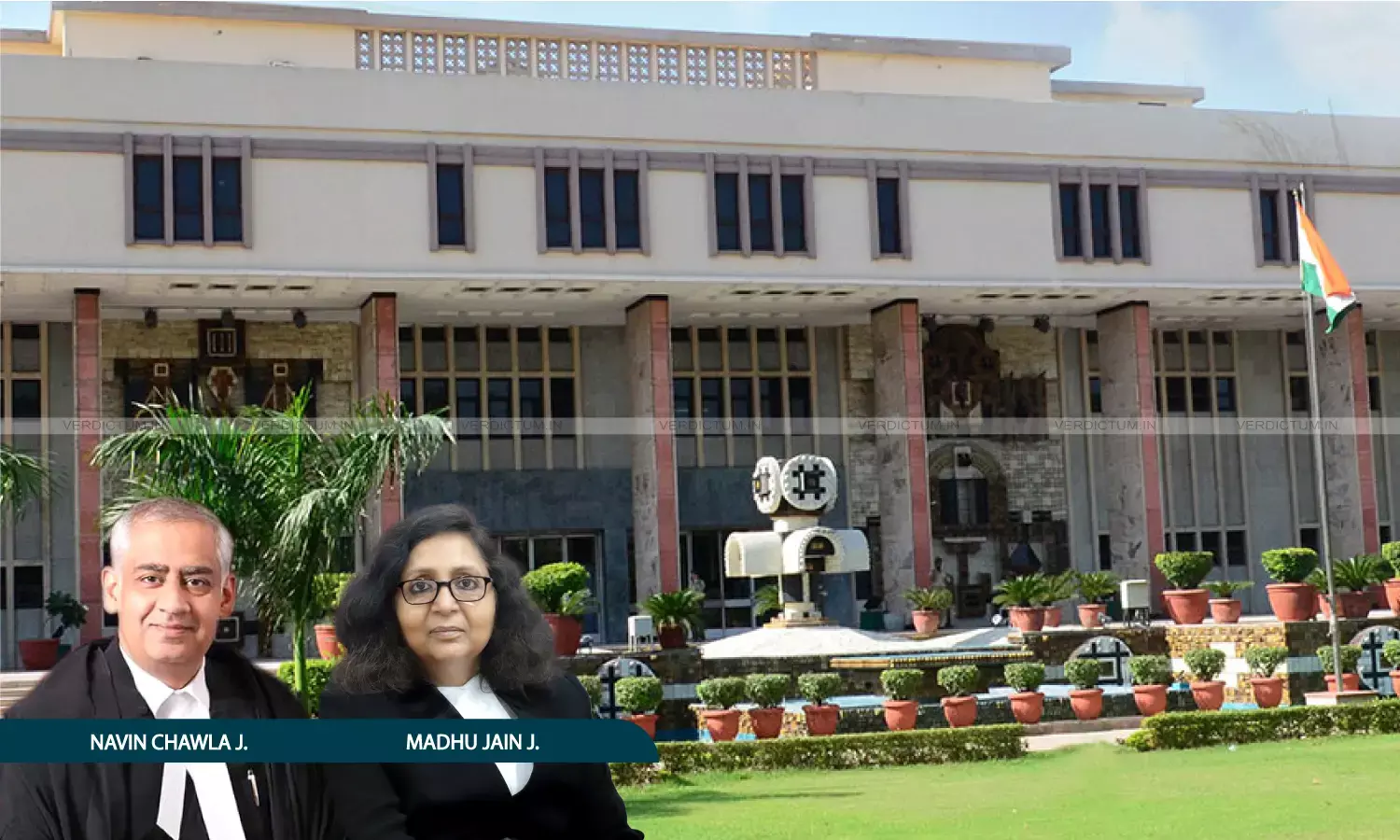
Justice Navin Chawla, Justice Madhu Jain, Delhi High Court
The Delhi High Court has observed that a candidate must list their Home State as their first preference to be considered for an "insider" vacancy under the Cadre Allocation Policy.
The Division Bench comprising Justice Navin Chawla and Justice Madhu Jain observed, “We are of the opinion that if Clause 8 of the Cadre Allocation Policy is to operate, the candidate must give his/her Home State as his/her first preference otherwise the whole scheme of Clause 8 would fail. This can be easily seen from the following example- Let us say, a candidate, like in the present case the respondent, had not given his Home State as the first preference but as the 6th preference.”
CGSC Pratima N. Lakra appeared for the Petitioner, while Advocate Sagar Saxena appeared for the Respondent.
Factual Background
A petition was filed challenging an order passed by the Central Administrative Tribunal, Principal Bench, New Delhi, whereby the Tribunal directed the Petitioner to consider the Respondent's allocation to the State of Rajasthan through the creation of a supernumerary post within five months, without awarding costs.
In this matter, the Respondent, an Indian Forest Service officer, challenged his allocation to the Nagaland cadre, contending that he should have been assigned to his home state of Rajasthan as an "insider" candidate. Although the respondent had mistakenly listed Rajasthan as his sixth preference on an initial form—a move he attributed to confusion between Roman and Arabic numerals—he argued that his explicit "yes" regarding home-state willingness and a subsequent corrective email dated May 8, 2010, should have taken precedence.
Consequently, he sought relief from the Tribunal to quash his Nagaland assignment and direct the petitioner to reallocate him to the Rajasthan cadre in accordance with his eligibility and preferred status.
Contentions of the Parties
The Petitioner submitted that the Tribunal erred in interpreting the Cadre Allocation Policy, and the Respondent was not entitled to one of the three available insider vacancies in Rajasthan based on his merit and category. It was said that for being appointed as an ‘Insider Candidate’, the Respondent was required to give his Home State, that is, Rajasthan, as the 1st preference.
The Respondent submitted that in terms of Clause 7 of the Cadre Allocation Policy, the rules for allocation of the Home Cadre have been prescribed. For the third insider vacancy, the respondent should have been allocated the same as he was the senior-most OBC insider candidate and had stated that he was willing to be allocated his Home State. However, by a wrong interpretation of the Cadre Allocation Policy, the Respondent was not allocated his Home State but instead allocated the Nagaland cadre, which was his 22nd preference.
Observations of the Court
The Court observed, “The candidate, because of merit, was entitled to one of the first five preferences that he had given as an outsider candidate. In case the preference of Home State is to prevail, such a candidate would necessarily be given the home cadre though that was not his choice, over and above the first five preferences. This would deny such a candidate of his right to be allocated a cadre in accordance with his merit and preference. The Cadre Allocation Policy does not provide for the same.”
The Court held that a reading of the policy would show that a candidate has to give his/her choice in order of his/her preference from amongst the various State cadres, including his/her ‘Home Cadre/State’. The candidate shall be allocated his home cadre or any other cadre, as the case may be, on the basis of his merit, preference and vacancy available ‘at his turn in his category. Clause 7 of the Cadre Allocation Policy gives a formula for filling up of an insider vacancy, that is, a vacancy earmarked for the Home State cadre, it added.
“The Cadre Allocation Policy cannot be read to mean that irrespective of the preference of the candidate, if an insider vacancy is available in his Home cadre and he has opted for the same, only the Home cadre will be allocated to such a candidate. This, to our mind, would defeat the rights of the candidate to be allocated the cadre as per his/her merit and his/her preference.”, the Court held.
The Court concluded, “In our view, the respondent was rightly not considered for the insider vacancy for his Home Cadre, that is, the State of Rajasthan, as he had chosen the same as his 6th preference of his cadre allocation, and when considered for the same as an Outsider Candidate, did not qualify as per his merit.”
Accordingly, the Court allowed the petition and concluded that the impugned order passed by the Tribunal was correct.
Cause Title: Union of India v. Shri Raj Priy Singh [Neutral Citation: 2026:DHC:137-DB]
Appearances:
Petitioner: CGSC Pratima N. Lakra, Advocates Shailendra Mishra, Mansi Aggarwal and Chanakya Kene.
Respondent: Advocates Sagar Saxena, Krishnandu Haldar and Abu Hassan Usmani