

Limitation In Partition Suit Is Mixed Question Of Law And Fact; Must Be Adjudicated After Parties Have Led Evidence: Delhi High Court
The Court held that the question of limitation becomes a mixed question of law and fact, which can be adjudicated after the parties have led their evidence.

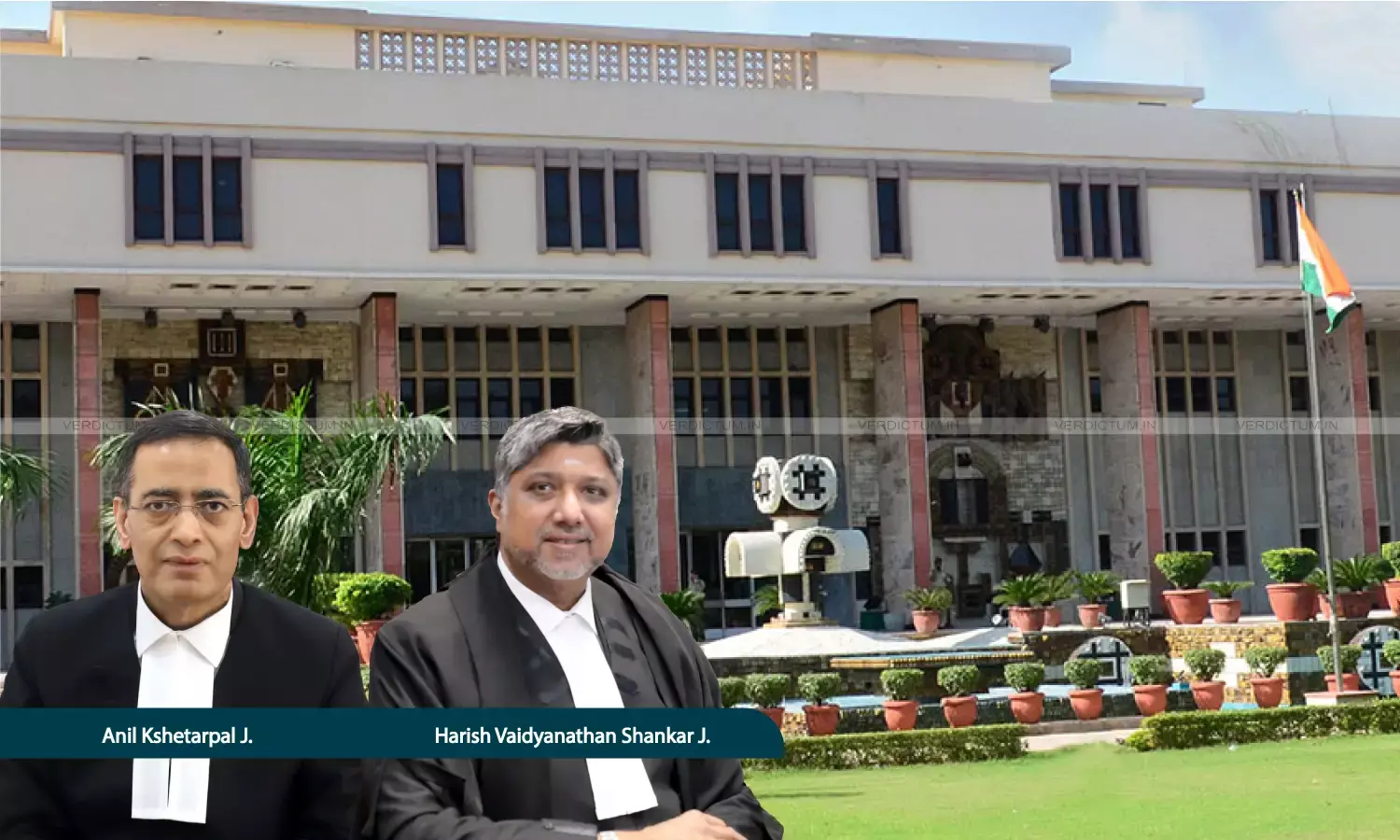
Justice Anil Kshetarpal, Justice Harish Vaidyanathan Shankar, Delhi High Court
The Delhi High Court observed that in a partition suit, the question of limitation becomes a mixed question of law and facts, which must be adjudicated after the parties have led their evidence.
The Court was hearing a challenge to the rejection of the application under Order VII Rule 11 of the Code of Civil Procedure, 1908.
The Division Bench comprising Justice Anil Kshetrapal and Justice Harish Vaidyanathan observed, “The plaint specifically avers that discussions for partition were initiated only in the year 2018 and that the Plaintiff’s demand for partition was refused thereafter. At this stage, where the averments in the plaint are required to be taken as correct, the suit cannot be held to be barred by limitation on the relief of partition…Further, the plaint contains clear pleadings that the Plaintiff became aware of the said Gift Deed dated 16.08.2005 only upon inspection of the records in proceedings instituted by the Defendant Nos.1 and 2 in the year 2018. Hence, the question of limitation becomes mixed question of law and facts, which can be adjudicated after the parties have led their evidence.”
Senior Advocate Krishnan Venugopal appeared on behalf of the Appellants, whereas Senior Advocate Samrat Nigam appeared for the Respondents.
Facts of the Case
The case involved a partition suit filed by Anita Munjal (Plaintiff) against her sisters and the heirs of her late brother, Vinay (Appellants). The conflict concerns two assets: the Bathla Property (Delhi), registered solely to Vinay, and the Gurugram Property (Haryana), originally held jointly by Vinay and their mother. The Plaintiff claimed the properties were purchased using "joint family funds" from their father’s estate for the family's collective welfare. She asserts that Vinay was a student with no independent income at the time of purchase.
The Appellants contended that Vinay was the exclusive owner, supported by a 40-year documentary trail. They rely on their father’s 1976 Will (acknowledged by the sisters in 1978), the mother’s 1985 Will, and the 2005 Gift Deed. They argue the suit is meritless, barred by limitation, and contradicts established titles and prior judicial records.
The Impugned Judgment dismissed the said application, holding that the plaint discloses a cause of action and that the issue of limitation would require adjudication at trial. Hence, the present appeal was filed assailing the judgment passed by the Single Judge dismissing the application under Order VII Rule 11.
Contention of the Parties
The Appellants/Defendants contended that the plaint, even when read along with the documents relied upon, does not disclose any cause of action warranting trial. Further, he added that the Impugned Judgment proceeds on impermissible presumptions by speculating that the Plaintiff may succeed if her averments are proved, whereas, under Order VII Rule 11of the CPC, the Court is required to confine itself strictly to the pleadings and documents on record. Furthermore, it was stated that the binding judicial determinations inter se the same parties, holding that there is no material to support the plea of acquisition of the suit properties from joint family funds, have been overlooked, despite having attained finality up to the Supreme Court.
Per contra, the Respondents supported the reasoning adopted in the Impugned Judgment and contends that, on a meaningful reading, the plaint discloses a sufficient cause of action warranting adjudication, and that the plea of limitation, as urged by Defendant Nos.1 and 2, involves disputed questions of fact which cannot be decided at the stage of Order VII Rule 11 of the CPC.
Observations of the Court
The Court observed, “Furthermore, the objection raised by the Defendant Nos.1 and 2 that the reliefs claimed in the present suit are barred by limitation does not commend acceptance at this stage. The submission that, since the title documents of the suit properties stand in the name of Vinay, the Plaintiff, by seeking partition, is in substance challenging the said documents, is misconceived. A plain reading of the plaint makes it evident that the Plaintiff does not assail the validity of the title deeds; she merely asserts her claimed share in the suit properties on the plea that the acquisitions were made from joint family funds. The relief sought, therefore, remains one for partition and not for setting aside the title documents.”
The Court also said, “The suit before the Court is one seeking partition of the suit properties. At the stage of Order VII Rule 11 of the CPC, the Court is required to proceed on the assumption that the averments made in the plaint are correct and truthful in their entirety, without embarking upon an enquiry into their veracity. If, upon such an assumption, the pleadings disclose a right in favour of the Plaintiff to seek a share in the suit properties, the existence of a cause of action for maintaining the present suit stands duly established.”
It was held that the limitation for a suit seeking partition is not specifically provided under any Article in the Schedule to the Limitation Act, 1963. Consequently, the claim is governed by the residuary provision, namely Article 113, which prescribes a period of three years from the date when the right to sue accrues. It is settled law that the cause of action in a suit for partition is of a recurring nature and continues so long as the joint status subsists, crystallising only upon refusal of a demand for partition, the court said.
Conclusion
In view of the foregoing, the Court found that neither ground is made out for rejection of the plaint under Order VII Rule 11 of the CPC. It was concluded that the plaint disclosed a clear cause of action for the institution of the suit, and the reliefs claimed therein cannot be held to be barred by limitation at this stage.
Accordingly, the Court dismissed the appeal as being devoid of merit.
Cause Title: Vibhuti Jauhari and Anr. v. Anita Munjal and Ors. [Neutral Citation:2025:DHC:11901-DB]
Appearances:
Appellants: Senior Advocate Krishnan Venugopal, Advocates Prity Sharma, Shikhar Shant, Ashwani Kaushik and Umang Motiyani.
Respondents: Senior Advocate Samrat Nigam, Advocates Ajay Dabas, Anand Dabas, Priyanka Dagar, Arpita Rawat, Ravi Dagar and Rishikesh