

One Year Separation Period For Mutual Consent Divorce U/S 13B(1) HMA Can Be Waived U/S 14(1): Delhi High Court
The Delhi High Court held that the waiver of 01-year separation period under Section 13B(1) of HMA does not preclude waiver of 06-month cooling-off period for filing the second motion under Section 13B(2).
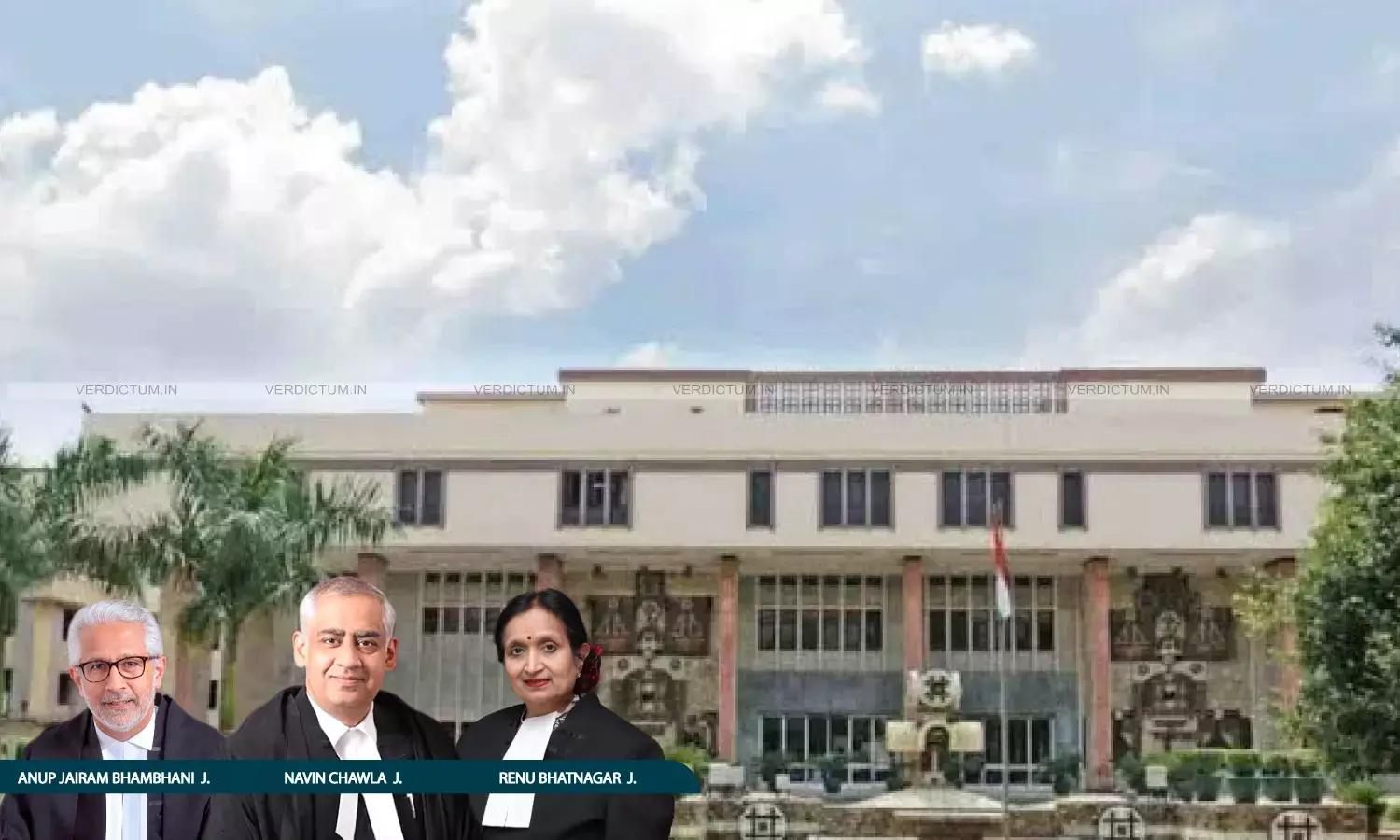
Justice Navin Chawla, Justice Anup Jairam Bhambhani, and Justice Renu Bhatnagar
The Delhi High Court held that the separation period of one year prescribed under Section 13B(1) of the Hindu Marriage Act, 1995 (HMA) as a pre-requisite for presenting the first motion, can be waived, by applying the proviso to Section 14(1) of the HMA.
The Court held thus in a Reference arising from the Judgment of the Division Bench in a matrimonial case, concerning the timeline prescribed for the presentation of a Petition for Divorce by Mutual Consent under Section 13(B) of HMA.
A Full Bench comprising Justice Navin Chawla, Justice Anup Jairam Bhambhani, and Justice Renu Bhatnagar observed, “The statutory period of 01-year prescribed under section 13B(1) of the HMA as a pre-requisite for presenting the first motion, can be waived, by applying the proviso to section 14(1) of the HMA. … The waiver of the 01-year separation period under section 13B(1) of the HMA does not preclude waiver of the 06-month cooling-off period for filing the second motion under section 13B(2); and waiver of the 01-year period under section 13B(1) and the 06-month period under section 13B(2), are to be considered independently of each other.”
The Bench said that where the Court is satisfied that the 01-year period under Section 13B(1) and the 06-month period under Section 13B(2) of the HMA deserve to be waived, the Court is not legally mandated to defer the date from which the divorce decree would take effect, and such decree may be made effective forthwith.
Senior Advocate (Amicus Curiae) Rajshekhar Rao, Advocates Aashna Chawla, Ajay Sabharwal, Wamic Wasim Nargal, and Zahid Laiq Ahmed appeared for the Appellant, while Advocate Saurabh Kansal appeared for the Respondent.
Factual Background
Having regard to the view taken by an earlier Division Bench of the High Court in the case of Sankalp Singh v. Prarthana Chandra (2013), the Division Bench in the present case observed that the interpretation adopted in Sankalp Singh case may warrant reconsideration. In light of the divergent opinion that the Division Bench was inclined to express in its Judgment dated April 22, 2025, it had formulated specific questions of law and requested the Chief Justice to place the case before a Full Bench of the Court for authoritative determination. The legal questions referred to the Full Bench read as follows –
(a) Whether a Petition under Section 13B(1) of the Hindu Marriage Act can be filed by the parties before completing the period of separation of one year?;
(b) If the answer to the above question is in the affirmative, whether the period of six months between the presentation of the First Motion under Section 13B(1) of the Hindu Marriage Act and the Second Motion under Section 13B(2) of the Hindu Marriage Act, can be waived off by the Court even though the parties have not been living separately for more than one year on the date when such waiver is prayed for?
In the case of Sankalp Singh, the Division Bench had envisaged the application of the proviso to section 14(1) of the HMA, adopting a liberal construction of that provision. The Division Bench held that so as not to compromise on the essential ingredients of Section 13B(1) of the HMA, though the first motion can be presented even before the 01-year period of separation prescribed under Section 13B(1) of the HMA has elapsed, that would however be subject to the qualification that the second motion under Section 13B(2) would be allowed and the divorce decree would be granted only after the 01-year of separation period, as required under Section 13B(1), is complete.
Court’s Observations
The High Court with respect to the first legal question, noted, “In view of the foregoing legal landscape, we are of the view that the first question of law framed for consideration before us –viz., whether the statutory period of 01-year prescribed under section 13B(1) of the HMA as a pre-requisite for presenting the first motion, can be waived – already stands answered in the affirmative by the Division Bench in Sankalp Singh invoking the proviso to section 14(1); and we find no reason to deviate from that judicial view. We may clarify that no decision of the Supreme Court has been brought to our notice which may have overruled Sankalp Singh or laid down law to the contrary.”
The Court clarified that the 01-year period stipulated under Section 13B(1) of the HMA, for presenting the first motion may be waived at the discretion of the Family Court or the High Court and consequently, it is legally permissible for a Court to entertain a first motion even prior to the expiry of the 01-year separation period.
“In view of our observations above, we are of the opinion that the view taken earlier by the various Single Benches of this court, holding that section 13B of the HMA is a complete code in itself and that the proviso to section 14(1) of the HMA does not apply to petitions filed under section 13B of the HMA, is not the correct view. We hold, that in light of the decision of the Division Bench of this court in Sankalp Singh, section 13B of the HMA is not a complete code; and the judgments of the various Single Benches of this court, taking the contrary view are hereby overruled”, it further held.
The Court was of the opinion that the procedural framework contained in the proviso to Section 14(1) of the HMA can be pressed into service in relation to Section 13B(1) of the HMA; and in appropriate cases the proviso to Section 14(1) can be invoked to entertain the first motion, to save parties from remaining trapped in a manifestly unworkable matrimonial relationship.
“That being said, we would hasten to caution against wanton application of the proviso to section 14(1) of the HMA to cases under section 13B(1), so that the 01-year separation period for presenting the first motion is not rendered frivolous or perfunctory”, it remarked.
Coming to the second legal question, the Court said that waiver of the 01-year period is permitted only in cases of exceptional hardship or exceptional depravity, as referred-to in that proviso.
“… We may clarify, that we are not suggesting that the 01-year period stipulated in section 13B(1) of the HMA should be waived for the asking; but subject to the court being satisfied on the touchstone of the indicative considerations and factors set-out by a Single Judge of this court in Pooja Gupta, we are of the view that it is permissible for a court, whether the Family Court or the High Court, to waive that period for entertaining the first motion. The purpose of that exercise must be for the court to satisfy itself as to existence of free and deliberated consent of the parties”, it observed.
The Court also noted that waiving the period of 01-year would not, in and of itself, disentitle the Court from waiving the 06-month period prescribed under Section 13B(2) of the HMA and in fact, waiver of the 01-year period under Section 13B(1) and waiver of the 06-month period under 13B(2), must be treated as two separate and distinct aspects; but waiver of one timeline would not preclude waiver of the other.
Moreover, the Court said that merely because, based on certain exceptional circumstances the Court decides to exercise its powers under the proviso to section 14(1) of the HMA to waive the period of 01-year before the first motion can be presented by the parties, that would not denude the Court of its power to also waive the cooling-off period between the first motion and the second motion.
“We must remind ourselves, that on first principles, a court must never presume that the Legislature has wasted its words or that any words used in a statute are superfluous or redundant. … As a sequitur of the above discussion, we agree with the view taken by the Division Bench of this court in Sankalp Singh, insofar as it holds that a petition under section 13B(1) of the HMA can be entertained even before parties have lived separately for a period of 01-year”, it added.
Conclusion
The Court enunciated that the Legislature has not mandated that if a Court has decided to grant a divorce decree, it must hold that the decree shall not have effect until after expiry of a period of 01 year from the date of marriage and instead the Legislature has used the word ‘may’, to say that “…… if it appears to the court at the hearing of the petition that the petitioner obtained leave to present the petition by any misrepresentation or concealment of the nature of the case, the court may, if it pronounces a decree, do so subject to the condition that the decree shall not have effect until after the expiry of one year from the date of the marriage…..”.
“It may be necessary to articulate, that even where spouses file for divorce by mutual consent, their wish to part-ways would always be rooted in some basis or reason, though they may have chosen to adopt the consensual route for divorce. In such circumstances, it would be wholly undesirable to keep spouses embroiled in a bad marriage, instead of releasing them from the matrimonial bond. It hardly needs enunciation that such a situation would inflict undue psychological and emotional distress on one or both spouses, and that in itself may qualify as exceptional hardship on them”, it clarified.
The Court ruled that the waiver can be granted both by the Family Court as well as the High Court and as contemplated in the proviso to Section 14(1) of the HMA, where a Court finds that the waiver of the 01-year period under Section 13B(1) has been obtained by misrepresentation or concealment, the Court may defer the date on which the divorce would take effect, as may be considered appropriate; or may dismiss the Divorce Petition, at whichever stage it is pending, without prejudice to the right of the parties to present a fresh Petition under Section 13B(1) of the HMA after expiration of the 01-year period, on the same or substantially the same facts as may have been pleaded in the Petition so dismissed.
“Such waiver is not to be granted merely for the asking but only upon the court being satisfied that circumstances of “exceptional hardship to the petitioner” and/or “exceptional depravity on the part of the respondent” exist, while also testing the case on the anvil of the considerations set-out in Pooja Gupta”, it concluded.
Accordingly, the High Court answered the Reference.
Cause Title- ABC v. XYZ (Neutral Citation: 2025:DHC:11467-FB)
Appearance:
Appellant: Senior Advocate (Amicus Curiae) Rajshekhar Rao, Advocates Aashna Chawla, Ajay Sabharwal, Wamic Wasim Nargal, and Zahid Laiq Ahmed.
Respondent: Advocates Saurabh Kansal, Raghav Vij, Suraj Kumar, Ritul Sharma, and Pratham Malik.
