

Lack Of Understanding Of Basic Legal Principles: Delhi High Court Directs Family Court Judge To Undergo Refresher Training
The Delhi High Court said that a Judicial Officer cannot amalgamate statutory provisions from different enactments in a manner that neither reflects the text of the law nor permits such blending.
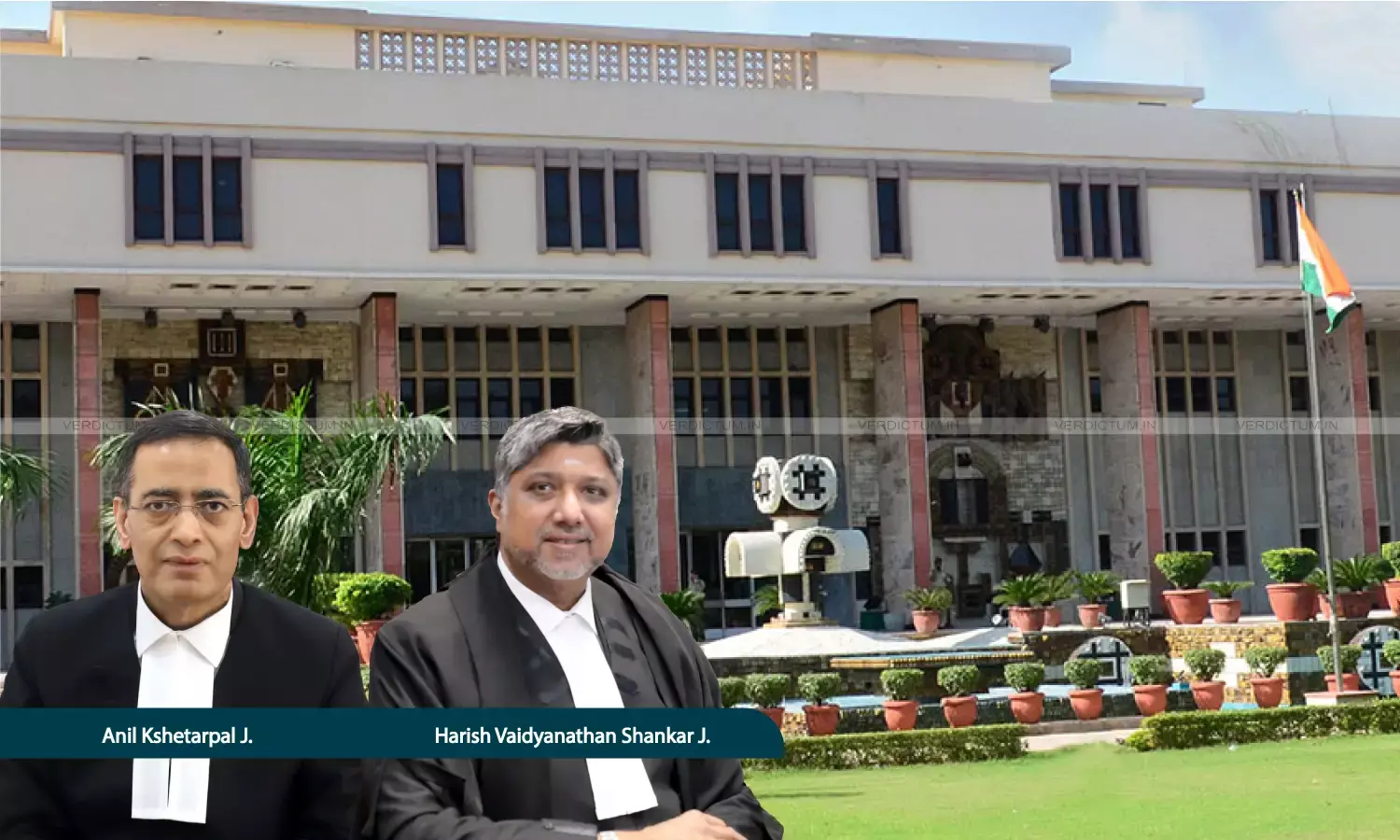
Justice Anil Kshetarpal, Justice Harish Vaidyanathan Shankar, Delhi High Court
The Delhi High Court has directed a Family Court Judge to undergo an appropriate and comprehensive refresher training program in Matrimonial Laws, under the aegis of the Delhi Judicial Academy.
The Court was hearing an Appeal challenging the Judgment of the Family Court, Patiala House Courts, New Delhi in a case by which the marriage held between the parties was dissolved on the grounds of cruelty.
A Division Bench comprising Justice Anil Kshetarpal and Justice Harish Vaidyanathan Shankar observed, “The overall conduct of the learned Family Court Judge, in this case, demonstrates a troubling lack of understanding of basic legal principles, the proper applicability of statutory provisions, and the jurisdictional boundaries within which a court must operate. The manner in which the learned Family Court Judge has proceeded reveals a serious misapprehension of the limits of judicial authority and undermines the integrity of the adjudicatory process.”
The Bench said that a Judicial Officer cannot amalgamate statutory provisions from different enactments in a manner that neither reflects the text of the law nor permits such blending.
Advocate Prosenjeet Banerjee represented the Appellant, while Advocate Padma Priya represented the Respondent.
Facts of the Case
The marriage between the parties was undisputed, but the date and form of the marriage were disputed. As per the Respondent-wife, the marriage was solemnized on December 11, 2011 according to Hindu rites and customs, whereas as per the Appellant-husband, marriage was performed on September 26, 2011 under the Special Marriage Act, 1954 (SMA) before the Marriage Officer and a social function was held on December 11, 2011 followed by a reception on December 15, 2011. The factum of marriage between the parties was not in dispute. However, the actual date of marriage and the statutory provision under which it was solemnised or recognised were matters of dispute before the Family Court. The wife claimed that she was subjected to regular physical assault, verbal abuse, and mental harassment by the husband.
She lodged an FIR against him and his family members under Sections 498A and 506 of the Indian Penal Code, 1860 (IPC) and provisions of the Protection of Women from Domestic Violence Act, 2005 (DV Act). The husband approached the Calcutta High Court challenging alleged forcible removal of the child and also filed a Guardianship Petition before the Additional District Judge (ADJ), Darjeeling. The Calcutta High Court directed transfer of proceedings under the Guardians and Wards Act, 1890 (GWA) from Darjeeling to the Court at Barasat, noting that both parties were working in Kolkata. Thereafter, the wife filed a Divorce Petition before the ADJ. The Family Court dissolved the marriage on the grounds of cruelty and this was under challenge before the Delhi High Court.
Court’s Observations
The High Court in view of the above facts, noted, “At the very outset, we deem it necessary to record our strong disapproval of the manner in which the learned Judge, Family Court, Patiala House Courts, has been adjudicating matrimonial matters. We have repeatedly found that he has conflated provisions of distinct and self-contained statutes, each with its own specific procedures and purposes, thereby distorting the statutory framework governing matrimonial disputes.”
The Court added that on earlier occasions as well, the Court’s interference has been necessitated, where the provisions of the Family Courts Act, 1984 (FC Act) have been invoked in a manner that effectively sidesteps or supplants the substantive requirements mandated under the Hindu Marriage Act, 1955 (HMA).
“While we are conscious that Family Courts are heavily burdened, owing to the increasing frequency with which parties separate, often on exceedingly trivial grounds, and the general erosion of the sanctity of marriage, this cannot be treated as a licence for any Court to indulge in what can only be described as statutory re-engineering. The statutory scheme must be followed, irrespective of caseload pressures”, it remarked.
The Court said that although the Divorce Petition was filed under Section 13(1)(ia) of the HMA seeking dissolution of marriage on the ground of cruelty, the Family Court Judge proceeded to apply provisions of the SMA, particularly an alleged Section 28A thereof, and extended this supposed provision on the ground that doing so would “save precious judicial time and spare the parties another round of litigation”
“By invoking procedural flexibility available to Family Courts under the FC Act, he has effectively disregarded the mandatory statutory requirements. … We were, in fact, taken aback to find that the learned Judge relied upon, in the Impugned Judgement, a provision, Section 28A of the SMA, that does not exist on the statute book, and on this basis granted a decree of divorce”, it observed.
The Court further said that it is incomprehensible how a Judicial Officer of the rank of a Family Court Judge could rely upon a non-existent statutory provision to grant a decree of divorce and not only did he erroneously import the SMA into a Petition filed under the HMA, but he then relied upon an entirely non-existent section of the SMA dealing purportedly with the irretrievable breakdown of marriage.
“His justification that this would save judicial time and spare the parties further litigation is wholly untenable. We are of the firm view that administrative convenience cannot override statutory mandates. … The conclusion drawn by the learned Judge, that marriages solemnised under the SMA “cannot be regarded as a holy union”, is an unwarranted extrapolation based on a misconceived and selective reading of various matrimonial statutes”, it emphasised.
The Court also noted that a marriage is viewed as a sacrament or as a civil contract under different personal laws has no bearing whatsoever on the sanctity, legitimacy, or legal force of a marriage solemnised under the SMA.
“The SMA is a secular code intended to provide a neutral and uniform legal framework for couples who choose to marry under it, and it in no manner diminishes the dignity, solemnity, or seriousness of such marriages. To characterise marriages under the SMA as not being a “holy union” is, therefore, neither appropriate nor appreciable”, it added.
The Court asked as to how the legislative intent to provide for dissolution of a marriage would take away from a Hindu marriage the character of a “holy union”.
“It would appear that the learned Judge verily believes that a marriage, in order for it to be considered “holy” would have to be characterised as an unbreakable, immutable or indissoluble “union” between two spouses, importing therein, not only the commonplace understanding of the popular phrase, “till death do us part” but extend further to transcend temporal boundaries, acquiring thereof a metaphysical character regenerating itself across seven births”, it said.
The Court was of the view that closing the wife’s right to adduce oral testimony at that first opportunity, without granting any further effective chance, is, ex facie, unfair and unreasonable and runs counter to settled procedural norms and Principles of Natural Justice.
“It is thus evident that the Wife’s grievance regarding the wrongful closure of her evidence was never abandoned; rather, it remained alive and was left open by the learned Single Judge. … Matrimonial disputes, by their very nature, require adjudication on the basis of properly led evidence, particularly oral testimony. Determination of issues such as cruelty cannot be undertaken merely on documents, much less on bare pleadings. In this case, the closure of the Wife’s evidence without granting a fair and adequate opportunity is wholly unsustainable”, it enunciated.
Conclusion and Directions
Furthermore, the Court observed that the Family Court appears to have acted in a tearing hurry which has resulted in the rendering of a Judgment without a proper appreciation of the various aspects and nuances of the matter.
“It is therefore evident that the learned Family Court Judge acted unreasonably in the present case, not only by deciding the matter without any evidence after hastily closing the Wife’s right to lead evidence, but also by applying substantive provisions of the SMA in a petition admittedly filed under the HMA and, further, by relying upon a provision that does not exist in the statute book of the SMA. The justification offered, which appears to be, namely, the need to “save judicial time”, cannot legitimize such fundamental errors in procedure or law”, it remarked.
The Court emphasised that High Courts should ordinarily refrain from making personal remarks against Judicial Officers of the subordinate judiciary, however, the manner in which the Family Court Judge has repeatedly conducted proceedings not only disturbs judicial conscience but also threatens the integrity of the administration of justice.
“As noted earlier, the same learned Judge has, in several matters coming before this roster, repeatedly ignored clear statutory mandates. Although appellate courts exist to correct errors of subordinate courts, they cannot permit a situation where proceedings are conducted in disregard of the law or judgments are rendered on the basis of provisions that do not exist”, it also noted.
The Court remarked that if Courts begin to decide cases in the manner adopted herein, purportedly to ensure expeditious disposal, in complete disregard of the applicable statutory framework, it would lead to an inevitable collapse of the system of administration of justice and Courts cannot be permitted to cast aside the law in the name of convenience or expedition.
“We further direct that the concerned learned Family Court Judge, Sh. Harish Kumar, shall undergo an appropriate and comprehensive refresher training program in Matrimonial Laws, under the aegis of the Delhi Judicial Academy, post-haste, before he adjudicates any further matrimonial matters”, it directed.
Accordingly, the High Court allowed the Appeal, set aside the impugned Judgment, and remanded the case to the Family Court.
Cause Title- ABC v. XYZ (Neutral Citation: 2025:DHC:10461-DB)
Appearance:
Appellant: Advocates Prosenjeet Banerjee, Shreya Singhal, Mhasilenuo Keditsu, Kushagra, Anshika, Vijayrajeshwari, and Sarthak.
Respondent: Advocates Padma Priya, Chitrangda Rastrauara, Abhijeet Singh, Anirudh Singh, Aishwaray Mishra, Dhananjay Shekhawat, Sakshi Aggarwal, Yuvraj Singh, Pearl Pundir, and Bhumika.
