

Mutation Entries Do Not Confer Title; Issues Of Coparcenary, Limitation And Succession Cannot Be Decided At Threshold: Delhi High Court
The High Court held that mutation entries are not documents of title and that questions relating to ancestral property, coparcenary rights, limitation, and statutory succession require full evidentiary adjudication.
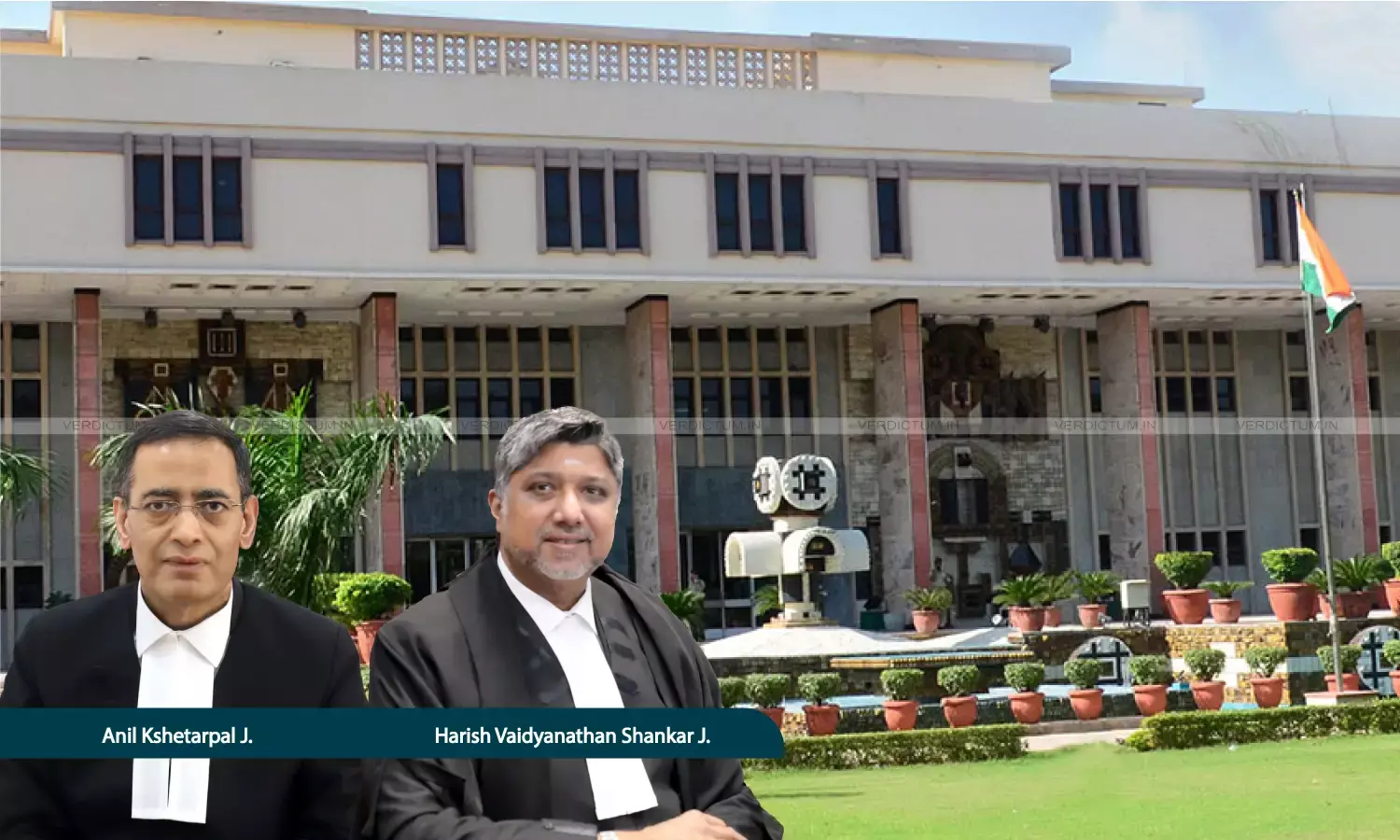
Justice Anil Kshetarpal, Justice Harish Vaidyanathan Shankar, Delhi High Court
The Delhi High Court has held that mutation entries in revenue records do not confer title and cannot be treated as determinative of ownership or succession rights, while stating that disputes concerning ancestral property, coparcenary status, and succession necessarily involve questions of fact and evidence.
The High Court was hearing an appeal against an order of a Single Judge rejecting a civil suit at the threshold under Order VII Rule 11 of the Code of Civil Procedure. The suit sought a declaration, partition, cancellation of sale deeds, possession, and consequential reliefs in respect of immovable property.
A Division Bench comprising Justice Anil Kshetarpal and Justice Harish Vaidyanathan Shankar examined whether objections relating to limitation, Order II Rule 2 CPC, Section 50 of the Delhi Land Reforms Act, and mutation entries could be conclusively adjudicated without trial, and held that “the LSJ failed to appreciate that mutation entries do not confer title, that issues concerning ancestral property and coparcenary are matters of evidence, and that objections pertaining to limitation, Order II Rule 2 of the CPC or Section 50 of the DLR Act require factual determination and cannot be adjudicated at the threshold”.
Advocates Kajal Chandra and Madan Lal Sharma represented the petitioner and respondents, respectively.
Background
The plaintiff asserted that the suit property was ancestral in nature and belonged to her father, who died intestate. According to her, upon his death, she, along with her mother and brothers, became joint owners of the property, which was never partitioned by metes and bounds.
It was alleged that shortly after the father’s death, the property was mutated in the names of the brothers without the plaintiff’s consent. Thereafter, the brothers executed multiple sale deeds in favour of third parties, alienating different portions of the property.
The plaintiff contended that these alienations were unilateral, fraudulent, and not supported by any legal necessity, and therefore could not bind her undivided share. She also pleaded that the land had subsequently been urbanised, altering the legal regime governing succession.
The defendants sought rejection of the plaint because succession was governed by Section 50 of the Delhi Land Reforms Act, that mutation had attained finality, that the suit was barred by limitation and Order II Rule 2 CPC, and that no cause of action was disclosed.
Court’s Observation
The Delhi High Court, at the outset, reiterated that mutation entries under revenue law are maintained for fiscal purposes and for updating records, and do not create, extinguish, or determine title. It held that treating mutation as conclusive proof of ownership is legally impermissible.
The Court observed that questions as to whether the property was ancestral, whether the plaintiff was a coparcener, and whether the property had remained joint are matters that can only be decided after parties are permitted to lead evidence. Such issues cannot be conclusively determined on a plain reading of the plaint.
Addressing the contention based on Section 50 of the Delhi Land Reforms Act, the Court held that the applicability of the provision itself was a mixed question of law and fact, particularly in light of subsequent urbanisation. The effect of urbanisation on the governing succession law could not be presumed at the threshold.
The Bench further held that objections relating to limitation and Order II Rule 2 CPC are ordinarily mixed questions of law and fact. Unless the bar is apparent on the face of the plaint, such objections cannot form the basis for rejection under Order VII Rule 11 CPC.
The Court emphasised that “once the Plaintiff’s prima facie status as a coparcener is recognised, the unilateral alienations by the brothers cannot bind her share absent proof of legal necessity”, while holding that the plaint therefore, “raises bona fide issues warranting a full trial, and none of these matters can be determined without permitting the parties to lead their evidence”.
Conclusion
The High Court held that the learned Single Judge erred in rejecting the plaint at the threshold, while stating that statutory and procedural objections raised by the defendants could not be adjudicated without trial.
Accordingly, the appeal was allowed, the impugned order was set aside, and the suit was restored to its original number for adjudication on the merits. The Court clarified that it had expressed no opinion on the ultimate merits of the parties’ claims.
Cause Title: Indu Rani Alias Indu Rathi v. Pushpa Varat Mann & Ors.(Neutral Citation: 2025:DHC:11638-DB)
Appearances
Appellants: Advocates Kajal Chandra, Hatneimawi, Suyash Swarup, Ananyay Bhardwaj
Respondents: Advocates Madan Lal Sharma, Tejaswini Verma, Pankit Bhardwaj, Manika Gaba, Abhay Singh, A.K. Sen
