

Severity Of Allegations Can’t Become Justification For Perpetual Incarceration: Chhattisgarh High Court Grants Bail To Former CM Baghel’s Son In Liquor Scam Case
The Chhattisgarh High Court said that the apprehensions, howsoever grave, must be founded on tangible material and not on conjecture.
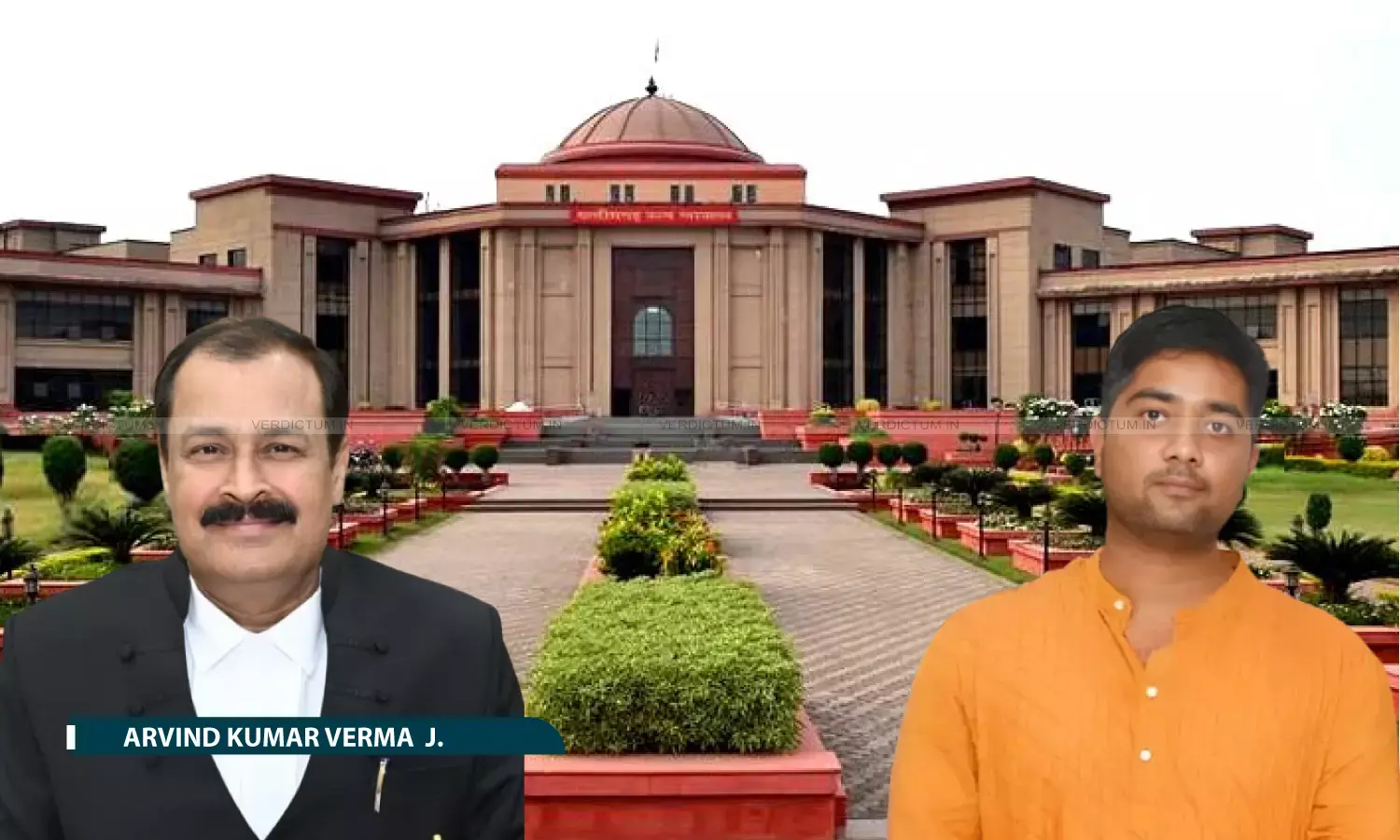
Justice Arvind Kumar Verma, Chhattisgarh High Court, Chaitanya Baghel
The Chhattisgarh High Court has granted bail to Chaitanya Baghel, son of former Chief Minister (CM) of Chhattisgarh-Bhupesh Baghel in Rs. 2161 crores liquor scam case.
An Application was filed under Section 483 of the Bhartiya Nagarik Suraksha Sanhita, 2023 (BNSS), seeking grant of regular bail in connection with the offence registered by the Enforcement Directorate (ED), alleging commission of offence punishable under Section 3 read with Section 4 of the Prevention of Money Laundering Act, 2002 (PMLA).
A Single Bench of Justice Arvind Kumar Verma held, “This Court is conscious of the gravity of offences under the PMLA and the deleterious impact of money laundering on the financial health of the nation. However, severity of allegations cannot, by itself, become a justification for perpetual incarceration, particularly when the adjudicatory process is bound to take years. The criminal justice system does not countenance a regime where detention becomes the rule and trial the exception. Such an approach would reduce the concept of bail to a mere illusion and render Article 21 a dead letter.”
The Bench said that the apprehensions, howsoever grave, must be founded on tangible material and not on conjecture.
Senior Advocate N. Hariharan appeared on behalf of the Applicant/Accused, while Advocate Zoheb Hossain appeared on behalf of the Respondent/ED.
Brief Facts
An FIR was registered in 2024 for offences punishable under Sections 420, 467, 471, and 120-B of the Indian Penal Code, 1860 (IPC) and Sections 7 and 12 of the Prevention of Corruption Act, 1988 (PC Act), alleging a large-scale criminal conspiracy in the excise administration of the State of Chhattisgarh during the period 2019 to 2023, resulting in an alleged loss of approximately Rs. 2161 crores to the State exchequer. The gravamen of the ED case was that the proceeds generated from the alleged excise scam constitute “proceeds of crime” which were concealed, layered and projected as untainted property by various accused persons.
The excise policy of the State underwent a structural change in 2017 with the creation of the Chhattisgarh State Marketing Corporation Limited (CSMCL), entrusted with exclusive retail sale of liquor through State-run outlets, with procurement from manufacturers and storage through the Chhattisgarh State Beverage Corporation Limited (CSBCL).
The prosecution alleged that a criminal syndicate comprising senior bureaucrats, politicians, excise officials and private entities subverted the statutory excise framework and converted CSMCL into an instrumentality for institutionalized corruption. It was further alleged that the Applicant-accused was associated with certain individuals who are stated to be part of the said syndicate. The ED had filed multiple prosecution complaints, including supplementary complaints, before the Special Court under PMLA.
Reasoning
The High Court in view of the above facts, observed, “… parity cannot be denied unless clear and cogent distinguishing features are established. … parity, though not absolute, cannot be brushed aside when similarly placed co-accused stand enlarged on bail and no distinguishing circumstance is shown.”
The Court noted that once the grounds of arrest cease to have a live and compelling nexus with the necessity of further detention, continued incarceration would offend the constitutional mandate of Article 21 of the Constitution and liberty, though not absolute, cannot be curtailed on speculative apprehensions.
“Applying the aforesaid principle, this Court finds that the prosecution case against the applicant is predominantly document centric, resting upon statements recorded under Section 50 of the PMLA, financial records, digital material and inferential links. The admissibility, credibility and evidentiary worth of such material are matters that can only be conclusively adjudicated during trial, after full fledged examination and cross examination”, it remarked.
The Court said that only those entries which are recorded in books of account regularly kept, having regard to the nature of occupation or business, can be treated as admissible under law.
“Significantly, no recovery of proceeds of crime has been effected from the personal possession of the applicant, nor is there any allegation of the applicant having directly enjoyed the fruits of the alleged proceeds of crime in a manner demonstrable at this stage. The role attributed to the applicant, though serious, rests largely on all allegations of supervisory control and association which are yet to be established by cogent and impeachable evidence”, it added.
The Court was of the view that continued incarceration of the accused would convert the presumption of innocence into a hollow promise, thereby offending the constitutional mandate of fairness.
“The complexity of the matter is further compounded by the fact that the predicate offence encompasses an even larger evidentiary canvas, involving an extraordinary volume of material, numerous accused and a vast array of witnesses. In such circumstances, it would be wholly unrealistic to expect that the trial, either in the scheduled offence or the PMLA proceedings would conclude in the near future”, it further noted.
The Court reiterated that a trial under the PMLA cannot logically or legally be concluded prior to the culmination of the trial in the predicate offence.
“In cases such as the present, where there are multiple accused, voluminous evidence to be appreciated, scores of witnesses to be examined and no reasonable likelihood of early conclusion of trial and where the delay is not attributable to the accused, continued custody by mechanically invoking Section 45 of the PMLA would reduce the provision to a tool of incarceration rather than a safeguard”, it also observed.
The Court emphasised that Constitutional Courts retain the plenary power to grant bail on the grounds flowing from Part III of the Constitution and Section 45 of the PMLA does not, and cannot, operate as an absolute embargo where continued incarceration would infringe the fundamental right to personal liberty and fair trial.
“The sacrosanct guarantee under Article 21 must prevail even in the face of stringent provisions contained in special statutes. … The right to a speedy trial, as an inseparable facet of Article 21 of the Constitution, cannot be sacrificed at the altar of procedural rigidity. The Apex Court in Manish Sisodia Vs. CBI & ED (2024) has categorically held that where the trial is unlikely to conclude within a reasonable period, prolonged pre-trial detention under special statute offends Article 21, particularly when the conclusion of trial is not foreseeable, even in cases involving economic offences”, it added.
The Court said that the argument of the ED that the accused wields political influence, though noted, cannot be accepted as a standalone ground to deny bail in the absence of specific material demonstrating actual attempts at witness intimidation or obstruction of justice.
“The principle of parity which is a facet of Article 14 of the Constitution and a well recognized cannon of bail jurisprudence, mandates that similarly situated accused persons ought not to be subjected to disparate standards of treatment in matters affecting personal liberty. Once the Apex court has delineated the contours within which investigation against a co-accused must be concluded and has envisaged consideration of bail on merits thereafter this Court would be failing in its constitutional duty if the present applicant- standing on lesser footing is denied the same normative protection”, it enunciated.
Conclusion
The Court elucidated that parity does not demand mechanical replication of orders; however, it does require the Court to ensure consistency in judicial approach, unless distinguishing circumstances of a compelling nature are demonstrated.
“The material relied upon by the Enforcement Directorate does not disclose any document, official communication, financial instrument, bank account, or property standing in the name of the applicant which would, by itself, demonstrate direct involvement in the generation of proceeds of crime. The allegations, as they stand, are premised primarily on statements recorded under Section 50 of the PMLA and broad assertions regarding influence and proximity, rather than concrete acts of commission”, it said.
Furthermore, the Court remarked that while it is alleged that the accused stood “at the apex” of the syndicate, no contemporaneous documentary evidence has been placed on record to establish that he exercised control over procurement decisions, fixation of commission rates, award of tenders, movement of liquor, or handling of cash collections.
“The applicant is not shown to have held any statutory position in the Excise Department, CSMCL, CSBCL, or any licensing authority, nor is he alleged to have issued any administrative direction, policy decision, or official order forming part of the scheduled offences. … The statutory rigour of Section 45 of the PMLA, when tested against the touchstone of constitutional proportionality, stands sufficiently satisfied at this stage. Continued incarceration of the applicant, in the facts of the present case, would amount to pre-trial punishment, which is alien to the settled principles of criminal jurisprudence”, it concluded.
Accordingly, the High Court allowed the Application and granted bail to the accused.
Cause Title- Chaitanya Baghel v. Directorate of Enforcement (Neutral Citation: 2026:CGHC:233)
Appearance:
Applicant: Senior Advocate N. Hariharan, Advocates Mayank Jain, Madhur Jain, Arpit Goel, Deepak Jain, and Harshwardhan Parganiha.
Respondent: Advocates Zoheb Hossain, Pranjal Tripathi, and Dy. A.G. Saurabh Kumar Pande.
