

RBI Master Directions Not Mere Paper Tiger Enabling Banks To Initiate Action On Convenience: Bombay High Court Grants Interim Relief To Anil Ambani
The Bombay High Court emphasised that the Banks are required to follow and adhere strictly to the “Rule of Law” and principles of due process of law in all operations.
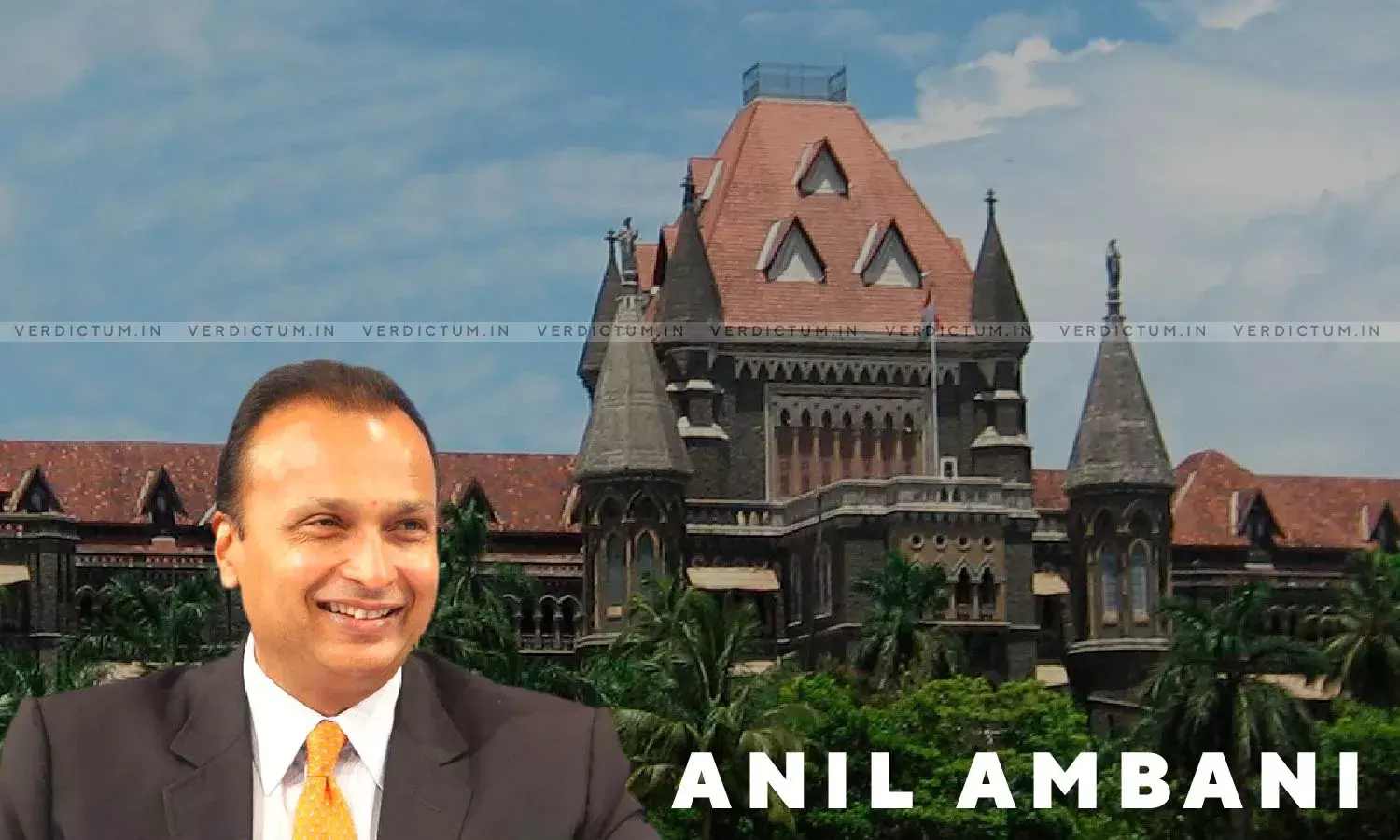
Bombay High Court, Anil Ambani
While granting interim relief to industrialist Anil Ambani, the Bombay High Court remarked that the RBI (Reserve Bank of India) Master Directions are not mere paper tiger to enable the Banks to initiate action as per their convenience.
The Court was hearing Suits and Interim Applications challenging fraud proceedings against Reliance Communications (RCOM) group companies.
A Single Bench of Justice Milind N. Jadhav observed, “The Master Directions of RBI are not a mere paper tiger to enable the Banks to wake up from their deep slumber and initiate action according to their convenience. Had the concerned accounts of Plaintiff being Red Flagged on account of one or two EWS in the year 2013 itself or even thereafter and had the Banks acted strictly in consonance with the prevailing Master Directions, the present situation would not have arisen. The Banks are equally accountable and answerable. I say this so because in the present case, the figures are humongous. They rattle a common man who places his hard earned savings with Public Sector Banks with the hope that they shall remain in safe custody and grow.”
The Bench said that it is shocking to the core that Banks, instead of adhering to the EWS and Red Flagging of the account have not adhered to the regime of the Master Directions at all.
Senior Advocates Gaurav Joshi and Ashish Kamat appeared on behalf of the Plaintiff/Applicant, while Senior Advocates Zal Andhyarujina, Kevic Setalvad, Zarir Bharucha, and Advocate Kunal Dwarkadas appeared for the Defendants.
Facts of the Case
The Plaintiff-Anil Ambani was the Non-Executive Director of Reliance Communications Limited (RCOM) from its inception till the year 2019. RCOM, Reliance Telecom Limited (RTL), and Reliance Infratel Limited (RITL) together with its 98 subsidiaries operated as a Single Economic Unit. In 2016, RBI issued Master Directions on Fraud – Classification and Reporting by Commercial Banks and select FIs and in terms of Clause 8.9.4 thereof a Forensic Audit was required to be carried out before classifying a person as a ‘Fraud’. In 2017, Joint Lenders’ Forum (JLF) of which Defendant-Bank was a member considered appointment of an Audit firm for Forensic Review of RCOM, RTL and RITL. Banks were primarily interested in recovery of their dues through sale of assets of the said Companies. Thereafter, Ericsson Indian Pvt. Ltd. filed a Company Petition against RCOM and in 2018, RCOM was admitted into Corporate Insolvency Resolution Process (CIRP) by National Company Law Tribunal (NCLT) and the Board of Directors (BOD) stood superseded by the Resolution Professional (RP).
Subsequently, RBI issued new Master Directions on Fraud Risk Management in Commercial Banks (including Regional Rural Banks) and All India Financial Institutions Directions, 2024 wherein Clause 10 expressly provided that the 2024 RBI Master Directions superseded the 2016 RBI Master Directions. The counsel for the Plaintiff submitted that Clause 4.1 read with Footnote 14 of the 2024 RBI Master Directions mandates Forensic Audit must be conducted by an Auditor who is qualified as Auditor under the relevant statutes. It was further submitted that the FAR (Forensic Audit Report) prepared by Defendant No.2 – BDO LLP is not an entity competent to conduct the External Audit. The Plaintiff sought interim relief in consequence of the Show Cause Notices (SCNs) and coercive action in furtherance thereof on the principal ground that FAR prepared and submitted by BDO LLP was not qualified to conduct the Forensic Audit and its signatory i.e., Defendant No. 3 is not a Chartered Accountant (CA).
Reasoning
The High Court after hearing the arguments from both sides, noted, “There are 41 types of EWS prescribed in the 2016 RBI Master Directions and the said directions clearly contemplate that even if one or two EWS are detected, the account has to be red flagged and immediate consequential steps have to be taken by the Bank as detailed therein while adhering to the stipulated timeline of completing the declaration within six (6) months.”
The Court said that in 2019 the External Auditor was appointed to investigate the accounts pertaining to the period between 2013 and 2017 and the RBI Master Directions are rendered completely redundant if this timeline is seen.
“It is seen that under the 2016 RBI Master Directions or even the 2024 RBI Master Directions once the Auditor is appointed he has to submit his Report within three months but in the present case it has taken an invariably long time of 17 months for submitting the FAR. It is seen that after the date of appointment despite two months having been granted to the Forensic Auditor to submit the Report, it has given a complete go by to the timeline stipulated or even prescribed in the Master Directions and submitted the FAR after more than 17 months”, it added.
The Court was of the view that if Banks themselves do not follow the Rule of Law and timelines as prescribed under the RBI Master Directions which is prima facie observed in this case and take action at the right time, it will affect the broader economy of the country.
“This is a classic case where the Banks have woken up from their deep slumber seeking to conduct Forensic Audit for the period from Audit 2013 and 2017 in the year 2019 without adhering to any of the timelines prescribed under the 2016 RBI Master Directions”, it further remarked.
The Court observed that the FAR and all consequential action based thereupon with which Plaintiff is aggrieved will have to be interfered with by the Court as the FAR forms the foundation of the SCNs and all consequential steps adopted by the Banks.
“Though it is true that Plaintiff has filed several proceedings to challenge the show-cause notice and the consequential actions taken thereafter but it is equally true and an admitted position by all parties before me that the validity of the Report on the basis of qualification of the author of the report is not challenged by Plaintiff in any proceedings after he received the Report and this is the first instance of maintaining the challenge”, it also noted.
The Court emphasised that the Banks are required to follow and adhere strictly to the “Rule of Law” and principles of due process of law in all operations, including Audits and this obligation stems from the comprehensive legal and regulatory framework governing the Banking Sector.
“Banks have to operate for all purposes within a clear, established legal framework, and not by arbitrary power. Banks cannot appoint an ineligible and unqualified Auditor, whether Internal or External for Audit contrary to provisions of eligibility prescribed under the provisions of Section 141(1) and 141(2) of the Companies Act, 2013 if the Auditor is not a practicing Chartered Accountant registered with the ICAI”, it added.
Conclusion
Moreover, the Court said that prima facie case and balance of convenience clearly shifts in favour of the Plaintiff due to the frailty of the FAR and qualification of the Auditor.
“Banks’ case that interfering with the Show Cause Notices and further consequential action will derail investigation cannot be countenanced if the edifice on which it is based is itself palpably dubitable. Allowing the impugned action to proceed will lead to disastrous consequences in such cases where it leads to a certain civil death without trial. Hence on the parameter of grave and irreparable harm / loss, Plaintiff’s case deserves to be accepted for grant of interim relief for all the above reasons, legal and factual, and in accordance with the principles of natural justice”, it concluded.
Accordingly, the High Court allowed the Interim Applications and granted interim relief to the Plaintiff.
Cause Title- Anil D. Ambani v. Indian Overseas Bank and Ors. (Neutral Citation: 2025:BHC-OS:26292)
