

No Religion Prescribes Prayers That Disturb Peace Of Others: Bombay HC Rejects Mosque Plea To Use Loudspeaker
The Nagpur Bench took suo moto cognizance of the noise pollution in the city of Nagpur.

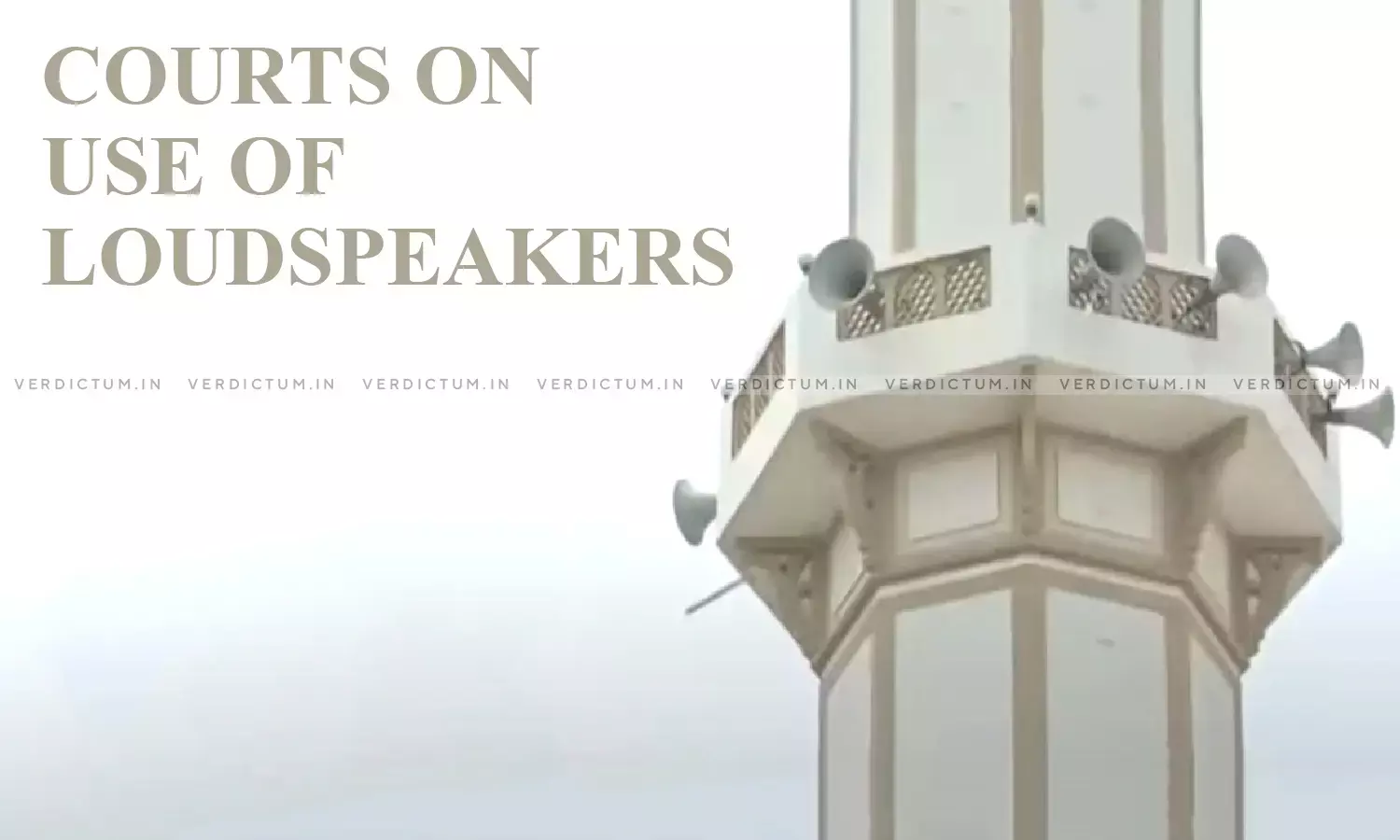
The Bombay High Court, while rejecting a plea of a Mosque for using loudspeakers, reiterated that no religion prescribes that prayers should be performed by disturbing the peace of others, nor does it preach that they should be through voice amplifiers or beating of drums.
The Court also took suo moto cognizance of the noise pollution that is recurring in Nagpur City.
The Division Bench of Justice Anil L Pansare and Justice Raj D Wakode reiterated, “Thus, the Supreme Court observed that no religion prescribes that prayers should be performed by disturbing the peace of others nor does it preach that they should be through voice amplifiers or beating of drums. The Supreme Court also highlighted the importance of other citizens entitled to enjoy reasonable quietness, particularly those who are of tender age and those who are aged, sick, people afflicted with psychic disturbances.”
Advocate Sanket Bhandarkar appeared on behalf of the Petitioner, whereas APP KR Lule Respondents.
The Petitioner-Mosque (Masjid A. Gousiya, Gondia) approached the Court seeking directions to the Respondents to restore the use of loudspeakers in the mosque. The main question before the Court was whether, for practising religion installation of a loudspeaker is mandatory/necessary.
The bench observed that the Petitioner-Mosque was unable to submit any material to show that the use of loudspeakers was mandatory/necessary to practice their religion.
“The petitioner, therefore, is not entitled to seek relief for the installation of a loudspeaker, as of right. The petition is accordingly dismissed,” the court said.
The Court also relied on the landmark ruling of the Apex Court in In Re Noise Pollution – Implementation of the Laws for Restricting use of Loudspeakers and High Volume Producing Sound Systems : Forum, Prevention of Envn. and Sound Pollution Vs. Union of India & Anr. [AIR 2005 SC 3136 : 2005 AIR SCW 3525], and said, “Thus, the Court held that right to life enshrined in Article 21 is not of mere survival or existence but it guarantees a right of persons to life with human dignity. The Supreme Court also noted that while there is a right to speech, there exist right to listen or decline to listen. Nobody can be compelled to listen and nobody can claim that he has a right to make his voice trespass into the ears or minds of others.”
The bench also highlighted the consequences of noise pollution. It said that it is a serious threat to public health and welfare. It causes “fight to flight” syndrome, releasing cortisol and other harmful chemicals into the flood stream. Over time, these chemicals built up in the body, leading to a host of health problems, including cardiovascular disease, aggression, chronic fatigue, headaches, high blood pressure, mental illness and anxiety. Noise pollution caused in between levels of 80 to 110 decibels (dB) can cause hearing damage. Noise pollution above 120 dB can exceed human pain threshold and noise pollution in between 140 to 160 dB can cause ear drum rupture, the Court added.
It was observed, “In this context, we would like to highlight certain issues which are existing in Civil Lines area of Nagpur. There are various clubs and marriage halls. Certain portion of the clubs is given for various programs, most of which are for marriage ceremonies. The celebration is obvious. The system/means deployed for celebration is, however, violating the provisions of the Act of 1986 and the Rules of 2000. Not only that the system/means deployed have output far beyond the permissible decibel volume, but are continued beyond 10.00 p.m. Along with these means, celebrations are held by bursting crackers that too at midnight… In our view, while permitting various celebrations, these venues should take responsibility of ensuring adherence to the provisions of the Act of 1986 and the Rules of 2000. The competent authority should also examine whether change of user of land by these venues is sanctioned under the relevant provisions of law and if yes, how is it sanctioned without making provisions for parking space.”
It further added that in religious places, various activities such as bhajans, ajans etc. are performed on loudspeakers and in complete violation of the provisions of the Act of 1986 and the Rules of 2000.
While directing the State Government to come up with an effective solution and follow the directions issued vide judgment of the Apex Court in Noise Pollution (V), IN RE [(2005) 5 SCC 733] it was concluded, “These directions remain on paper. We hope, the State Government will be sensitive to the issue involved which affects public health and will come up with effective solution. One of the best ways of implementation of rules or orders is to provide the consequence of failure to implement rules or orders. The State Government may consider to issue fresh order with consequence of failure to implement the order…We accordingly take suo moto cognizance of the noise pollution that is recurring in the Nagpur City and direct Registry to register it as Suo Moto Public Interest Litigation.”
Accordingly, the Court dismissed the petition.
Cause Title: Masjid A. Gousiya, through its Secretary, Sayyad Iqbal Ali, Gondia vs. The State of Maharashtra, through its Principal Secretary, Mantralaya, Mumbai and others [Neutral Citation: 2025:BHC-NAG:13411-DB]
Appearances:
Petitioner: Advocate Sanket Bhandarkar
Respondents: PP KR Lule