

Government Land Encroachers Cannot Claim Land Acquisition Compensation Under RFCTLARR Act: Andhra Pradesh High Court
Long possession, payment of property tax, or utility connections do not create ownership rights; encroachers cannot invoke the Land Acquisition Act, 2013 for compensation

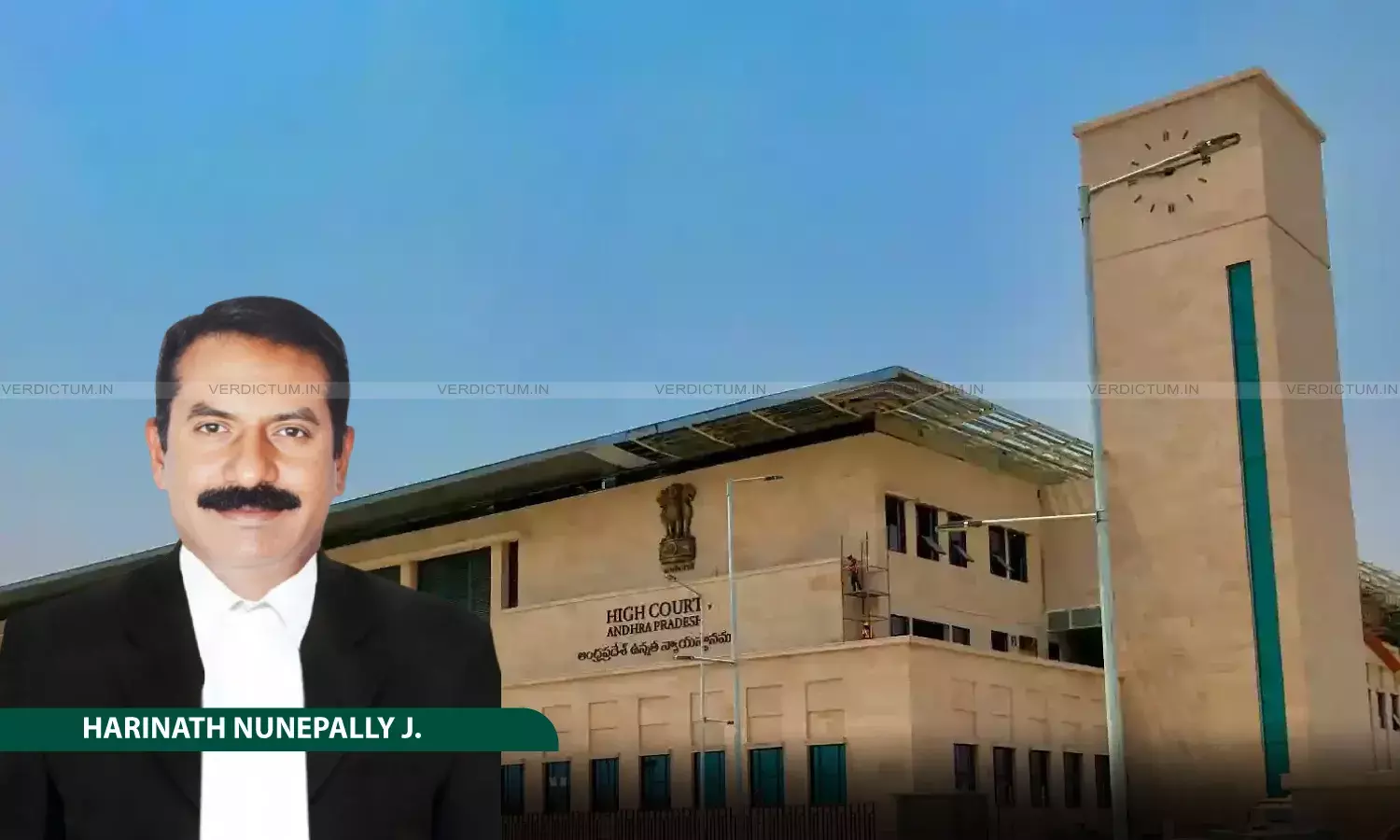
The Andhra Pradesh High Court has dismissed a batch of writ petitions filed by residents of the Gunadala area in Vijayawada, holding that persons occupying government poramboke land without valid title cannot seek compensation under the Right to Fair Compensation and Transparency in Land Acquisition, Rehabilitation and Resettlement Act, 2013 (the Act).
The bench said that illegal encroachers, irrespective of long possession or ancestral occupation claims, do not fall within the definition of “land owner” or “person interested” under Sections 3(r) and 3(n) of the Act, and therefore cannot demand acquisition proceedings or compensation when government land is required for public projects.
Justice Harinath N. observed, “Illegal encroachers cannot claim compensation and invoke the Right to Fair Compensation and Transparency in Land Acquisition, Rehabilitation and Resettlement Act, 2013. The said Act was not introduced in the interest of illegal encroachers. The Act is a beneficial legislation which ought to be extended to the land owners and property owners, who have a valid title over the same or granted any vested rights under the various enactments or granted any patta rights over the property, including assigned lands or the property owners who are declared as owners by virtue of Court orders”.
Advocate Venkateswara Rao Gudapati appeared for the petitioner and S.V.S.S. Sivaram, SC appeared for the respondent.
In the matter, the petitioners had claimed that they and their ancestors had been residing for decades, for over a century, on a land situated at Gunadala, Vijayawada.
The area was originally under a Gram Panchayat and later merged into the Vijayawada Municipal Corporation (VMC) in 1981.
The petitioners relied on long-standing possession, assessment of property tax, electricity connections, and municipal water supply to assert lawful occupation.
The dispute arose when authorities sought to clear the land for construction of a Railway Over Bridge (ROB), asserting that the petitioners were occupying government poramboke land classified partly as canal land, burial ground, and Rivas canal.
The petitioners contended that eviction could only take place after formal acquisition under the Act, with payment of compensation.
However, the State and the municipal authorities disputed the ownership claims on the ground that none of the petitioners possessed title deeds or pattas, while some relied only on unregistered agreements of sale. Further contended that payment of property tax or utility bills does not confer title as the land was government land required for a public infrastructure project.
The authorities also highlighted that alternative housing had already been provided to many occupants on humanitarian grounds under housing schemes, and several petitioners had accepted such allotments.
Pursuant to which, the Court rejecting the petitions held that long or uninterrupted possession does not legalise encroachment on government land. Furthermore, assessment for tax, electricity or water connections does not create ownership or transferable rights.
On the scope of the Act, the bench further said that the Act of 2013 is a beneficial legislation meant for lawful landowners and persons with recognised legal interests, not encroachers. The Court relied on earlier precedents to reiterate that encroachers cannot claim parity with lawful landowners.
While upholding the legality of eviction, the Court noted that the State had already provided alternative housing to affected occupants purely on humanitarian considerations. However, such rehabilitation does not convert illegal occupation into a legal entitlement to compensation.
The Court thus while dismissing the writ petitions and connected contempt cases held that the petitioners had failed to establish any statutory or legal right to seek acquisition or compensation under the 2013 Act.
Cause Title: Thota Venkatadri v. The State Of Andhra Pradesh [Neutral Citation: 2026:APHC:1684]
Appearance:
Petitioner: Venkateswara Rao Gudapati, Ramineni Satish Babu, Advocates.
Respondent: S.V.S.S. Sivaram SC, Advocate