

Claimant In Electrocution Cases Need Not Prove Negligence By Authorities; Strict Liability Applies Once Injury Is Established: Allahabad High Court
The Court held that once electrocution from a live high-tension wire is proved, liability follows irrespective of negligence, and compensation must be determined on settled principles.
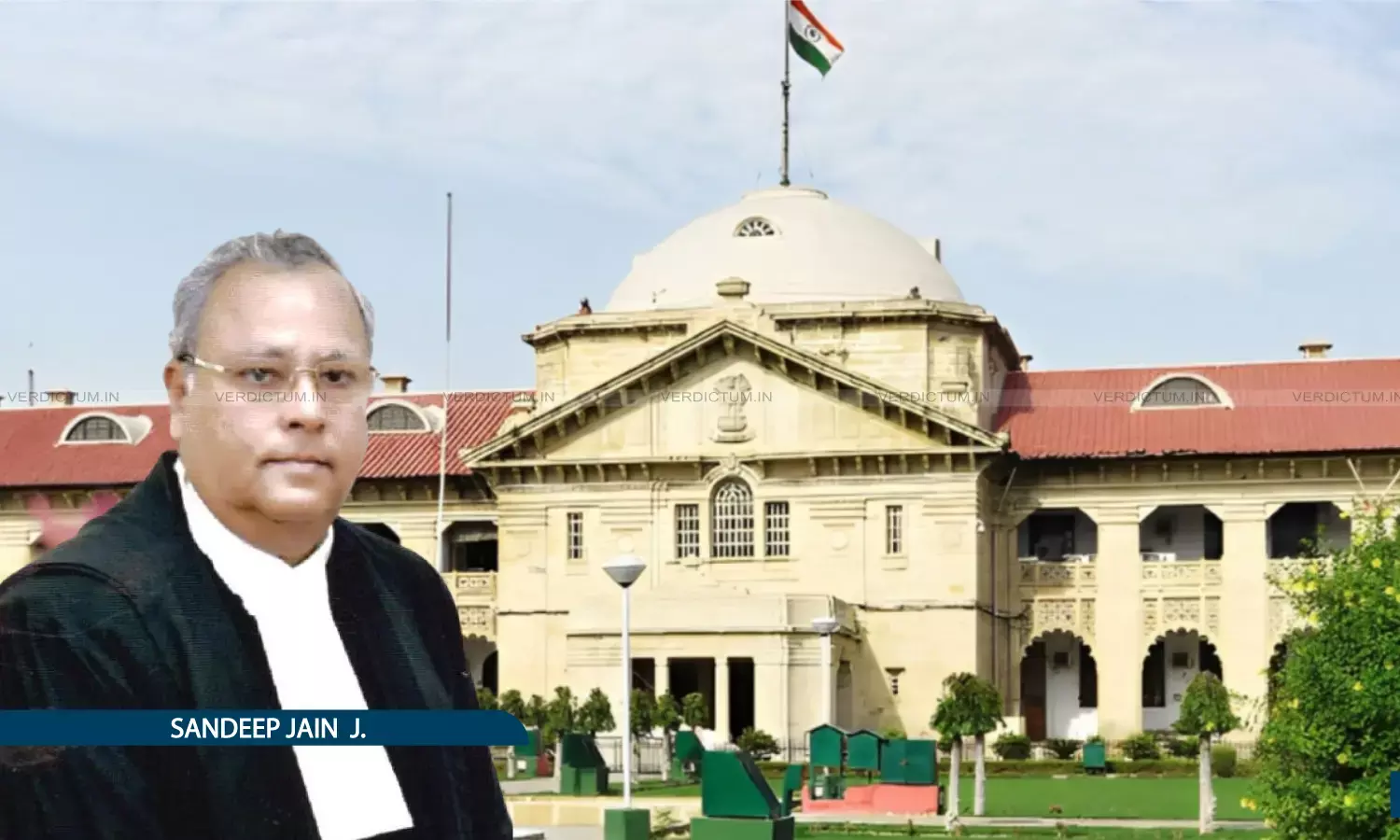
Justice Sandeep Jain, Allahabad High Court
The Allahabad High Court has reiterated that in cases of electrocution, the principle of strict liability applies, and the claimant is not required to prove negligence on the part of the electricity authorities once it is established that injuries were caused due to electrocution.
The Court was hearing a first appeal filed by U.P. State Power Corporation Limited, challenging the judgment of the trial court, which had awarded compensation to the plaintiff for injuries suffered due to electrocution.
A Single Judge Bench of Justice Sandeep Jain observed: “… in cases of electrocution, the principle of strict liability is applicable and the plaintiff is not required to prove that the accident occurred due to the negligence of the employees and servants of the defendant in maintaining the high tension electricity line, which snapped due to poor maintenance. The plaintiff has only to prove that he suffered injuries due to electrocution, which he has successfully proved from his evidence”.
Advocate Shivam Yadav appeared for the appellant, while Advocates Ajay Kumar Srivastava, Jitendra Pal Singh and Pradeep Kumar Singh appeared for the respondent.
Background
The plaintiff, a labourer, sustained severe burn injuries on 02.01.2007 when a live high-tension electric wire snapped and fell upon him while he was standing near his house.
Due to the injuries, he suffered extensive burns on multiple parts of his body, including his neck, chest, hands, and thigh. His left hand developed gangrene and had to be amputated to save his life. Medical evidence also indicated permanent disability to the extent of 65%.
The plaintiff filed a suit seeking compensation on the ground that the accident occurred due to poor maintenance of the electricity line by the defendant.
The defendant denied the occurrence of the accident and contended that no electricity line had snapped, that there was no negligence on its part, and that the plaintiff had failed to prove his injuries and disability.
The trial court, after evaluating oral and documentary evidence, held that the plaintiff had indeed suffered electrocution due to a snapped high-tension wire and awarded compensation of ₹3,87,500/- along with interest. This was challenged in the appeal.
Court’s Observation
The High Court framed key issues, including whether the plaintiff suffered electrocution injuries, whether there was a nexus between the injuries and subsequent amputation, and whether proof of negligence was required.
At the outset, the Court examined the legal position governing liability in electrocution cases and referred to precedents including Parvati Devi v. Commissioner of Police (2000) and M.P. Electricity Board v. Shail Kumari (2002).
The Court emphasised: “It is well settled that in cases of strict liability, the negligence of the defendant… is not to be proved.” The Court held that electricity is a hazardous activity, and authorities engaged in its supply are under a heightened duty of care. Once it is established that injury or death occurred due to electrocution from such infrastructure, liability follows irrespective of fault.
Applying these principles, the Court found that the plaintiff had successfully proved electrocution through consistent oral and medical evidence. It noted that the testimony of the plaintiff (PW-1) was corroborated by an eyewitness (PW-2), who deposed that he saw the plaintiff lying unconscious with a live electric wire over him.
Further, the medical evidence established that the plaintiff suffered electric burn injuries, developed gangrene, and underwent amputation of his left hand. The Court observed: “From the above evidence… it is proved that a live high tension electricity line snapped and fell on the plaintiff… due to which he was badly burnt…”
The Court also found a direct nexus between the electrocution injuries and the amputation, holding that the gangrene developed as a consequence of the burn injuries.
The defence of the electricity corporation was rejected, particularly in light of admissions by its own witnesses regarding the presence of high-tension lines in the locality and the occurrence of faults from time to time. The Court also noted that the movement register, which could have supported the defence, was not produced.
Additionally, reliance was placed on the order of the Collector under the Public Liability Insurance Act, which had also recognised the occurrence of electrocution and awarded compensation, further corroborating the plaintiff’s case.
On the question of compensation, the Court observed that the trial court had, in fact, awarded inadequate compensation, particularly in relation to loss of future earnings, prospects, and medical expenses. However, in the absence of any cross-appeal by the plaintiff, the compensation could not be enhanced.
Conclusion
The High Court held that the plaintiff had successfully established that he suffered injuries due to electrocution from a high-tension electricity line of the defendant, attracting strict liability. It upheld the findings of the trial court and held that no proof of negligence was required in such cases.
Accordingly, the appeal was dismissed, and the compensation awarded by the trial court was affirmed.
Cause Title: U.P. State Power Corporation Ltd. v. Mohd. Nisar Alias Bade Lalla (Neutral Citation: 2026:AHC:67581)
