

Magistrates Must Direct Written Complaint U/S 195 CrPC In Cases Of False FIRs: Allahabad High Court
The High Court issued directions requiring Magistrates to ensure the initiation of proceedings against informants and witnesses for furnishing false information when the investigation ends in a closure report in favour of the accused, and cautioned that non-compliance would amount to contempt of court.
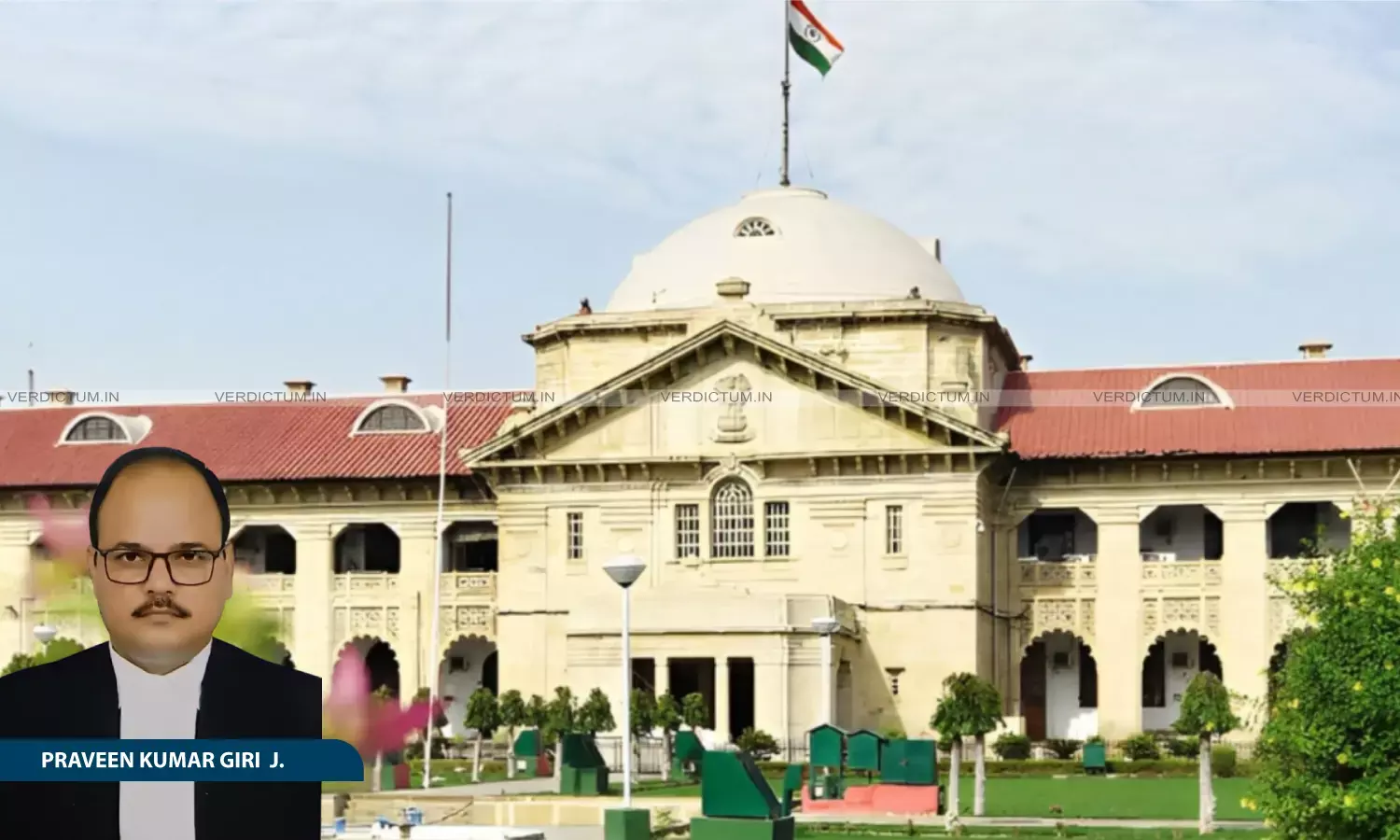
Justice Praveen Kumar Giri, Allahabad High Court
The Allahabad High Court held that where an investigation culminates in a closure report concluding that the allegations in an FIR are false, the Magistrate cannot treat the matter as closed and is duty-bound to ensure initiation of proceedings against the informant and witnesses who furnished false information, in accordance with the statutory mandate.
The Court was hearing an application under Section 528 of the Bharatiya Nagarik Suraksha Sanhita, 2023 (corresponding to Section 482 of the Code of Criminal Procedure, 1973) arising from a judgment of the Chief Judicial Magistrate, Aligarh, whereby a protest petition was accepted, the closure report was rejected, and cognizance was taken in a case registered under the Indian Penal Code, 1860.
A Single Judge Bench of Justice Praveen Kumar Giri, upon examining the material placed on the record, remarked: “this Court also directs all the Judicial Magistrates or Courts that in case a final report i.e. closure report is submitted in favour of alleged accused, the learned Judicial Magistrates/Courts shall receive the entire case diary along with documents and final report i.e. closure report, but the Judicial Magistrates/Courts shall also direct the Investigating Officer/Police for submitting written complaint against informant, as well as witnesses of the FIR as provided under section 195(1)(a) Cr.P.C. (corresponding Section 215(1)(a) BNSS) in respect of furnishing false information with intent to cause public servant to use his lawful power to the injury of the alleged accused persons”.
The applicant was represented by Advocate Manoj Kumar Pandey, while the respondents were represented by Advocate Najam Uz Zaman Khan and the Additional Government Advocate for the State.
Background
The proceedings arose from an FIR lodged alleging the commission of offences punishable under Sections 504 and 507 of the Indian Penal Code, 1860. The case was investigated by the police in exercise of powers under Chapter XII of the Code of Criminal Procedure, 1973.
Upon completion of the investigation, the Investigating Officer concluded that the allegations were not substantiated by the material on record and accordingly submitted a final report (closure report) under Section 173 of the Code of Criminal Procedure, 1973, in favour of the accused.
Thereafter, the informant filed a protest petition before the Magistrate. The Magistrate rejected the closure report, accepted the protest petition, and proceeded to take cognisance of the alleged offences and issue a process against the accused.
Aggrieved by the rejection of the closure report and the consequential cognizance-cum-summoning order, the accused approached the High Court, invoking its inherent jurisdiction, seeking quashing of the proceedings and appropriate directions in accordance with law.
Court’s Observation
The Allahabad High Court noted that the FIR was registered for offences under Sections 504 and 507 of the Indian Penal Code, 1860, and held that both offences are non-cognizable and bailable, punishable up to two years, and therefore triable as summons cases. The Court observed that, despite this, the police registered the information as an FIR under Section 154 of the Code of Criminal Procedure, 1973 (corresponding to Section 173 of the Bharatiya Nagarik Suraksha Sanhita, 2023), instead of treating it as a non-cognizable report under Section 155 of the Code of Criminal Procedure, 1973 (corresponding to Section 174 of the Bharatiya Nagarik Suraksha Sanhita, 2023).
The Court referred to the Uttar Pradesh Police Regulations and observed that police officers are required to register and process reports strictly in accordance with the statutory framework and the classification of offences. It held that deviation from the prescribed procedure, particularly in matters affecting personal liberty, would be inconsistent with the requirement of procedure established by law under Article 21 of the Constitution of India.
On the consequences of a closure report, the Court held that where investigation results in a final report in favour of the accused, the Investigating Officer is under a statutory obligation not only to submit the closure report, but also to move the competent court for prosecution of the informant and witnesses, where the case is found to have been set up on false information.
The Court held that furnishing false information with the intent to cause a public servant to use lawful power to the injury of another attracts offences under Sections 177 and 182 of the Indian Penal Code, 1860 (corresponding to Sections 212 and 217 of the Bharatiya Nyaya Sanhita, 2023). It held that proceedings for such offences must be initiated by way of a written complaint contemplated under Section 195(1)(a) of the Code of Criminal Procedure, 1973 (corresponding to Section 215(1)(a) of the Bharatiya Nagarik Suraksha Sanhita, 2023), and that these provisions cannot be rendered redundant by inaction.
The Court then examined the legality of the cognizance-cum-summoning order passed by the Magistrate. It held that cognisance in respect of non-cognizable offences could not be taken in the manner adopted, and found that the Magistrate had proceeded in derogation of the procedure contemplated under the Code of Criminal Procedure, 1973, for such cases.
The Court further held that the Magistrate had neither treated the police report as a complaint in terms of the Explanation to Section 2(d) of the Code of Criminal Procedure, 1973, nor proceeded by taking cognisance under Section 190(1)(a) of the Code of Criminal Procedure, 1973 as required.
Conclusion
The Allahabad High Court held that the cognizance-cum-summoning order passed by the Judicial Magistrate was unsustainable in law. Accordingly, it quashed and set aside the impugned order and remanded the matter to the Judicial Magistrate to pass a fresh order in accordance with law and the Court’s observations, after providing an opportunity of hearing to the accused, within the time directed.
The Court also directed that Magistrates must first independently assess the case diary and, if no offence is made out, proceed on a written complaint submitted by the Investigating Officer for offences relating to furnishing false information. Where a prima facie case appears to subsist, the Magistrate may invite a protest petition and proceed in accordance with the prescribed procedure.
The Court further directed the Director General of Police and senior police authorities to ensure that Investigating Officers, upon filing a closure report in cases found to be false or frivolous, mandatorily submit written complaints against informants and witnesses who misused the criminal process. Failure to do so was held to defeat the legislative intent and attract consequences under the law.
The Court cautioned that non-compliance with these directions by judicial or police authorities would amount to contempt of court. With these observations and directions, the application was disposed of.
Cause Title: Umme Farva v. State of Uttar Pradesh & Another (Neutral Citation: 2026:AHC:8949)
Appearances
Applicant: Manoj Kumar Pandey, Advocate
Respondents: Najam Uz Zaman Khan, Advocate; Pankaj Kumar Tripathi, Additional Government Advocate
