Section 29 POCSO Presumption Not Applicable At Stage Of Pre-Arrest Bail: Allahabad High Court Grants Anticipatory Bail To Swami Avimukteshwaranand
The Court held that the Apex Court has not laid down any law that the presumption under Section 29 of the POCSO Act applies at the stage of pre-arrest bail, and found that the facts of the case warranted the grant of anticipatory bail.
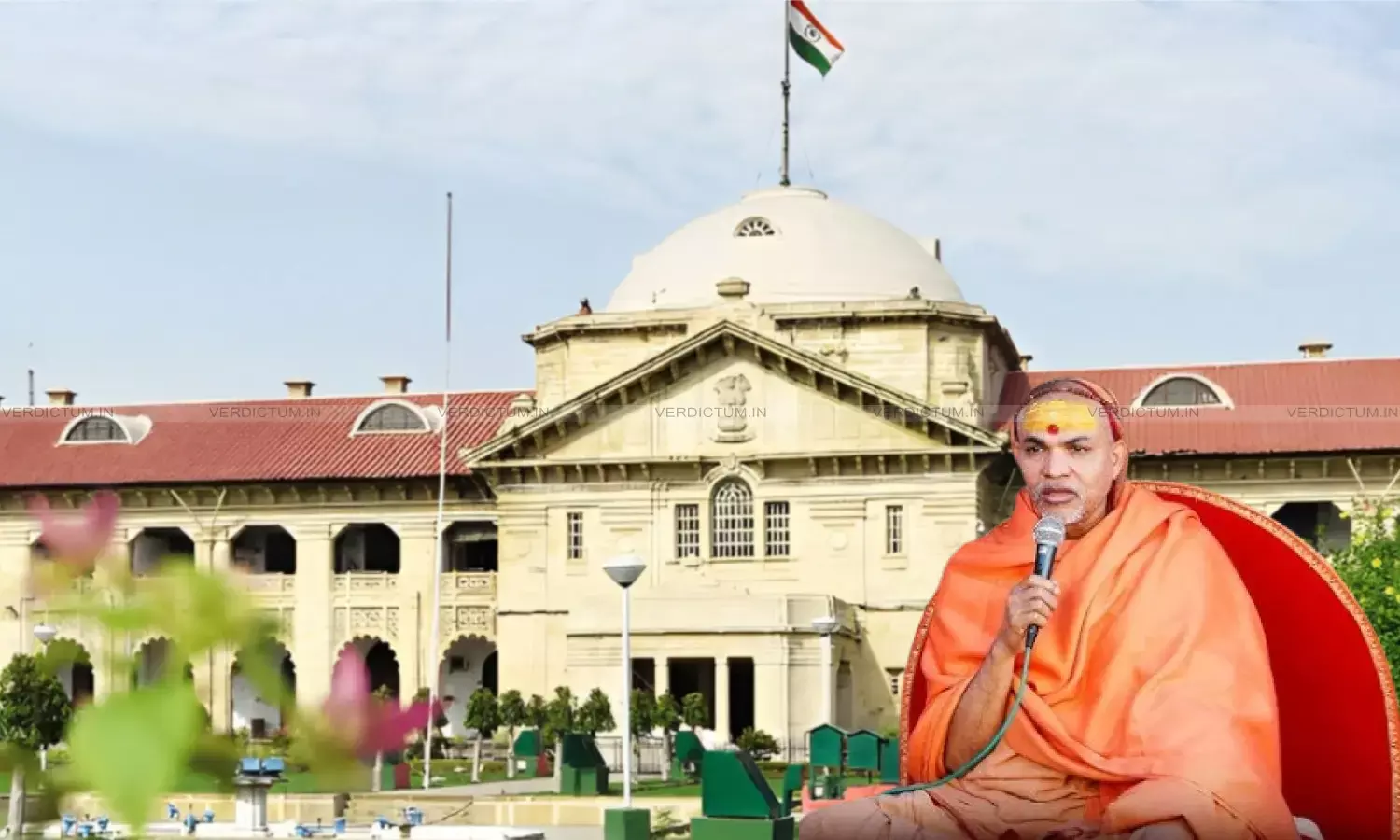
The Allahabad High Court has held that no law has been laid down by the Supreme Court to the effect that the presumption under Section 29 of the POCSO Act applies at the stage of pre-arrest bail or bail, while granting anticipatory bail to Swami Avimukteshwaranand Saraswati Jagatguru Shankaracharya Jyotishpeethadheeshwar and a co-accused.
The Court was hearing an application under Section 482 BNSS seeking anticipatory bail in a case registered at Police Station Jhunsi, District Prayagraj, under Section 351(3) of the BNS and Sections 5(1), 6, 3, 4(2), 16 and 17 of the POCSO Act.
A Bench of Justice Jitendra Kumar Sinha, while allowing the bail application, observed: “Learned Additional Advocate General has placed reliance on the judgment of Hon'ble Supreme Court in State of Bihar Vs. Rajballav Prasad alias Rajballav Prasad Yadav alias Rajballabh Yadav (2017) 2 Supreme Court Cases 178, in which the issue was whether the grant of second bail by a Division Bench of the High Court, soon after the first bail application was rejected by another Bench, the same was justified or not. The facts of the above case relate to the offences under the POCSO Act, and the Hon'ble Supreme Court in paragraph 22 of the judgement has held that the case was at the stage of trial and the witnesses were being examined by the learned trial Court. The Hon'ble Supreme Court has not laid down any law that presumption under Section 29 of the POCSO Act can be invoked at the stage of pre-arrest bail before framing of charge”.
The applicants were represented by Senior Advocate Dilip Kumar, while the respondents were represented by Manish Goyal, learned Additional Advocate General.
Background
The anticipatory bail application arose from FIR No. 58 of 2026, lodged pursuant to an order of the Special Judge (POCSO) Act, Prayagraj, passed on an application under Section 173(4) BNSS moved by the first informant. The allegations in the FIR related to offences under the BNS and the POCSO Act.
On behalf of the applicants, it was argued that the FIR had been lodged belatedly, that the alleged victims were never students of the ashram of applicant no. 1, and that there were material improvements in their subsequent statements with regard to the period and place of occurrence.
It was also contended that the victims had not initially been placed in proper custody, had remained in the company of the first informant, and had later been interviewed by media channels. Further submissions were made that one of the victims had attained majority during the period described in the FIR, that the medical opinion was inconclusive, and that the applicants had been falsely implicated.
The State and the first informant opposed the plea. A preliminary objection was raised to the maintainability of the application on the ground that the applicants had approached the High Court directly without first moving the Sessions Court. On merits, it was contended that the allegations were grave, that the victims had supported the allegations in their statements, that the applicants were influential, and that the grant of anticipatory bail would adversely affect the investigation and trial. Reliance was also placed on Section 29 of the POCSO Act.
Court’s Observation
The Court first addressed the objection to maintainability. It noted that Section 482 BNSS confers concurrent jurisdiction on the High Court and the Court of Session to entertain anticipatory bail, though judicial pronouncements ordinarily require an applicant to first approach the Sessions Court.
The Court referred to the five-Judge Bench decision in Ankit Bharti v. State of U.P., as well as the Supreme Court rulings in Manjeet Singh v. State of Uttar Pradesh and Mohammed Rasal C. v. State of Kerala, and held that in extraordinary circumstances, the High Court may be approached directly.
In fact, the Court found such circumstances to exist because the FIR itself had been directed to be registered by the Special Judge (POCSO) Act, who was of the rank of Additional Sessions Judge. Referring to Harshad S. Mehta v. State of Maharashtra, the Court held that the Special Judge acts in dual capacity as Magistrate and Sessions Court. It was therefore concluded that the preliminary objection was not sustainable.
The Court found that the victims were said to have informed the first informant of the incident on 18.01.2026, but the first information about the alleged offence was given to the police on 24.01.2026. The explanation assigned was that the first informant had been engaged in “Pooja / Yagya.”
The Court further noted that the first informant had already lodged another complaint on 21.01.2026 relating to an offence under Section 109 and other provisions of the BNS, but had not disclosed the present allegations in that complaint.
The Court considered this sequence significant and treated the delay, coupled with the omission in the earlier complaint, as one of the circumstances requiring greater caution at the anticipatory bail stage.
The Court noted that the victims had remained in constant company of the first informant and had not been made over to proper custody or to the custody of their parents before 25.02.2026. It also recorded that, after registration of the FIR, the victims had been interviewed by leading Hindi news channels. The Court described this as “highly condemnable and deplorable in the facts and circumstances of the case and not consistent with law and procedure related to POCSO cases.” The Court treated this aspect as material while evaluating the surrounding facts and the manner in which the prosecution's version had developed.
The Court found discrepancies between the FIR and the subsequent statements of the victims. According to the FIR, the period of occurrence was from January 2025 to February 2026, that is, Mahakumbh 2025 to Magh Mela 2026, and the place of occurrence was Prayagraj. However, in their statements recorded after registration of the FIR, the victims stated that incidents had taken place since June 2024 in different ashrams of applicant no. 1, including Narsinghpur and Badrinath.
The Court also noticed that one victim’s educational certificate showed his date of birth as 01.08.2006, which meant that, on the dates of occurrence stated in the FIR, he was a major, though he would have been a minor in June 2024 as stated in his later version. The Court treated these changes as material improvements.
The Court noted that the victims were institutional students of a Sanskrit school and not students of schools run by the ashram of applicant no. 1, as was evident from their educational records. This circumstance was included by the Court among the factual features relevant for deciding the anticipatory bail application.
Concerning the medical material, the Court noted that the doctor had opined that sexual assault could not be ruled out, but had found no external injury on the persons of the victims. The Court further observed that the doctor had not indicated the basis on which such an opinion had been given, and noted the submission that, according to medical jurisprudence, signs of sexual assault ordinarily do not survive after a delay of around 40 days, especially in cases of penetrative sexual assault involving the mouth. The Court also noted that the FSL report had been sought and that no conclusive finding had been given by the doctor. The Court additionally recorded that the applicants had not been medically examined, which it noted is required in cases involving sexual assault.
A central issue in the case was the State’s reliance on Section 29 of the POCSO Act. After considering the Supreme Court decision in Sumitha Pradeep v. Arun Kumar C.K., the Court held that the judgment did not lay down that the presumption under Section 29 applies at the stage of pre-arrest bail or bail. The Court specifically noted that, in Sumitha Pradeep, the Supreme Court had itself said, “We are not going into the issue of Section 29 of the POCSO Act in the present case.”
The Court also considered State of Bihar v. Rajballav Prasad, and held that it was a case arising at the trial stage, where witnesses were being examined, and that it did not lay down that Section 29 could be invoked at the stage of pre-arrest bail before framing of charge.
The Court then referred to the Delhi High Court decision in Dharmander Singh @ Saheb v. State (Govt. of NCT of Delhi) and the coordinate Bench ruling in Monish v. State of U.P., both of which held that the presumption under Section 29 cannot be invoked before framing of charge. Quoting from Dharmander Singh, the Court noted, “if a bail plea is being considered before charges have been framed, Section 29 has no application; and the grant or refusal of bail is to be decided on the usual and ordinary settled principles.”
The Court also dealt with the objection that applicant no. 1 had not filed his own affidavit and that the supplementary affidavit had been filed by a stranger. It held that procedural laws are handmaidens of justice and not meant to defeat their ends, and since applicant no. 2 had filed an affidavit stating that he was doing pairavi on behalf of applicant no. 1, the application could not be thrown out on that ground alone.
As to the extensive submissions on whether applicant no. 1 was the real or disputed Shankaracharya of Jyotishpeeth, the Court held that it was not required to adjudicate that issue in the anticipatory bail proceedings, and that it was concerned only with the allegations in the FIR, the material collected during the investigation, and the surrounding facts. It further held that nothing was found in the media interviews of applicant no. 1 to show that they would create fear in the minds of the victims, while noting again that the victims themselves had been interviewed by leading Hindi news channels.
Conclusion
On the aforementioned basis, the Court concluded that the preliminary objection to direct maintainability before the High Court was not sustainable in the facts of the case, and further held that no law had been laid down by the Supreme Court, making the presumption under Section 29 of the POCSO Act applicable at the stage of pre-arrest bail. Taking into account the overall factual matrix, the Court found that a case for anticipatory bail had been made out.
Accordingly, the anticipatory bail application was allowed. The Court directed that, in the event of arrest, the applicants be released on anticipatory bail on furnishing personal bonds of ₹50,000 each with two sureties each in the like amount, subject to conditions that they would not tamper with evidence, would not make any inducement, threat or promise to persons acquainted with the facts, would cooperate during trial, would not leave India without prior permission of the court concerned, and that the applicants, victims and first informant would not give any media interviews regarding the case during pendency of investigation or trial.
The prosecution was left at liberty to seek cancellation of anticipatory bail in case of breach of any condition.
Cause Title: Swami Avimukteshwaranand Saraswati Jagatguru Shankaracharya Jyotishpeethadheeshwar And Another v. State of U.P. And 5 Others (Neutral Citation: 2026:AHC:61379)
Appearances
Applicants: Senior Advocates Dilip Kumar & Prakash, with Rajrshi Gupta, Sudhanshu Kumar, Varad Nath, Advocates.
Respondents: Manish Goyal, Additional Advocate General; Patanjali Mishra, Government Advocate; Roopak Chaubey, AGA I; Reena N. Singh, Advocate.