

Magistrate Can’t Ignore IO’s Closure Report After Taking Cognizance; Proceeding Further Without Considering Such Report Amounts To Procedural Illegality: Allahabad High Court
The Allahabad High Court was considering a criminal appeal filed under Section 14-A(1) Scheduled Castes & Scheduled Tribes (Prevention of Atrocities) Act seeking setting aside of the impugned order passed by Special Judge SC/ST Act.

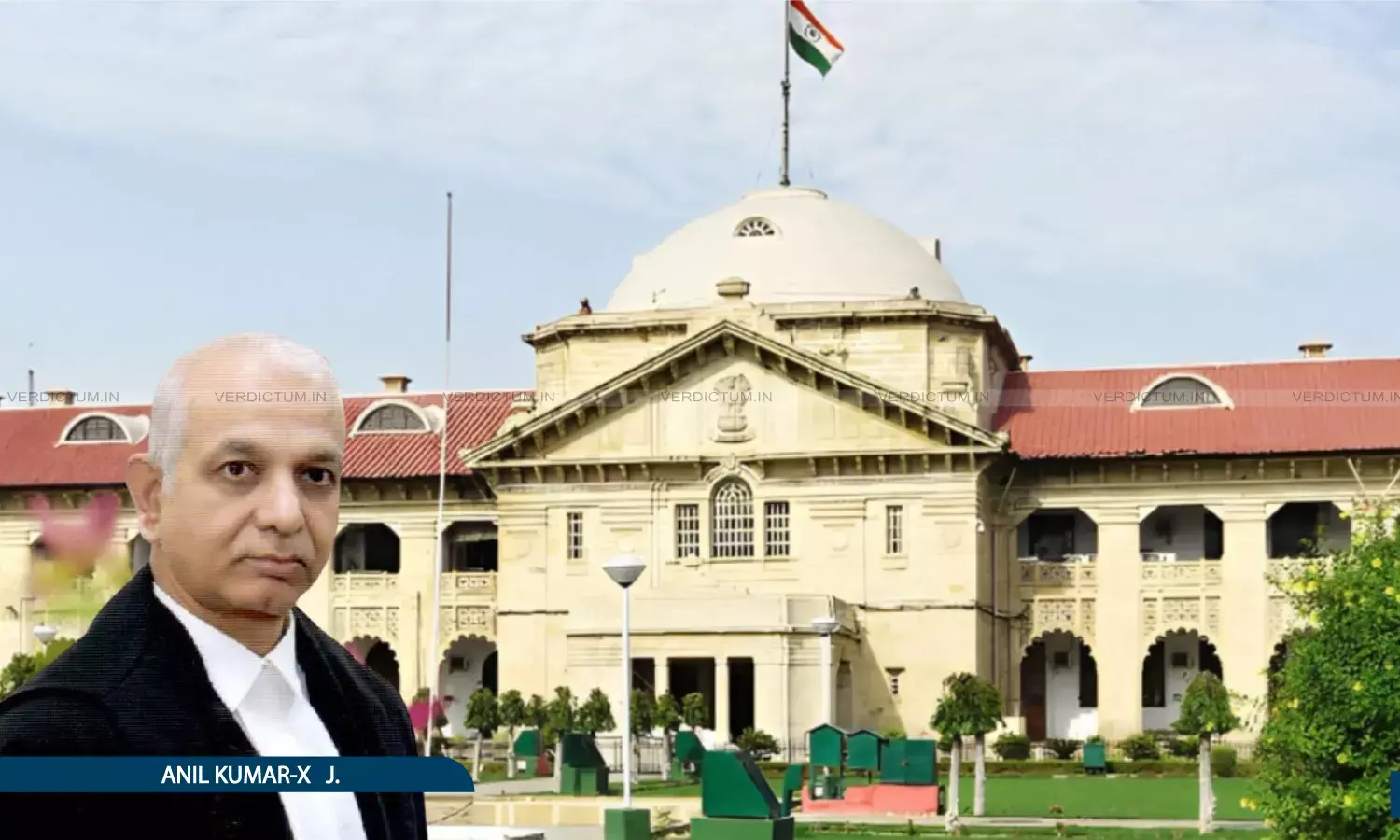
Justice Anil Kumar-X, Allahabad High Court
The Allahabad High Court has explained that if a Magistrate has taken cognizance of an offence and, thereafter, the Investigating Officer submits a Final Report (closure report) stating that no case is made out, the Magistrate cannot ignore that report.
The High Court was considering a criminal appeal filed under Section 14-A(1) Scheduled Castes & Scheduled Tribes (Prevention of Atrocities) Act seeking setting aside of the impugned order passed by Special Judge SC/ST Act in a case registered under Sections 147, 452, 323, 504, 506 of the IPC and 3(1)(d) SC/ST Act.
The Single Bench of Justice Anil Kumar-X held, “Therefore, it becomes abundantly clear that if a Magistrate has taken cognizance of an offence and, thereafter, the Investigating Officer submits a Final Report (closure report) stating that no case is made out, the Magistrate cannot ignore that report. He is legally bound to consider the Final Report and pass an appropriate order on it. He may accept it, reject it, or take cognizance despite it but he must apply his judicial mind to the report. If the Magistrate proceeds further in the case without considering the Final Report at all, such inaction amounts to a procedural illegality.”
Advocate D.K.Tripathi represented the Appellant, while Government Advocate represented the Respondent.
Factual Background
An FIR was filed against the appellants under Section 147, 452, 323, 504, 506 of the IPC and 3(1)(d) of the SC/ST Act. The Matter was investigated, and the I.O. submitted a charge sheet against the appellants. The Court took cognizance and as the investigation was still under progress, a supplementary report was filed under Section 173(2) Cr.P.C., which was submitted by I.O., concluding that the allegations against the appellants were found false. A final report was submitted by I.O. subsequent to the order of taking cognizance upon the charge-sheet.
Arguments
It was the case of the appellants that the proceedings under Section 228 of the CrPC were carried out without considering the final report. As per the appellants, it was incumbent for the court to pass appropriate orders on the final report dated March 31, 2024, before framing charges against the appellants on August 7, 2025.
Reasoning
The Bench, at the outset, explained the procedure provided by the Cr.P.C. regarding the powers which a Magistrate is bound to exercise after submission of a report under Section 173 (2) Cr.P.C. The Bench explained that a Magistrate has several distinct options upon submission of police report and those options include accepting the report and taking cognisance or rejecting the Report (Closure or Final Report).
As per the Bench, an investigating officer may complete the entire investigation at once. If he does, he must submit a police report. However, I.O by virtue of Section 173(8) Cr.P.C has a broad power to continue the investigation even after submitting initial report (known as a charge sheet or final report). If he later discovers new evidence or facts directly related to and crucial for the case, he can conduct further investigation and file another police report. “The act of taking cognizance of an offense is not finalized by the submission of an initial report. The investigating officer's duty to pursue the investigation to its logical conclusion continues beyond the "primary report." Just as the Investigation Officer must continue their investigation until a final logical conclusion is reached, the Magistrate's obligation persists until the police submits their final conclusive report. Consequently, the Magistrate is duty-bound to exercise judicial mind and consider all police reports submitted during the investigation of a single case”, it added.
On a perusal of the judgments of the Apex Court, the Bench noted that if a Final Report is submitted by the police after the submission of the charge sheet upon which the Magistrate has already passed an order taking cognizance, he will have to pass another order on the Final Report after applying his judicial mind to the contents available in both reports. He will have to assess both the reports conjointly for arriving at a conclusion. He has the same options as are available at the time the "primary report" under Section 173(2) Cr.P.C. is placed before him, namely, to issue process by taking cognisance, accept the Final Report and drop proceedings, or direct further investigation.
The Bench thus enumerated the following points:
- Every supplementary report under Section 173(2) Cr.P.C. is not different from the initial report (primary report) filed by the I.O.
- Though the Magistrate is empowered to take cognizance upon a police report only once, if supplementary police reports are filed, he must treat such supplementary reports as an integral part of the primary (initial) report under Section 173(2) Cr.P.C.
- The primary report (initial report) and all further supplementary must be read conjointly before reaching any conclusion.
- On every supplementary report, a Magistrate/Court is bound to apply his mind independently, without being influenced by his earlier order of taking cognizance upon primary report (initial report/charge sheet).
- If a Magistrate, after applying his judicial mind to the supplementary report, arrives at a conclusion contrary to his earlier decision of taking cognizance on the charge sheet (primary report), the recording of such a contrary opinion will not amount to a review or recall of his earlier order.
Thus, allowing the appeal and setting aside the impugned order, the Bench directed the Trial Court first to consider the final report and pass an order after considering both the initial report (charge sheet) and the final report.
Cause Title: Sonu And 5 Others v. State of U.P. and Another (Neutral Citation: 2026:AHC:32574)
Appearance
Appellant: Advocate D.K.Tripathi
Respondent: Government Advocate, Manoj Kumar Srivastava