

Confession In Police Custody Inadmissible Even If It Was Made Before Registration Of FIR: Allahabad High Court
Holding that the embargo under Section 26 of the Evidence Act extends to confessions made by a suspect while in police custody, even before the registration of an FIR, the Court ruled that such statements are inadmissible unless made in the immediate presence of a Magistrate.
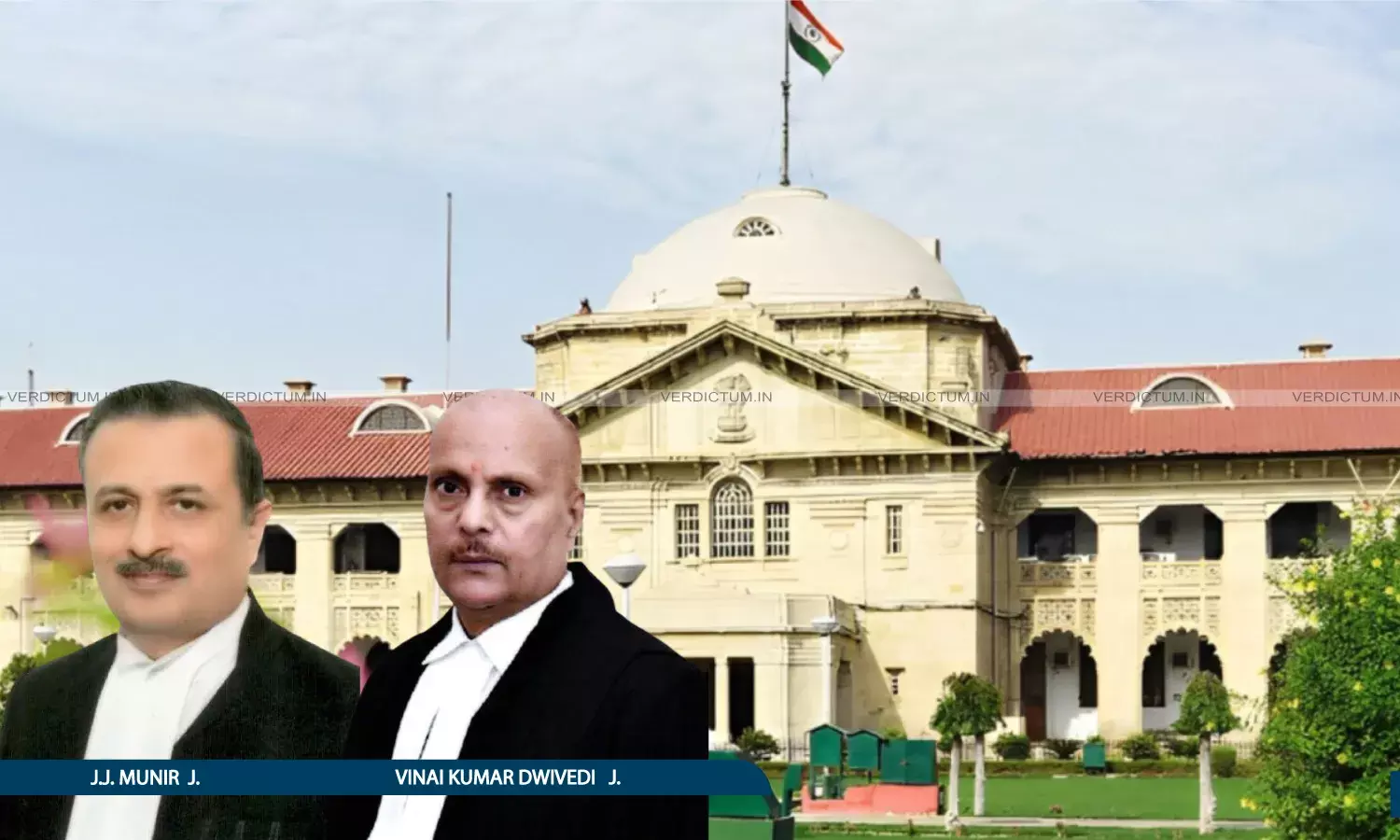
The Allahabad High Court, while clarifying the distinction between Sections 25 and 26 of the Indian Evidence Act, observed that the embargo under Section 26 is wider in scope and applies even where a person, though not formally accused or named in an FIR, is in police custody.
The Court held that an extrajudicial confession allegedly made while in police custody, even before the registration of the FIR, is inadmissible unless made in the immediate presence of a Magistrate.
A Division Bench of Justice J.J. Munir and Justice Vinai Kumar Dwivedi observed: “There is a distinction between a confession made to a police officer and a confession made by a person while in the custody of a police officer. The former is governed by Section 25 of the Evidence Act and the latter by Section 26. The confession referred to under Section 26 may be made to any person other than a police officer, but while in the custody of one, whereas that under Section 25 is necessarily one made to a police officer. The confession under Section 26 may be made to any other person while in police custody, or may be to a police officer himself, but in the custody of the Police. The scope of Section 26 is wider because the embargo there applies to the case of a person, who is in the legal sense of the term not yet accused of an offence, but in the custody of the Police, which may be as a suspect pending ascertainment of facts or the formal registration of a crime”.
Background
The prosecution's case was that the deceased male victim was a tenant in the appellants’ house. It was alleged that he had an illicit relationship with the appellants’ minor daughter, who was found to be pregnant. On the intervening night, both the deceased and the minor girl were found dead inside a room situated within the appellants’ premises.
The case rested entirely on circumstantial evidence. The prosecution relied on motive, telephonic conversations allegedly made on the night preceding the deaths, medical evidence pointing to death by strangulation, and an alleged extrajudicial confession made by one of the appellants.
The trial court accepted the prosecution's case and convicted both accused persons.
Court’s Observation
The High Court first examined whether the deaths were homicidal or suicidal. Relying on medical evidence and authoritative medical jurisprudence, the Court held that strangulation is ordinarily homicidal in nature and that suicidal strangulation is rare and requires the presence of a contrivance to maintain pressure until death. No such contrivance was found at the scene.
The Court concluded that the deaths were homicidal and occurred within a room forming part of the appellants’ premises. In such circumstances, the burden under Section 106 of the Evidence Act lay on the appellants to explain the circumstances leading to the deaths.
The alibi set up by the appellants was found unconvincing. The Court held that the explanation offered did not inspire confidence and that their failure to satisfactorily explain the circumstances constituted a significant link in the chain of circumstantial evidence.
A crucial issue before the Court was whether an alleged extrajudicial confession made by one of the appellants could be relied upon.
The prosecution witnesses stated that when they arrived at the scene, one of the accused confessed to having committed the murders. However, the evidence also showed that at that time, the accused had already been apprehended by the police and was under their control, although the FIR was registered later that day.
The State contended that since the FIR had not yet been registered, Section 25 of the Evidence Act would not be attracted.
Rejecting the State’s submission, the High Court examined the distinction between Sections 25 and 26 of the Evidence Act and clarified that the two provisions operate in different fields. It held that while Section 25 concerns confessions made to a police officer, Section 26 deals with confessions made by a person who is in police custody, regardless of to whom the confession is made.
The Court further explained that Section 26 has a wider scope, as it applies even where the person is not yet formally accused of an offence but is in police custody as a suspect, pending investigation or even before the registration of an FIR.
The Bench accordingly concluded that the accused “apparently being in police custody, the extrajudicial confessions attributed to her cannot be read against her, unless these were in the immediate presence of a Magistrate, which is not the case here.”
Accordingly, the alleged extrajudicial confession could not be relied upon as a circumstance against the appellants.
Conclusion
Upon an overall appraisal of the circumstances on record, the High Court held that the prosecution had succeeded in establishing a complete and unbroken chain of circumstances consistent only with the guilt of the appellants.
The Court affirmed the conviction of the appellants under Section 302/34 IPC and held that the sentence of life imprisonment awarded by the trial court was the minimum prescribed and appropriate in the facts of the case.
Accordingly, both criminal appeals were dismissed. The appellant, who was on bail, was directed to surrender within two weeks, failing which the Chief Judicial Magistrate concerned was directed to secure her custody and commit her to prison to serve out the sentence. Her bail bonds were cancelled and the sureties discharged.
Directions were also issued for communication of the order to the appellant in custody through the Jail Superintendent, and for forwarding a copy of the judgment along with the lower court record to the trial court for compliance.
Cause Title: Smt. Seema Gupta v. State of U.P. (Along with connected appeal) (Neutral Citation: 2026:AHC:31529-DB)
Appearances
Appellants: Shweta Singh Rana, Advocate
Respondents: Anil Kumar Mishra, Additional Government Advocate
