High Courts Competent Courts For Enforcement Of Domestic Awards In International Commercial Arbitration U/S 36 A&C Act: Allahabad High Court
The High Court held that, irrespective of whether the Arbitration and Conciliation Act, 1996 or the Commercial Courts Act, 2015, applies, an application under Section 36 for enforcement of a domestic arbitral award arising out of an international commercial arbitration lies only before the High Court.
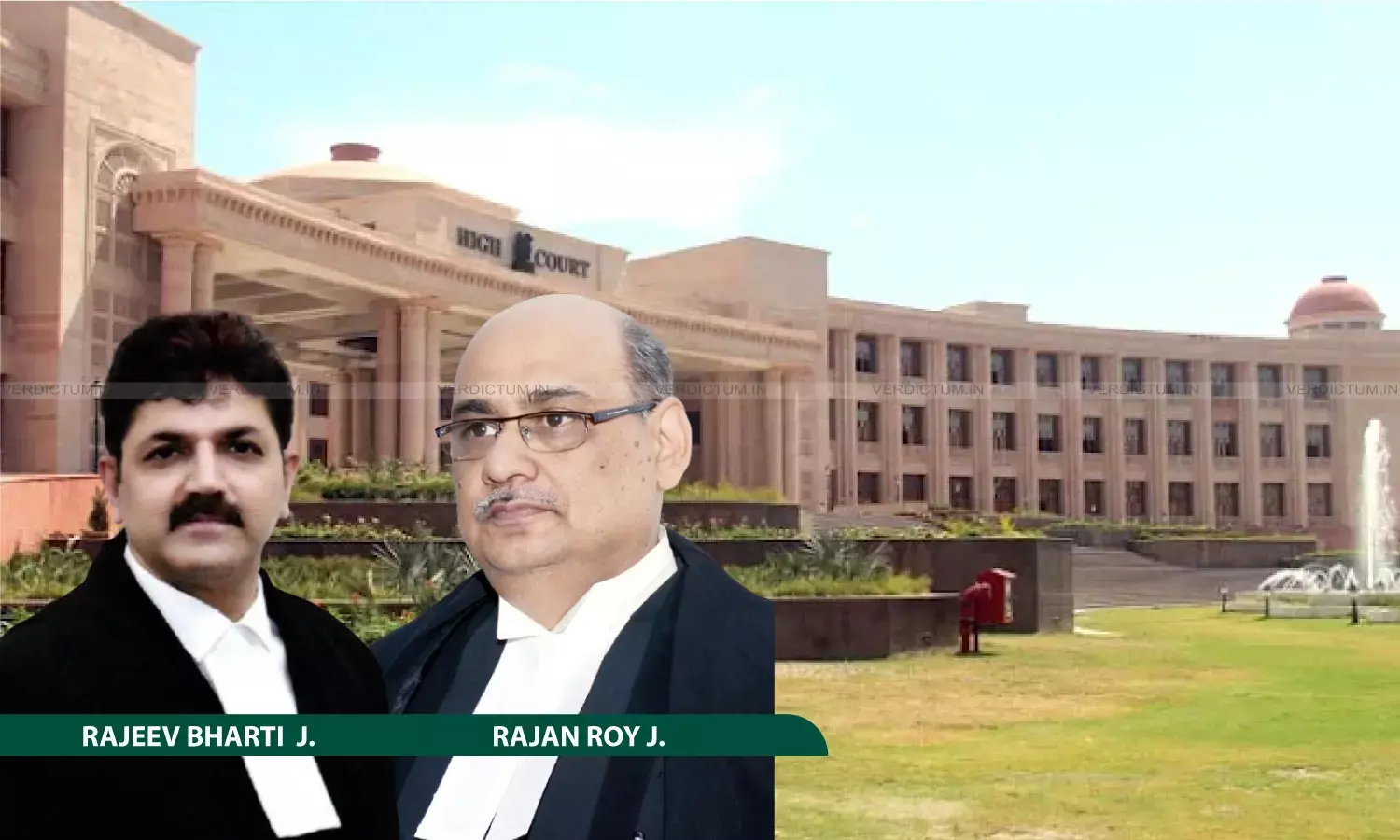
Justice Rajeev Bharti, Justice Rajan Roy, Allahabad High Court (Lucknow Bench)
The Allahabad High Court has clarified that the High Court alone is the Court competent to entertain an application under Section 36 of the Arbitration and Conciliation Act, 1996, for the enforcement of a domestic arbitral award arising out of an international commercial arbitration.
The Court held that such jurisdiction flows directly from the definition of “Court” under Section 2(1)(e)(ii) of the Arbitration and Conciliation Act, 1996, read conjointly with Section 36 thereof and Section 10 of the Commercial Courts Act, 2015.
The Court was hearing a special appeal challenging an order passed by the Commercial Division of the High Court rejecting objections to the maintainability of execution proceedings initiated under Section 36 of the Act of 1996.
A Division Bench comprising Justice Rajan Roy and Justice Rajeev Bharti, upon hearing the matterm observed: “…in either eventuality, where it is the Act 1996 or the Act 2015, it is the High Court which is the 'Court' for filing an application under Section 36 of the Arbitration and Conciliation Act, 1996 for enforcement of a domestic award pertaining to an international commercial arbitration”.
Senior Advocate Pritish Kumar appeared for the appellants. Advocate Pankaj Kumar Singh appeared for the respondents.
Background
The dispute arose out of an arbitral award rendered in an international commercial arbitration, the seat of arbitration being in India. It was not disputed that the award was a domestic award, albeit one rendered in the context of an international commercial arbitration as defined under Section 2(1)(f) of the Arbitration and Conciliation Act, 1996.
The respondents initially applied Section 36 of the Act of 1996 before the District Commercial Court for enforcement of the award. Upon an objection regarding maintainability, the respondents withdrew the said application and filed a fresh application before the Commercial Division of the Allahabad High Court at Lucknow.
The learned Single Judge rejected the objection raised by the appellants regarding maintainability and held that the High Court was the competent forum for enforcement. Aggrieved, the appellants filed the present special appeal under Chapter VIII Rule 5 of the Allahabad High Court Rules, 1952.
Court’s Observation
At the outset, the Division Bench held that the special appeal was maintainable, as the order under challenge had been passed by the learned Single Judge in exercise of original jurisdiction under the Commercial Courts Act, 2015, read with the Arbitration and Conciliation Act, 1996, and was not covered by the exclusionary clause under Chapter VIII Rule 5.
On merits, the Court noted that Section 36 of the Arbitration and Conciliation Act, 1996 provides the manner of enforcement of an arbitral award, treating it as a decree of the Court, but does not specify the forum before which such enforcement must be sought. The determination of the competent forum, therefore, necessarily required reference to the definition of “Court” under Section 2(1)(e) of the Act.
The Court emphasised that Section 2(1)(e) draws a clear distinction between arbitrations other than international commercial arbitration and international commercial arbitration. In cases of international commercial arbitration, Section 2(1)(e)(ii) defines “Court” to mean “the High court in exercise of its ordinary original civil jurisdiction having jurisdiction to decide the question forming the subject matter of the arbitration if the same had been the subject matter of a suit, and in other cases, a High court having jurisdiction to hear the appeals from decrees of Courts subordinate to that High Court”.
The Bench held that since the Allahabad High Court does not exercise ordinary original civil jurisdiction, the latter limb of Section 2(1)(e)(ii) squarely applied, making it the competent Court for enforcement.
The Court rejected the appellant’s contention that enforcement must lie before the District Commercial Court merely because execution of decrees under the Code of Civil Procedure ordinarily takes place before district courts. It held that Section 36 cannot be read in isolation and must be interpreted harmoniously with Section 2(1)(e)(ii).
Addressing the reliance placed on the explanation to Section 47 of the Act of 1996 (introduced by the 2016 amendment), the Court held that Section 47 falls under Part II, which exclusively deals with foreign awards. The explanation inserted therein, the Court held, cannot be used to draw any inference regarding the enforcement of domestic awards under Part I of the Act.
The Bench reiterated that Part I and Part II of the Act operate in distinct fields, as authoritatively settled by the Constitution Bench in Bharat Aluminium Company v. Kaiser Aluminium Technical Services Inc. and the three-Judge Bench decision in PASL Wind Solutions Pvt. Ltd. v. GE Power Conversion India Pvt. Ltd.
The Court also examined Section 10 of the Commercial Courts Act, 2015 and held that sub-section (1) thereof expressly mandates that all applications arising out of international commercial arbitration filed in a High Court shall be heard by its Commercial Division. This provision, the Court held, reinforces the conclusion flowing from Section 2(1)(e)(ii) of the Act of 1996.
In light of the statutory scheme and consistent judicial precedent, the Court concluded that there is no provision under either the Arbitration and Conciliation Act, 1996 or the Commercial Courts Act, 2015 that vests jurisdiction in the District Commercial Court to enforce a domestic award arising out of an international commercial arbitration.
Conclusion
Finding no infirmity in the order passed by the learned Single Judge, the Division Bench dismissed the special appeal and upheld the maintainability of the enforcement proceedings before the Commercial Division of the High Court.
Cause Title: Shri Colonizers and Developers Pvt. Ltd. v. Abha Gupta (Neutral Citation: 2025:AHC-LKO:84193-DB)
Appearances
Appellants: Pritish Kumar, Senior Advocate; Rajeev Sharan, Amal Rastogi, Devesh Bahadur Singh, Utkarsh Srivastava, Advocates
Respondents: Pankaj Kumar Singh, Advocate; Anurag Tyagi, Advocate