

Justice Cannot Ignore Extreme Age And Decades Of Delay: Allahabad High Court Acquits 100 Year Old Accused In 1984 Murder Case
Justice cannot be divorced from human conditions; when an accused stands before the Court at the twilight of life after decades of delay, penal insistence risks becoming ritual rather than justice, the Allahabad High Court held while acquitting a centenarian accused.
The Allahabad High Court has held that criminal justice must remain anchored in human realities, observing that where guilt is not proved beyond a reasonable doubt, and the accused has endured decades of litigation into extreme old age, continued penal consequences would undermine fairness and dignity.
The Court made these observations hearing a criminal appeal arising from a conviction recorded by the Sessions Court in a murder prosecution dating back to the mid-1980s, ultimately setting aside the conviction in the decades-old murder case and acquitting the centenarian accused of all charges.
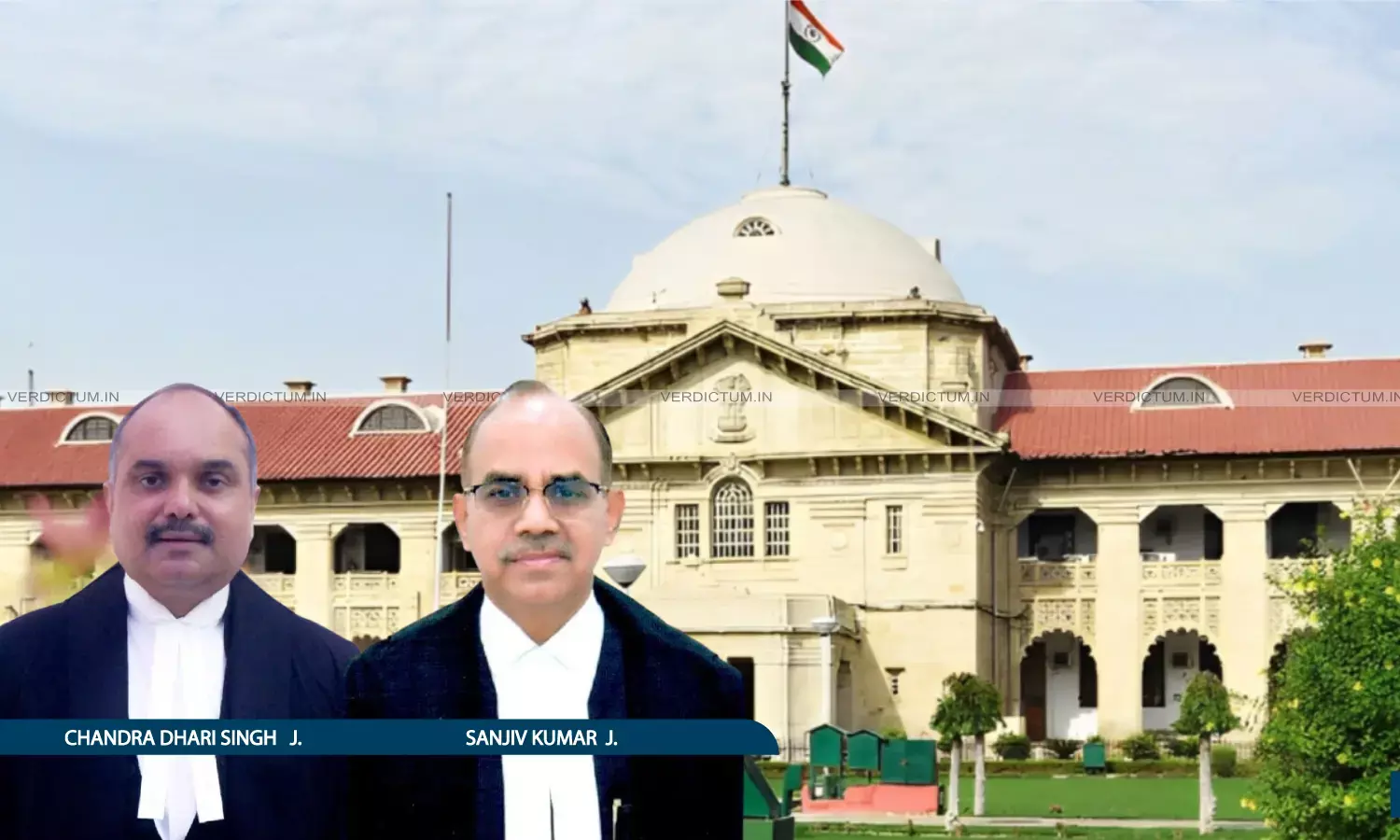
A Bench of Justice Chandra Dhari Singh and Justice Sanjiv Kumar, while examining the evidence and the extraordinary delay in adjudication, emphasised: “Justice is not an abstraction divorced from human conditions. The law cannot be oblivious to the reality that advancing age brings with its physical fragility, dependence and a narrowing horizon of life. When a person stands before the Court at the twilight of existence, the insistence on penal consequences, after decades of procedural delay, risks transforming justice into a ritual divorced from the purpose it intends.”
Background
The prosecution's case arose from an incident in which the accused was alleged to have assaulted the deceased with weapons. The Sessions Court convicted the appellants of murder. One of the appellants challenged the conviction on appeal and remained on bail during the pendency of proceedings, which extended for nearly four decades.
During appellate consideration, it was undisputed that the appellant had reached approximately one hundred years of age and was physically frail. The defence argued that the evidence did not establish guilt beyond a reasonable doubt and that the prolonged pendency, coupled with advanced age, required a cautious and humane judicial approach. The State defended the conviction but acknowledged the appellant’s age.
The High Court re-examined the testimonial evidence, medical material, and surrounding circumstances to determine whether the prosecution had discharged its burden.
Court’s Observations
The Court first assessed the credibility of eyewitness testimony and found that the evidence did not inspire confidence sufficient to sustain a conviction. It held that criminal guilt must be proved beyond a reasonable doubt and that deficiencies in the prosecution's case could not be cured by presumption. On a careful evaluation, the Bench concluded that the evidentiary foundation was inadequate to uphold the finding of guilt.
The Court then addressed the broader context of delay and the appellant’s extreme age. It observed that the passage of time is not a mere procedural irregularity but a factor that bears directly upon fairness. The Bench noted: “Delay of such magnitude is not a mere administrative lapse, rather it becomes a substantive factor affecting fairness. A criminal process that stretches across generations ceases to be only a mechanism of accountability and assumes, in itself, the character of punishment.”
The Court further held that constitutional guarantees of fair procedure extend through the entire lifecycle of a criminal case, including appeal. Where the justice system fails to deliver finality within a reasonable time, courts are justified in tempering relief with humane considerations:
“The constitutional promise of fair and reasonable procedure does not end with trial. It permeates the entire life cycle of a criminal case, including appeal. When the system itself has been unable to deliver finality within a reasonable time, Courts are justified in adopting a tempered, human approach while fashioning relief”, the Bench remarked.
The Bench emphasised that “Ultimately, the legitimacy of criminal justice lies not in the severity of its outcomes but in their moral coherence… the only outcome consistent with justice, fairness, and human dignity is complete exoneration…”
The Court also referred to judicial precedent recognising that extreme age and extraordinary delay are relevant mitigating considerations in criminal appeals. It held that prolonged pendency, liberty on bail for decades, and advanced age together justified moulding relief in favour of acquittal, particularly where the evidentiary standard had not been satisfied.
Conclusion
Allowing the appeal, the High Court set aside the Sessions Court conviction and acquitted the appellant of all charges, holding that the prosecution failed to establish guilt beyond a reasonable doubt. The Court directed that the appellant’s bail bonds stand discharged and ordered the return of the trial court record.
Cause Title: Satti Din & Another v. State of Uttar Pradesh (Neutral Citation: 2026:AHC:22625-DB)
Appearances
Appellant: Advocates Ram Bahadur, Ramesh Prajapati, S.K. Srivastava
Respondents: A.G.A & D.G.A
