

Allahabad High Court Seeks Explanation From Trial Judge For Citing Non-Existent SC/ST Act Provision
A petition was filed by the accused–applicant, who asserted that he had been falsely implicated in a case under the SC/ST Act.
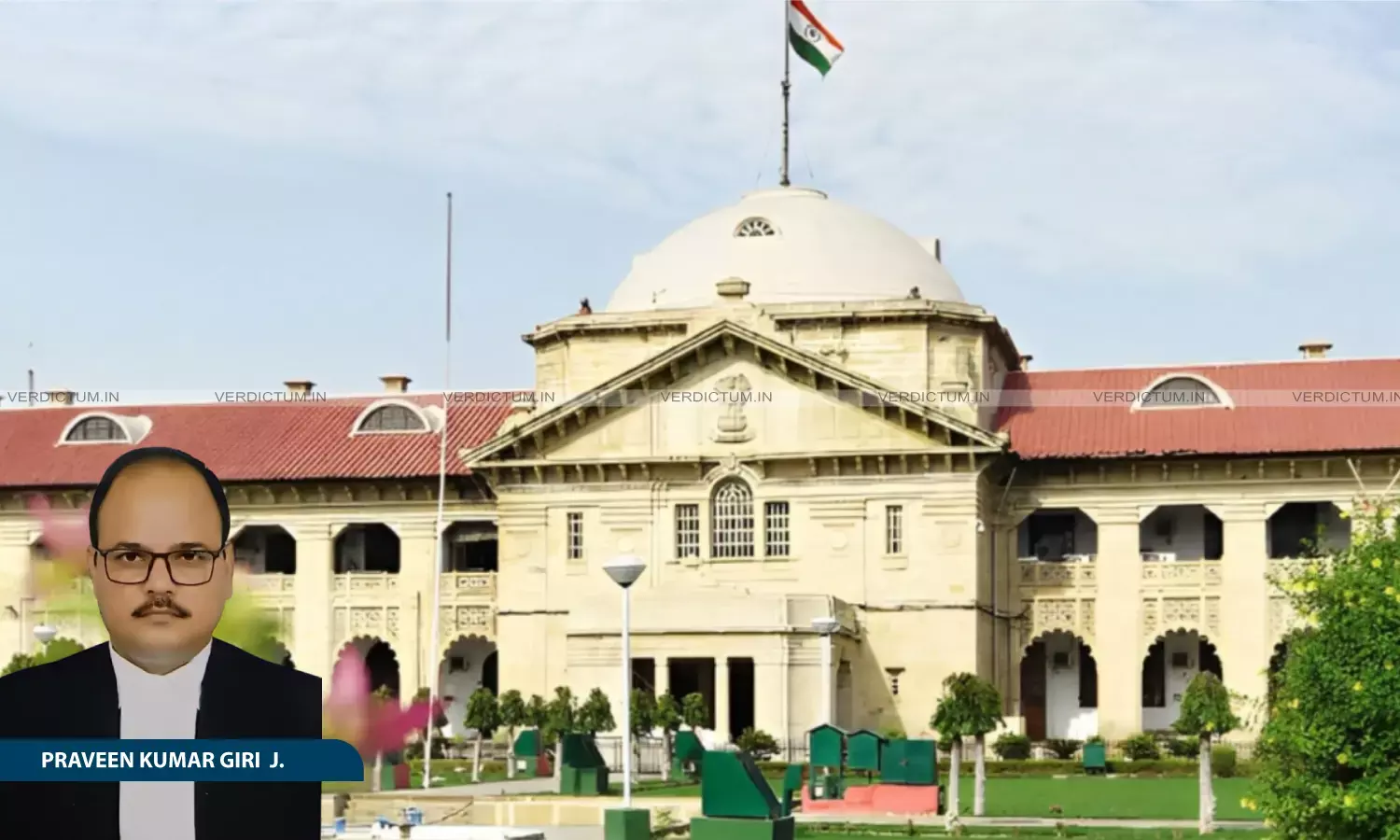
Justice Praveen Kumar Giri, Allahabad High Court
The Allahabad High Court has called for an explanation from a trial judge posted in Aligarh after it was alleged that the judge, while summoning an accused, cited a non-existent provision of the Scheduled Castes and Scheduled Tribes (Prevention of Atrocities) Act, 1989.
A Bench of Justice Praveen Kumar Giri expressed serious concern over the manner in which judicial power was exercised, observing that such casual and careless orders have grave consequences for an individual’s personal liberty.
The Court directed, “The present Special Judge, SC/ST Act, Aligarh as well as the then Special Judge, SC/ST Act, Aligarh, who passed the summoning order dated April 30, 2024, are directed to submit their explanation as to why the summoning order was passed in such a casual manner, violating the fundamental right of the applicant under Article 21 of the Constitution of India.”
Advocate Raghav Arora appeared for the Appellant.
Background
A petition was filed by the accused–applicant, who asserted that he had been falsely implicated in a case under the SC/ST Act. According to the applicant, the criminal proceedings were the outcome of a property dispute that arose after he was allotted a piece of land declared as industrial land by the Uttar Pradesh State Industrial Development Corporation (UPSIDC).
He contended that the complainant initiated criminal proceedings solely to exert pressure on him in relation to the property dispute.
The complainant had accused the applicant of committing offences under Sections 323 and 504 of the Indian Penal Code, along with offences under the SC/ST Act. On the complainant’s application, the Judicial Magistrate, Aligarh, directed the registration of an FIR.
Pursuant to the Magistrate’s order, the police registered an FIR under the relevant provisions of the IPC and the SC/ST Act and carried out an investigation concluding that no prima facie case was made out against the accused. Dissatisfied with this outcome, the complainant filed a petition challenging the closure report.
Thereafter, the Special Judge (SC/ST Act), Aligarh, treated the matter as a complaint case and proceeded to record the statements of the complainant and witnesses under Sections 200 and 202 of the Code of Criminal Procedure (CrPC). Subsequently, the Special Judge summoned the accused to face trial.
Aggrieved by the summoning order, the accused approached the Allahabad High Court, contending that the order was illegal and unsustainable. He pointed out that the trial court had invoked “Section 3(2)(5)” of the SC/ST Act, a provision that does not exist in the statute.
Finding
The High Court sought explanations not only from the trial judge(s) concerned but also called for a response from the complainant. The Court also granted interim protection to the applicant, directing that no coercive steps be taken against him in connection with the SC/ST Act case until the next date of hearing.
It further ordered that if any warrants had been issued against the applicant, the same would remain in abeyance till further orders.
The High Court ordered that the explanations be filed by January 30, 2026, the date fixed for the next hearing in the matter.
Cause Title: Rajan Bajaj v. State of Uttar Pradesh and Anr.
