

Allahabad High Court: U.P. Zamindari Abolition & Land Reforms Act Can’t Be Applied For Determining Value Of Land Under Indian Stamp Act
The Allahabad High Court said that the presumption of usage of subject matter of instrument in future for some commercial purposes cannot be the ground of invocation of the provisions of the ISA for alleged deficiency in stamp duty.
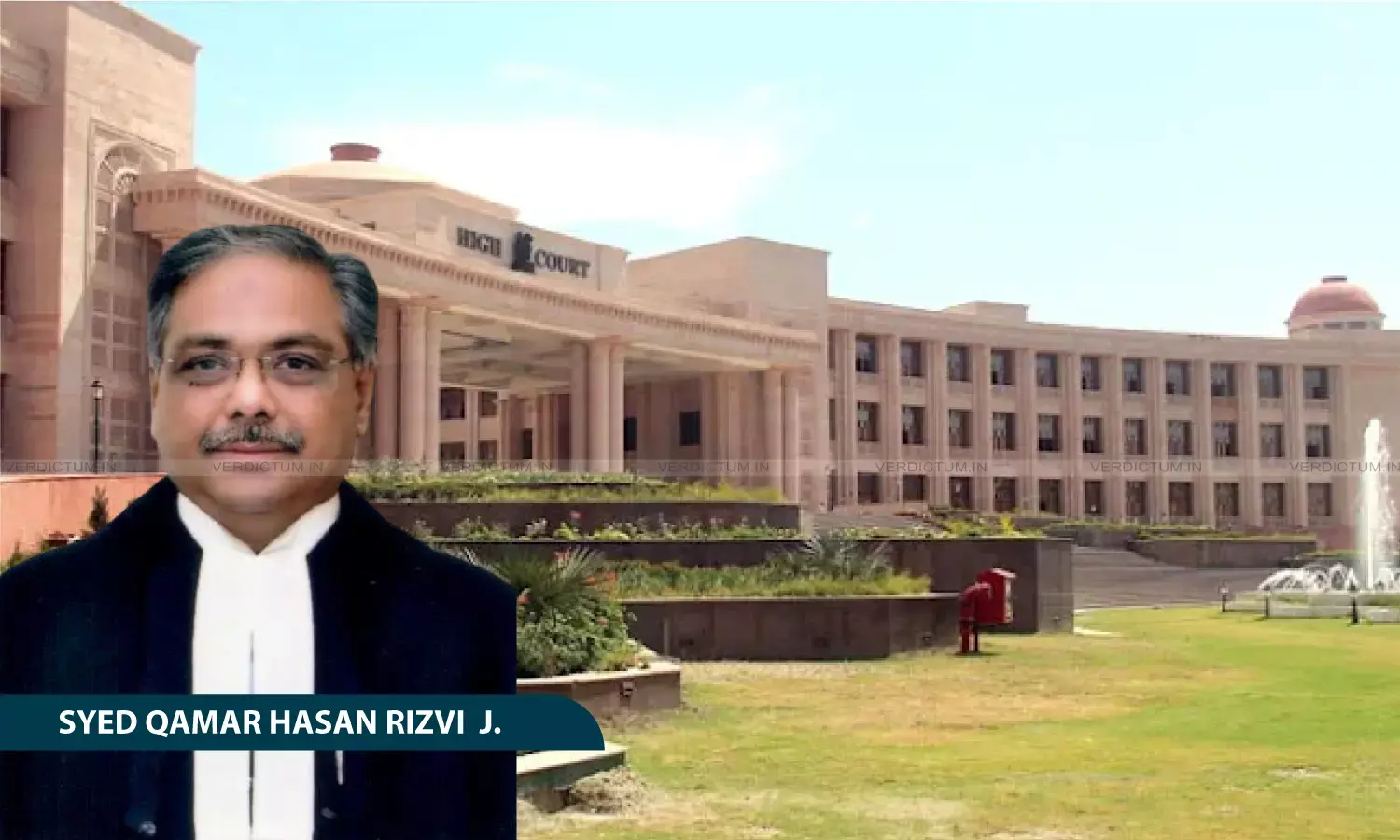
Justice Syed Qamar Hasan Rizvi, Allahabad High Court, Lucknow Bench
The Allahabad High Court has clarified that the U.P. Zamindari Abolition and Land Reforms Act, 1950 cannot be applied for determining value of the land under the Indian Stamp Act, 1899 (ISA).
The Lucknow Bench was hearing a Writ Petition challenging the Order passed by the Collector in a case under Sections 47A and 33 of ISA and the Order of the Deputy Commissioner in a case under Section 56(1) of ISA.
A Single Bench of Justice Syed Qamar Hasan Rizvi observed, “There is no doubt that the provisions of U.P. Zamindari Abolition and Land Reforms Act, 1950 encompasses different object and cannot be applied for the purpose of determination of the value of the land insofar it relates to Indian Stamp Act. Such determination is not controlled in any manner by the provisions of U.P. Zamindari Abolition and Land Reforms Act 1950. Notification under Section 143 of the U.P. Zamindari Abolition and Land Reforms Act, 1950 can at best be one of the factors for consideration at the time of determination of the market value under the Indian Stamp Act and relevant Rules as prescribed under the U.P. Stamp (Valuation of Property) Rules, 1997.”
The Bench said that the presumption of usage of subject matter of instrument in future for some commercial purposes cannot be the ground of invocation of the provisions of the ISA for alleged deficiency in stamp duty.
Advocates Surya Prakash and Arsh Bugga appeared for the Petitioner, while Additional Chief Standing Counsel (ACSC) Abhishek Kumar Pandey, Standing Counsels Suresh Chandra Kushwaha, and Mohd. Kasim appeared for the Respondents.
Factual Background
The Petitioner had purchased a plot of land and at the time of registration of the Sale Deed, she paid a stamp duty of Rs. 46 lakhs per hectare. She also paid 150% excess cost as the land was within 100 meters from the residential area and was adjoining to the village. Thus, total value of the land as calculated was Rs. 20,53,000/-. Being a lady, she paid 4% stamp duty on the amount of Rs. 10 lakhs and 5% stamp duty on the rest of the amount. Resultantly, the total stamp duty was Rs. 92,650/- The Sub Registrar Fatehpur, based on a spot inspection, submitted its Report before the Assistant I.G. Stamp mentioning therein some deficiency of stamp duty.
Therefore, a case under Sections 47A and 33 of ISA was registered and consequently, a notice was issued to the Petitioner. However, it was alleged in the Writ Petition that the same was never served upon the Petitioner. The Collector vide its Order held that the plot of land is situated at Kursi Road and at present a saw-machine / Aara machine is stalled in the southern side of the plot of land. Accordingly, a penalty of Rs. 1 lakh was imposed by holding deficiency of stamp duty amounting to Rs. 4,28,850/-. Being aggrieved, the Petitioner was before the High Court.
Reasoning
The High Court in view of the facts and circumstances of the case, noted, “The Collector even could not cite any exemplar to show that the properties adjacent or around the subject matter of instrument have been sold or purchased at the commercial rate. Thus, the findings on the basis of which the impugned deficiency of stamp duty has been determined is unsustainable.”
The Court remarked that ISA does not provide Collector to order recovery of any deficiency in the payment of 'Registration fee' and in the absence of any statutory provision, the Collector could not have passed any order for recovery of “deficiency of registration fee” in the proceedings instated under the ISA.
“Moreover, it is well-settled that penalty should not to be imposed mechanically. The authorities must apply their mind to the facts and circumstances of each case. In the present case, the Revisional Authority has committed error by affirming the order of the Collector (opposite party no.3) without independently applying its mind to the facts and circumstances of the case and without addressing the specific grounds raised by the petitioner in the revision”, it reiterated.
The Court further said that the order passed by the Deputy Commissioner does not reflect any consideration of the issues involved and the Deputy Commissioner has simply dittoed that order of the Collector in passing the impugned order and the same does not stand to reason.
“In view of the deliberations and observations made hereinabove, this Court is of the considered opinion that the impugned orders dated 04.02.2016 and 24.05.2017 suffer from serious perversity, being based merely on an ex parte spot inspection report having no support of any credible material. Value of the land has to be determined on the basis of the constructive material available before the authorities; which is completely lacking in the present case”, it added.
The Court also observed that the impugned orders are based on irrelevant presumptions and on erroneous appreciation of facts and hence, the authorities have failed to comply with the mandatory requirements of Rule 7 of the Uttar Pradesh Stamp (Valuation of Property) Rules, 1997 as the impugned order was passed without 'notice' upon the Petitioner in the manner as provided under the Rules of 1997 and without appreciation of any oral or documentary evidence by the Collector.
“… the commercial value of the subject matter of instrument has to be determined on the basis of the constructive material available before the authorities, the same is completely lacking in the present case. Treating the property as commercial merely on the basis of the report showing certain commercial activities around the subject matter of the instrument is not sufficient to treat the nature of the land as commercial, unless it is proved that its nature has undergone a change”, it enunciated.
Conclusion
Moreover, the Court remarked that the potential of the land is to be assessed on the date of execution of the instrument itself.
“It is not in dispute that at the time of the execution of the Sale-Deed, the nature of the subject matter of instrument was agricultural and in the absence of any material otherwise, the same cannot be treated as commercial. The market value of the land is required to be judged on the nature and use of the land existing on the date of purchase of the land in question and the authorities are not required to judge the use of the land which could be put to a different use in future”, it added.
The Court clarified that the deficiency of stamp can neither be determined on the value of the future use of the property nor it can be levelled on the ground that the property can fetch good market value.
“… this Court is of the considered opinion that no useful purpose would be served in remanding the matter to the authorities to pass fresh order regarding the determination of the stamp duty in respect of the instrument which was executed way back in the year 2013. The law is well settled that the value of the land in so far as it relates to Indian Stamp Act, 1899, can be determined only with reference to the date on which the document was executed and that any subsequent change in the nature or use of the land which may result in the enhancement of the market value of the property can not be taken into account. As such, if any inspection is carried out in the year 2025 or thereafter, the same would be of no use under law for the purpose of determination of the stamp duty on the date of the execution of the sale-deed executed on 24.06.2013”, it concluded.
Accordingly, the High Court allowed the Writ Petition, set aside the impugned Orders, and directed the Collector to refund the amount deposited by the Petitioner.
Cause Title- Raziya Kahtoon v. State of U.P Thru Prin Secy Stamp and Registration Lko and Ors. (Neutral Citation: 2025:AHC-LKO:79825)
Appearance:
Petitioner: Advocates Surya Prakash, Arsh Bugga, and Ratnesh Singh Tomar.
Respondents: ACSC Abhishek Kumar Pandey, Standing Counsels Suresh Chandra Kushwaha and Mohd. Kasim.
