

Direction For Re-Recording Of Statement U/s.183 Of BNSS May Be Issued If Original Statement's Integrity Is Seriously Compromised: Allahabad High Court
The Allahabad High Court was considering a Petition filed by the complainant/victim seeking issuance of a direction for re-recording her statement under section 183 of BNSS, 2023.

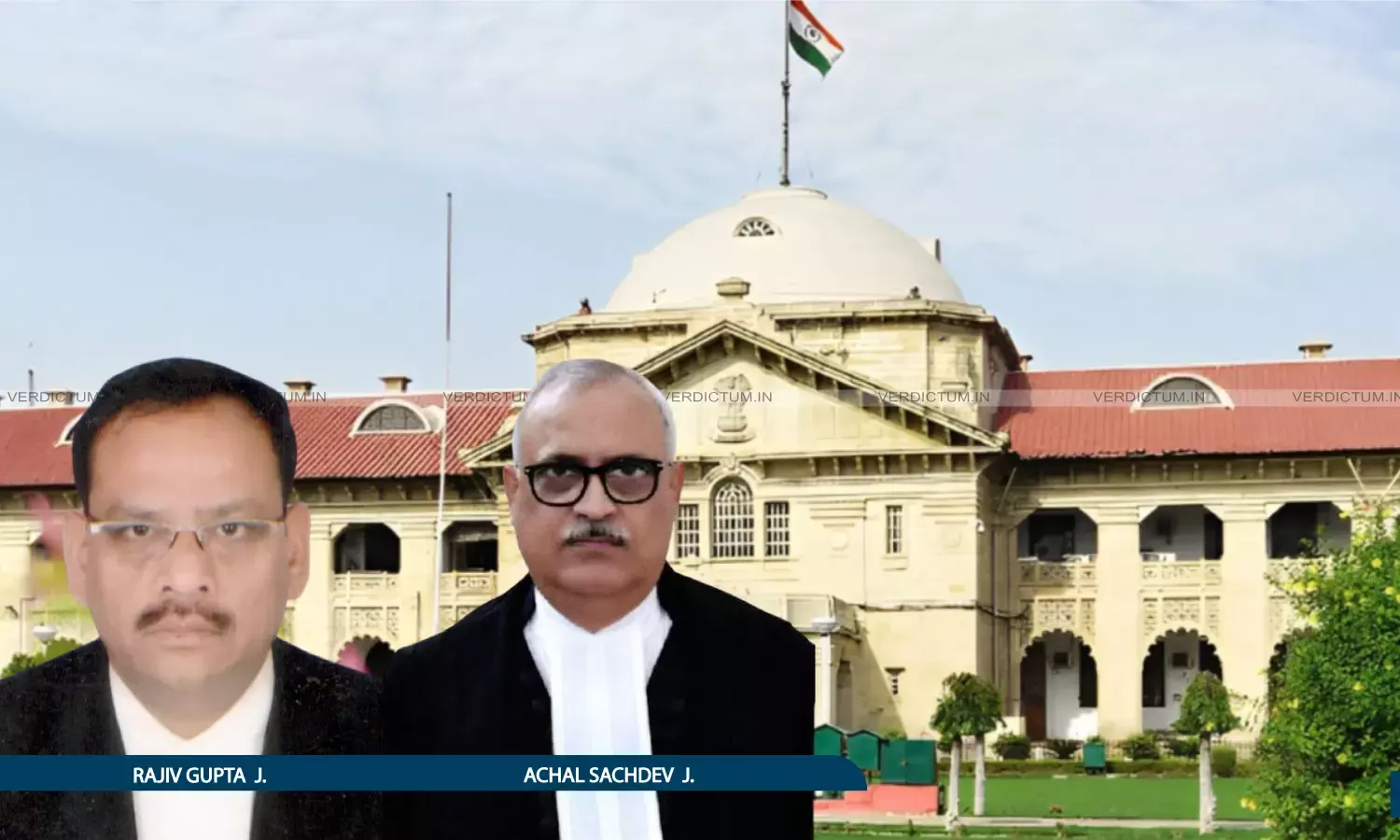
Justice Rajiv Gupta, Justice Achal Sachdev, Allahabad High Court
The Allahabad High Court has held that the direction for re-recording of a statement under Section 183 B.N.S.S. may be issued if the integrity of the original statement is seriously compromised. The High Court also affirmed the Trial Court’s view that any direction for recording such a statement can be issued only by the High Court or by the Supreme Court under exceptional circumstances.
The High Court was considering a Petition filed by the complainant/victim seeking issuance of a direction to the respondent to re-record her statement under section 183 of BNSS, 2023, in pursuance of the order passed by the Additional District & Session Jude.
The Division Bench of Justice Rajiv Gupta and Justice Achal Sachdev held, “The direction for re-recording of statement under Section 183 B.N.S.S. may be issued if the original statements integrity is seriously compromised. While not every allegation is bound to succeed, a credible claim of non-reading of statement by the victim provides a strong ground for intervention to order a second statement under Section 183 B.N.S.S. to promote fairness and prevent misuse.”
“Ordinarily no routine direction for second statement under Section 183 B.N.S.S. can be given but under exceptional circumstances. High Court in exercise of it’s extraordinary jurisdiction, if justified to rectify injustice, may issue directions for recording second statement under Section 183 B.N.S.S. but it cannot be exercised as a general rule where victim alleges that her statement recorded under Section 183 B.N.S.S. was not read over to her or that she was not given an opportunity to confirm its correctness”, it added.
The petitioner appeared in-person while the Government Advocate represented the Respondent.
Factual Background
The case in question was registered under sections 70(1), 352, 351(1), 61(2) B.N.S., 2023. The Additional District & Session Judge, in its order, while disposing of applications for re-recording of her statement under Section 183 B.N.S.S.observed that the Statement under Section 183 is ordinarily recorded only once, and any direction for recording such a statement again can be issued only by the High Court or the Supreme Court.
Reasoning
The Bench explained that the primary purpose of Section 183 of BNSS is to provide a safe, voluntary and judicially supervised mechanism for recording confessions (by the accused) and statements (witnesses or the victims) during a criminal investigation or even afterwards, before inquiry or trial begins, and this ensures that these statements or confessions are made freely and without coercion. The Bench explained that the same carries higher reliability and evidentiary values as compared to ordinary police statements recorded under Section 180 of the BNSS.
“The procedural safeguards directs constitutional rights under Article 20(3) and the Article 21 of the constitution against self incrimination and for fair procedure, the core objectives of section 183 B.N.S.S. is to prevent police coercion or torture and police officer cannot record confessions even though they may be adorned with magisterial powers. Only a Judicial Magistrate can record a statement under Section 183 B.N.S.S., thus reducing risk of forced or induced confessions but the Magistrate must ensure voluntariness on part of the person making the statement”, it added.
The Bench was of the view that Section 183 of the BNSS acts as a judicial filter between police investigation and trial evidence, thereby capturing important statements/confessions in a protected, verifiable manner to aid truthfinding while safeguarding against abuse of power. It balances effective prosecution with protection of individual rights, with BNSS adding digital and victim-focused enhancements over the old CrPC framework.
The Bench stated, “There is no statutory mandate for multiple recordings of the same person's statement under Section 183 BNSS. Police statements under Section 180 BNSS (old Section 161 CrPC) can be recorded multiple times if needed during investigation, but magisterial statements under Section 183 BNSS are exceptional and meant to preserve evidence with higher reliability.” The Bench made it clear that the power to record a statement under Section 183 B.N.S.S. is discretionary and is typically initiated by the investigating officer to produce the person (witness/victim or accused) and the person voluntarily approaching the Magistrate.
On a perusal of the facts of the case, the Bench noted that the statement of the victim/petitioner recorded by the Magistrate showed that the petitioner had given the statement without any duress, had read the statement and thereafter had signed the statement, and thus, all the procedural aspects had been followed. "Trial court vide its order dated 13.01.2026 has rightly observed that the statement under section 183 B.N.S.S. is ordinarily recorded only once and any direction for recording of such statement can be issued only by Hon’ble High Court or by Hon’ble Supreme Court only under exceptional circumstances", it added.
Thus, holding that there were no extraordinary circumstances warranting the re-recording of the statement under Section 183 B.N.S.S., the Bench dismissed the writ petition.
Cause Title: Kirti Verma v. State of U.P. (Neutral Citation: 2026:AHC:43696-DB)