

Withdrawal of Suit Not Automatic On Mere Filing Of Application Under Order XXIII Rule 1 CPC: Allahabad High Court
Plaintiff’s right to withdraw is absolute, but not instantaneous; right to withdraw a suit must be read harmoniously with Section 151 CPC, which preserves the court’s inherent powers

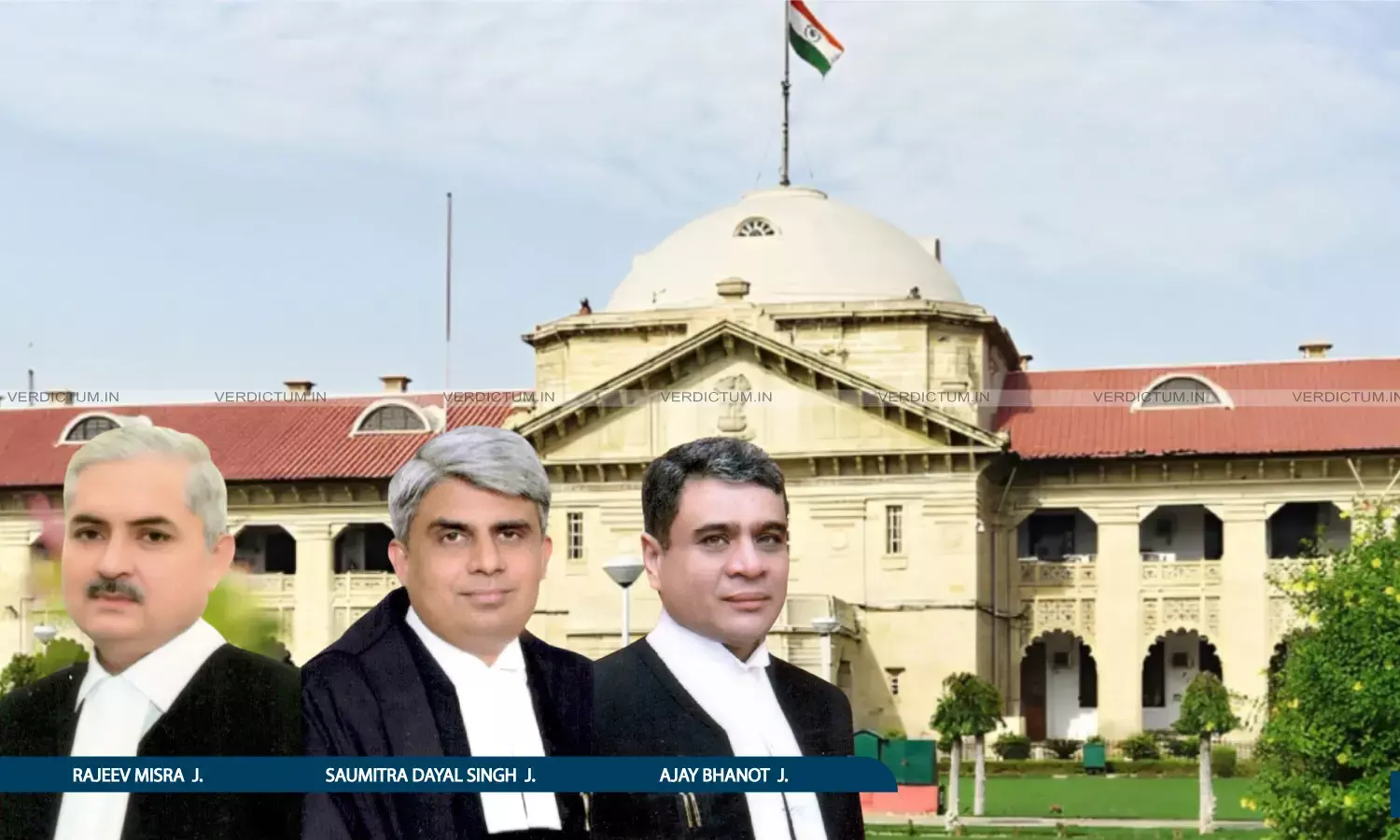
A Full Bench of the Allahabad High Court, in a significant judgment has clarified that while a plaintiff enjoys an absolute right to withdraw a suit under Order XXIII Rule 1 of the Code of Civil Procedure, 1908 (CPC) such withdrawal does not operate automatically the moment it is communicated to the court. If allowed ‘automatically’, besides leading to multiplicity of proceedings, it would result in obstructing the fair path of justice itself and the court would become a mere postman or a spectator, the bench said.
The Court further held that the plaintiff’s right to withdraw a suit must be read harmoniously with Section 151 CPC, which preserves the court’s inherent powers. The Bench said that until the court grants its imprimatur on a withdrawal application, a limited but crucial window remains open during which the plaintiff may even withdraw the withdrawal itself.
A Full Bench comprising Justice Saumitra Dayal Singh, Justice Rajeev Misra and Justice Ajay Bhanot observed, “If allowed ‘automatically’, besides leading to multiplicity of proceedings, it would result in obstructing the fair path of justice itself. The court would become a mere postman or spectator, entirely dependent on the conduct of a plaintiff (except in cases of fraud), with no eye on or intent to address the needs of justice. That dictation of the procedural law to override the substantive law may never be consistent to the ends of justice. Therefore, it may never be desirable”.
“…we may observe in brief - Order XXIII Rule 1 creates a ‘right’, sometimes described as ‘power’ on the plaintiff to withdraw from a suit proceeding, instituted by them. That right is absolute and one that may not require any further action on part of the Court, to fructify. Yet, that ‘right’ or ‘power’ is not in derogation, either to Section 151 of the Code which vests on the same plaintiff a right to seek withdrawal of his application to withdraw from a suit - before the Court grants its imprimatur and thus renders itself functus officio. That little window of time exists”, the bench further noted.
Senior Advocate Atul Dayal appeared for the petitioner and Senior Advocate Shambhu Nath appeared for the respondent.
In the pertinent matter, the dispute arose from a civil suit in which the plaintiff moved an application under Order XXIII Rule 1 CPC seeking withdrawal of the suit.
Now, before the trial court could pass any formal order on the withdrawal application, the plaintiff sought to withdraw the very withdrawal application itself by invoking Section 151 CPC. The trial court, however, declined to entertain the request, holding that the suit stood withdrawn the moment the intent was expressed.
Therefore, aggrieved by the order, the plaintiff approached the High Court on the question that whether withdrawal of a suit under Order XXIII Rule 1 CPC operates automatically upon expression of intent, or only upon judicial sanction.
Rejecting the notion of “instant” or “forthwith” withdrawal, the High Court thus cautioned that treating withdrawal as complete merely upon expression of intent would render Section 151 redundant and undermine the trial court’s discretionary powers, particularly in matters relating to costs, transposition of parties, or continuation of proceedings by assignees.
“…to read the withdrawal of a suit proceedings as complete immediately or forthwith - upon communication of the intent (by the plaintiff), to withdraw from a suit proceeding, besides needlessly defeating Section 151 of the Code, would also militate against the other discretionary powers of the trial court - whether with respect to award of cost or to allow a party to be transposed as a plaintiff or to allow an assignee to continue the suit”, it further held.
Thus, the bench held that procedural law cannot be allowed to dictate outcomes that override substantive justice. Allowing withdrawal to take effect mechanically, without judicial application of mind, would make the court “a mere postman”.
The Court concluded that procedural autonomy of a litigant must always operate within a framework that preserves fairness, balance, and judicial oversight.
Cause Title: Jeera Devi and another v. Additional District Judge Court No.12, Varanasi A227 No. - 4747 of 2019
Appearances:
Petitioner: Atul Dayal, Senior Advocate, Brij Raj, Advocate.
Respondents: Saurabh Pandey, Pratik J. Nagar, Shambhu Nath, Senior Advocate, Triveni Shanker, Advocates.
Click here to read/download the Judgment