

Complaint U/S 138 NI Act Cannot Be Dismissed For Complainant’s Absence When Accused Avoids Trial: Allahabad High Court
The High Court held that an acquittal under Section 256 CrPC cannot be recorded where the accused has never appeared before the trial court, as the provision contemplates the presence of the accused and judicial consideration of the necessity of the complainant’s attendance.
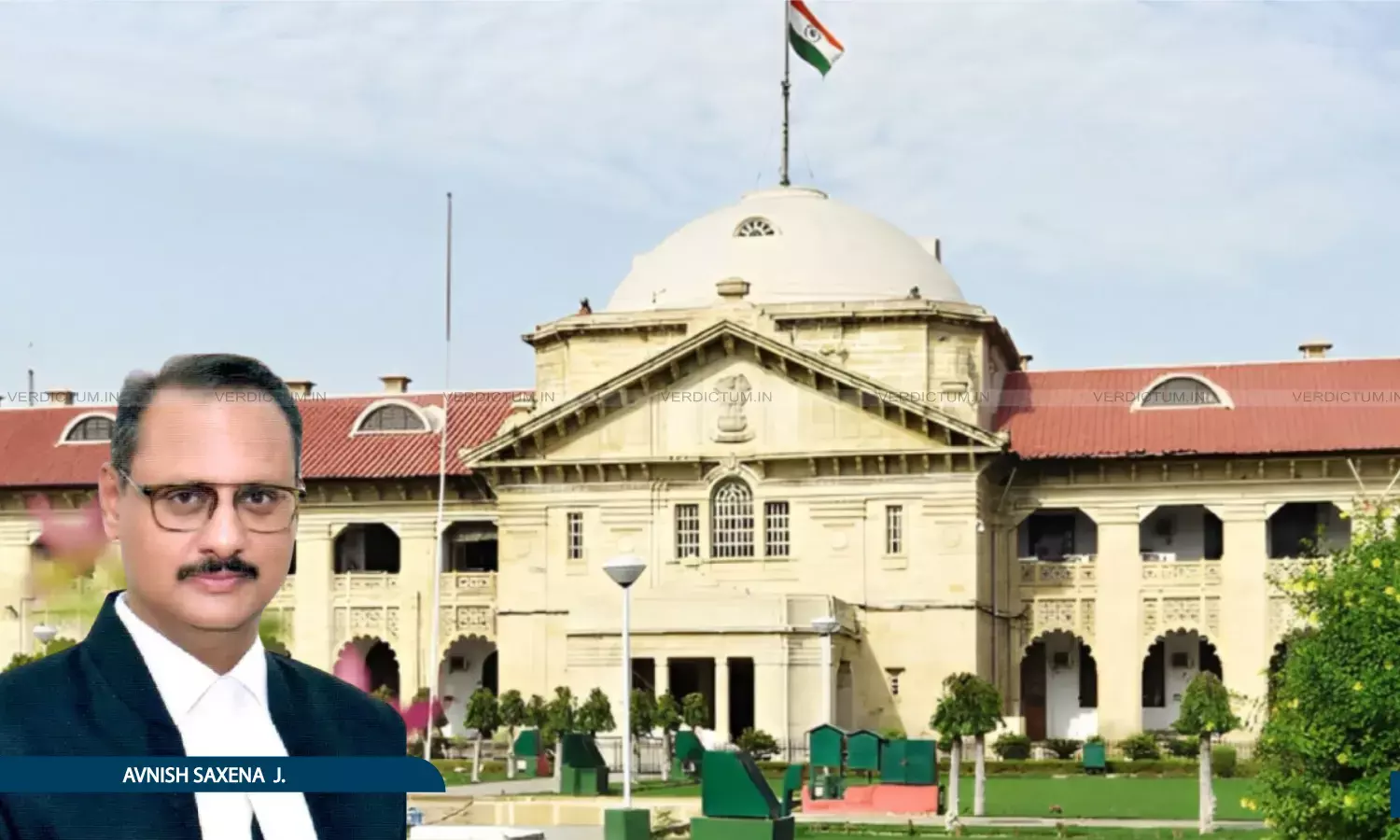
The Allahabad High Court held that dismissal of a complaint under Section 138 of the Negotiable Instruments Act and acquittal of the accused solely on account of the complainant’s absence is impermissible where the accused himself has not appeared before the court.
The Court clarified that Section 256 of the CrPC applies only when the accused is before the court and the stage of hearing requires the complainant’s presence.
The Court was hearing multiple petitions arising from cheque dishonour complaints in which the Magistrate had dismissed the complaints and acquitted the accused due to the absence of the complainant on a single date, despite the accused having consistently failed to appear.
A Bench of Justice Avnish Saxena, who examined whether the revisional court was justified in setting aside the Magistrate’s orders and restoring the complaints for adjudication on merits, observed: “…the non-appearance of complainant on the date fixed would not lead to acquittal of accused at any stretch of imagination, because the accused was not appearing in the trial, …Section 256 CrPC contemplates acquittal of accused, who is before the court and not when he is absconding the trial, ...therefore, point no. (ii) & (iii) are accordingly decided in the light of the judgment of the Hon’ble Supreme Court considered herein above and the provisions of law that acquittal cannot be recorded where the requirement of presence of complainant is not necessary for hearing of the complaint”.
Background
The dispute arose out of eight cheque dishonour complaints filed in 2012, alleging that the accused had issued cheques totalling ₹30 lakh towards the refund of advance money paid for a proposed property transaction that did not materialise.
The Magistrate took cognisance and issued summons, followed by bailable warrants, but the accused did not appear for nearly two years.
On a later date fixed for further orders, neither party appeared, and the Magistrate dismissed the complaints and acquitted the accused under Section 256 CrPC.
The complainant challenged those orders in revision, and the revisional court set them aside, directing the Magistrate to decide the complaints on the merits.
The accused then approached the High Court seeking the quashing of the revisional orders and of the underlying proceedings.
Court’s Observation
The Court first examined the statutory framework governing complaint cases under the CrPC. It noted that dismissal of complaints before cognisance is governed by Sections 200–203, while once cognisance is taken and process issued under Section 204, the proceedings enter the stage of trial. In the present case, cognisance had already been taken and summons issued in all complaints.
The Court found that the complainant had taken necessary steps for service of process and that summons and warrants had repeatedly been issued against the accused, who nonetheless failed to appear.
The Bench undertook a detailed analysis of Section 256 CrPC, which permits dismissal of the complaint and acquittal of the accused if the complainant is absent on the date fixed. It emphasised that the provision must be read as a whole and applied judicially rather than mechanically.
Relying on Associated Cement Co. Ltd. v. Keshvanand, the Court reiterated that the provision exists to prevent harassment of an accused compelled to attend court repeatedly when the complainant is absent, but it does not impose a mandatory duty to acquit merely because the complainant is absent.
The Court also referred to S. Anand v. Vasumathi Chandrasekar, where it was held that dismissal is improper if the complainant’s presence is not necessary for the progress of the case.
The Court emphasised that the structure of summons trials under Chapter XX CrPC begins with the appearance of the accused. Only after appearance can the substance of the accusation be explained and the plea recorded under Section 251 CrPC.
It was observed that where the accused never appeared, the proceedings never progressed to the stage of trial or evidence. In such circumstances, an acquittal cannot legally be recorded because there is neither a plea nor any evidence for adjudication.
The Bench noted that after cognisance, no evidence was recorded because the accused never appeared.
Thus, there was no material before the Magistrate that could support a finding of acquittal. Recording an acquittal without evidence or trial would contradict the statutory scheme governing criminal adjudication.
The Court distinguished precedents cited by the accused, observing that in all those cases the accused had appeared and was facing trial when complaints were dismissed. The present case, the Bench noted, was materially different because the accused had not appeared at all.
The Court also relied on Ranjeet Sarkar v. Ravi Ganesh Bhardwaj, which clarified that an acquittal under Section 256 CrPC must logically follow from the complainant’s absence and the purpose for which the date was fixed.
Applying these principles, the Court held: “In the present case, the non-appearance of the complainant on the date fixed would not lead to acquittal of the accused at any stretch of imagination, because the accused was not appearing in the trial. Section 256 CrPC contemplates acquittal of the accused, who is before the court and not when he is absconding from the trial.”
The Court also examined the scope of revisional powers under Sections 397–401 CrPC and reiterated that such jurisdiction exists to correct illegality, impropriety, or jurisdictional error.
Relying on Amit Kapoor v. Ramesh Chandra, the Bench noted that revisional power may be exercised where there is palpable error, non-compliance with law, or arbitrary exercise of discretion.
Conclusion
The High Court held that the Magistrate’s order dismissing the complaints and acquitting the accused under Section 256 CrPC, despite the accused never appearing for trial, was contrary to law and unsustainable.
Accordingly, the application moved by the complainant was allowed with direction to the Additional Civil Judge or trial Magistrate to speed up the trial of all cases detailed above in accordance with the directions issued by the Hon’ble Supreme Court In-Re Expeditious Trial of Cases Under Sectionn138 NI Act, 1881.
Cause Title: Gopal Prased Sharma v. State of U.P. & Anr. and connected matters (Neutral Citation: 2026:AHC:29741)
Appearances
Appellant: Rajesh Kumar Pandey.
Respondent: Sushil Shukla, Senior Advocate, assisted by Ravitendra Pratap Singh, Raj Shekhar Srivastava, A.G.A.
