

Convicted Relying On Laws Which Were Made When Concept Of Live-In Didn’t Exist: Allahabad High Court Sets Aside Life Sentence
The Allahabad High Court rendered such findings while setting aside an order of life sentence imposed upon the accused after noting that the victim, who was a major, had a 6-year-long consenting relationship with him.

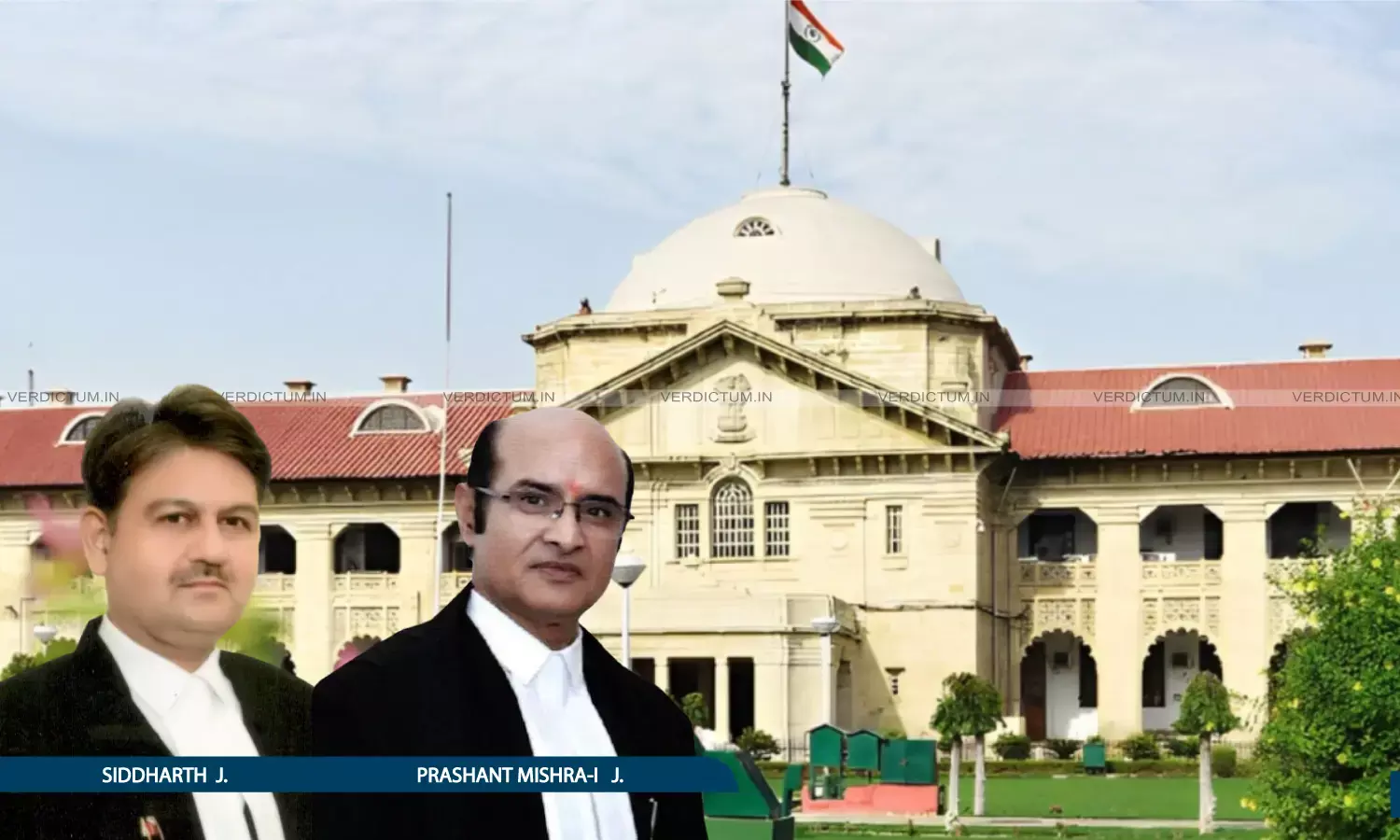
Justice Siddharth, Justice Prashant Mishra-I, Allahabad High Court
Highlighting the increasing tendency of the youth living together without solemnization of marriage under the concept of live-in, the Allahabad High Court has observed that when such relationships fail, FIR is lodged and boys/men get convicted relying upon the laws which were made when the concept of live-in was not in existence.
The High Court rendered such findings while setting aside an order of life sentence imposed upon an accused after noting that the victim, who was a major, had a 6-year-long consenting relationship with the accused.
The High Court was considering a criminal appeal filed against the judgment of the Special Judge, Exclusive Court (POCSO Act) convicting and sentencing the appellant to life imprisonment in a case registered under the provisions of the IPC, the POCSO Act and the Scheduled Caste and Scheduled Tribes Act.
The Division Bench of Justice Siddharth and Justice Prashant Mishra-I held, “Before parting, we find that this case is an example of increasing tendency of the youth living together without solemnization of marriage under the influence of western ideas and the concept of live-in. After such relationships fail, F.I.R. is lodged and the laws being in favour of women, the boys/men get convicted relying upon the laws which were made when the concept of live-in was no where in existence.”
Advocate Dinesh Kumar Pandey represented the Appellant, while Government Advocate Ashish Pandey represented the Respondent.
Factual Background
It was alleged that the appellant enticed away the informant's daughter, aged about 18-and-a-half years, with the intention to marry. Her daughter returned to her house and informed that the accused appellant enticed her with the intention to marry but he did not marry her and turned her out of his house. She could not approach the Police earlier because of shame. The victim’s date of birth, as per her Aadhar Card, is January 1, 2003, and the incident pertains to the year 2021.
After the investigation of the case, a chargesheet was submitted against the appellant. The trial court framed charges against the appellant under Sections 323, 363, 366, 376 of the IPC, Section 506 of the POCSO Act and Section-3(2)(V) of the SC/S.T. Act. The appellant denied the charges and sought a trial. The appellant claimed that the criminal case was lodged to falsely implicate the appellant, who belongs to a backward caste, by the victim and her mother with the intention of getting compensation from the Social Welfare Department.
Reasoning
The Bench noted that, as per Rule-12 of the Juvenile Justice (Care & Protection of Children) Rules, 2007, the certificate from the school first attended was required, and as per Section 94(2) of the Juvenile Justice (Care & Protection of Children) Act, 2015, the certificate from the school or matriculation certificate was required. The Bench noticed that in this case, the victim had not appeared in the matriculation examination.
The Bench further stated that the trial court had not considered the age certificate of the victim issued by the C.M.O. Maharajganj, which proved her age to be about 20 years on August 19, 2021. “Clearly P.W.-2 was major and eloped from her house to the house of the appellant and from there she went through Public Transport to Gorakhpur and from there to Bangalore, She can not be said to have been forcibly abducted for the purpose of forcible marriage with the appellant. She lived with the appellant in a locality full of other houses for 6 months before returning to her place of residence with the appellant. Therefore, the conviction of the appellant under Sections-363, 366 I.P.C. is absolutely unwarranted as per the Law”, it held.
As per the Bench, the conviction of the appellant under Section 6 of the POCSO Act and Section-376 of the IPC was unjustified as the victim was a major and had a consenting relationship with the appellant for six years. “The punishment under Section-3(2)(V) of S.C./S.T. Act is not independent provision and is applicable only where the accused is punished with imprisonment of 10 years or more under the provision of I.P.C., therefore the conviction of the appellant under Section-3(2)(V) of S.C./S.T. Act is also not sustainable and is hereby set aside”, the order read.
Thus, considering such facts and circumstances, the Bench allowed the appeal, set aside the judgment of the trial court, and directed the appellant to be set free.
Cause Title: Chandresh v. State Of U.P. (Neutral Citation: 2026:AHC:4399-DB)
Appearance
Appellant: Advocates Dinesh Kumar Pandey, Manu Sharma, Randhir Jain, Sandeep Kumar Keshari
Respondent: Government Advocate Ashish Pandey