

Court Shouldn’t Take Cognizance Beyond Period Of Limitation: Allahabad High Court Cautions Chief Judicial Magistrate; Calls For Training Of Officers
The Allahabad High Court was considering an application filed under Section 528 BNSS by the applicant seeking quashing of the entire proceeding in a case registered under Sections 379 and 411 of the IPC, as well as a cognisance order passed by the Chief Judicial Magistrate.

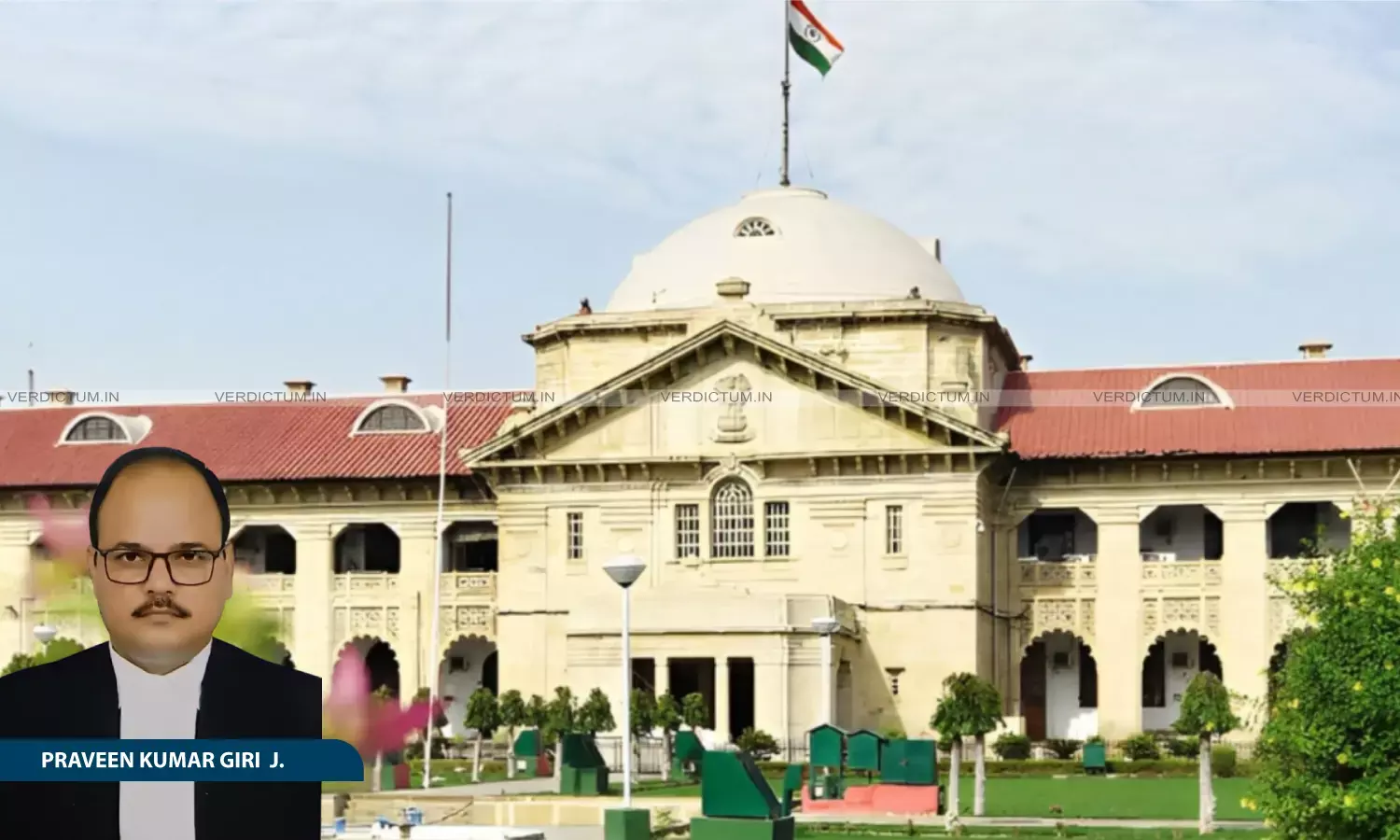
Justice Praveen Kumar Giri, Allahabad High Court
While dealing with a case where cognizance was taken beyond the limitation period as provided under Sections 468 and 469 of the CrPC, the Allahabad High Court has asked a Chief Judicial Magistrate to be more cautious in future. Directing the Judicial Training and Research Institute to impart training to the Judicial Officers, the High Court held that cognizance should not be taken contrary to the mandate of law.
The High Court was considering an application filed under Section 528 BNSS by the applicant seeking quashing of the entire proceeding in a case registered under Sections 379 and 411 of the IPC, as well as a cognisance order passed by the Chief Judicial Magistrate.
The Single Bench of Justice Praveen Kumar Giri held, “This Court has gone through the entire facts of the case as well as the provisions of law laid down by the Hon'ble Supreme Court in the judgments of P.K. Chaudhary (supra), Surinder Mohan Bikal (supra) as well as Sarwan Singh (supra) and has formed the opinion that where a provision is mandatory, the court should not take cognizance contrary to the mandate of law.”
The Bench ordered, “The Registrar General of the Allahabad High Court is directed to communicate this order to the Judicial Training and Research Institute (J.T.R.I.), Lucknow to impart such training to the Judicial Officers, as cognizance is the base of a criminal case so cognizance order must be passed in accordance with law.’
Advocate Pawan Singh Pundir represented the Applicant while Government Advocate represented the Opposite Party.
Factual Background
The Court, vide an order dated January 7, 2026, directed the then Chief Judicial Magistrate, Firozabad, to submit her explanation as to why cognisance was taken beyond the limitation period as provided under Sections 468 and 469 Cr.P.C. The Circle Officer informed the Court that the incident occurred on April 13, 2019, and the charge-sheet was prepared against two accused persons, which was kept in the office of the Circle Officer. The offence was punishable up to three years.
It was stated by the Officer that if the charge-sheet is not submitted in the Court within three years from the date of the alleged incident, the concerned Magistrate cannot take cognizance as it is barred under Sections 468 and 469 Cr.P.C., and indirectly the accused would be acquitted, as no further proceedings would be initiated against the accused in a time-barred case. In the present case, the charge-sheet was submitted in the court on November 24, 2024, after a lapse of three years, and the Judicial Magistrate took cognisance on November 25, 2024, ignoring the above-mentioned provisions and taking cognisance beyond the period of limitation.
Arguments
It was the case of the applicant that, as per the judgment of the Apex Court in P.K. Chaudhary vs. Commander (2008), Surinder Mohan Bikal vs. Ascharaj Lal Chopra (1978), as well as State of Punjab v. Sarwan Singh (1981), the Court cannot take cognisance after expiry of the limitation period.
Reasoning
The Bench noted that the then Chief Judicial Magistrate, Firozabad, Minakshi Sinha had given an explanation stating that as per the usual practice prevalent in all magisterial courts in the State of Uttar Pradesh, and perhaps in other states too, no in depth enquiry or examination of the record is made on receiving the police report i.e. the charge-sheet (or the final report) for purposes of taking cognizance of the offences and only a prima facie view is formed by the Magistracy based on the material contained in the case diary.
On this aspect, the Bench observed, “Such practice cannot substitute a law which is not mentioned in the Code of Criminal Procedure. For such explanation and passing of impugned order, it may be assumed that she is taking her judicial service very lightly and is not treating it as a serious obligation to impart justice. The behaviour as well as the conduct of the Presiding Officer as reflected from her explanation as well as cognizance order deserves initiation of departmental proceedings, as the same prima facie demonstrates conduct unbecoming of the office held by her, but taking a very lenient view, this Court is silent on this aspect.”
The Bench thus ordered, “The Chief Judicial Magistrate, Minakshi Sinha, is directed to be more cautious in future and to pass orders strictly in accordance with law and existing law may not be substituted by practice (if any) is illegally prevalent in all the Magisterial Courts in the State of U.P.”
“The other Judicial Magistrates as well as courts are also directed not to follow such practice, as mentioned in the explanation of the Chief Judicial Magistrate, Minakshi Sinha”, it further added.
The Bench thus disposed of the application by quashing the entire proceeding as well as the cognisance order passed by Chief Judicial Magistrate, Firozabad in respect of the applicant Avneesh Kumar and co-accused Suraj Thakur. The Bench, however, directed that the proceedings against the other five accused would continue, against whom a separate charge-sheet was submitted and cognizance was taken within the period of limitation.
Cause Title: Avneesh Kumar State of U.P. and Another (Neutral Citation: 2026:AHC:12245)
Appearance
Applicant: Advocates Pawan Singh Pundir, S.M.Ayaz Ali
Opposite Party: Government Advocate