

Cause Of Action For Declaring Marriage As Void Is Only Available To Spouse: Allahabad High Court
The Appeal before the Allahabad High Court was filed against an order passed by the family court in favour of the son’s widow.

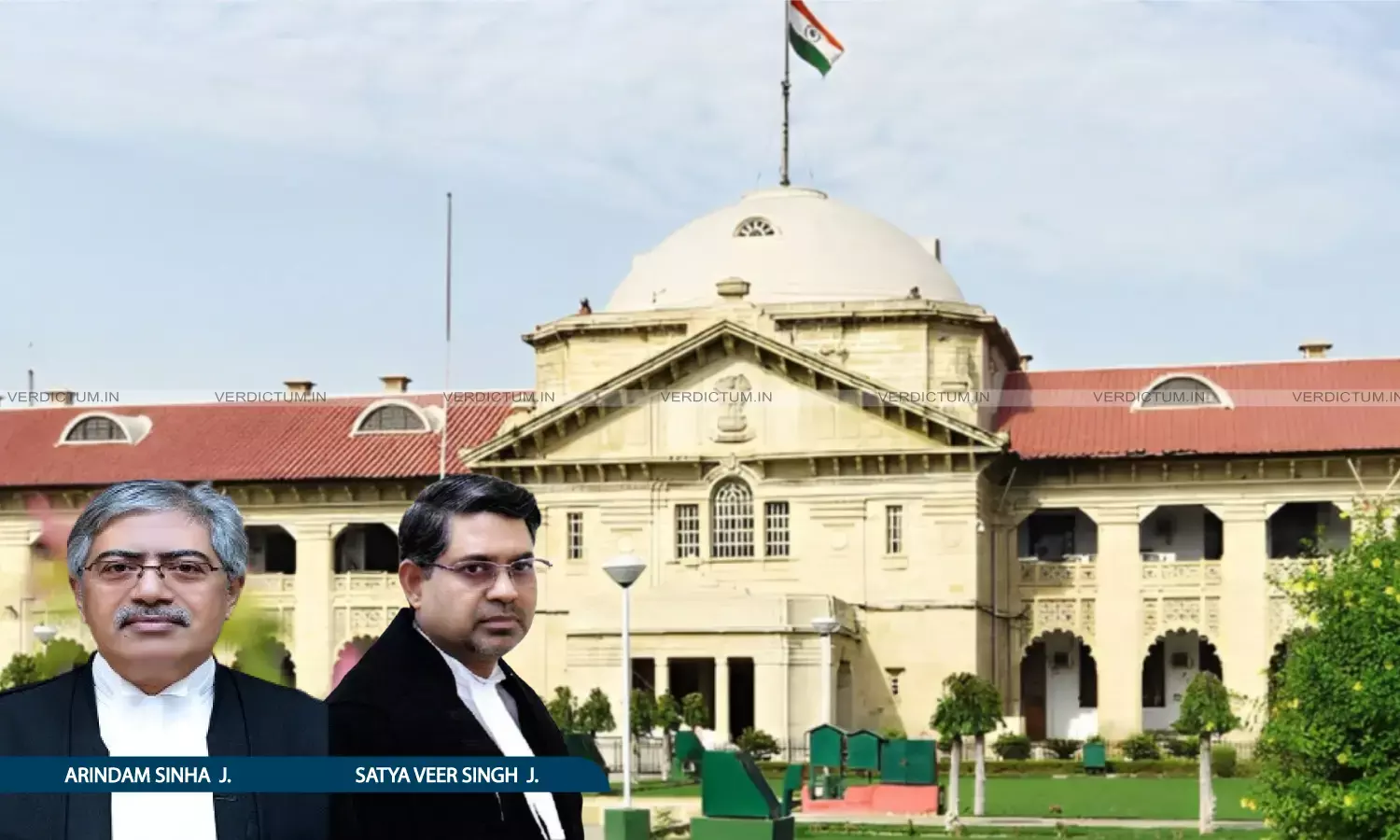
Justice Arindam Sinha, Justice Satya Veer Singh, Allahabad High Court
While dismissing the appeal filed by the parents of a deceased army soldier, the Allahabad High Court has held that the cause of action in section 11 of the Hindu Marriage Act, 1955, for declaring a marriage as void is only available to a spouse. The High Court also held that the parents of the deceased husband cannot seek a decree of nullity alleging that the wife was underage.
The Appeal was filed against an order passed by the family court in favour of the son’s widow.
The Division Bench of Justice Arindam Sinha and Justice Satya Veer Singh held, “The Legislature consciously omitted to include clause (iii) under section 5 in the provision of section 11. Furthermore cause of action in section 11 is only available to a spouse in a marriage. Appellants are parents of the deceased husband. Section 12, providing for voidable marriages, does not mention clause (iii) in section 5, for contravention of which a ground can be urged saying the marriage is voidable and be anulled by a decree of nullity.”
Advocate Vinod Kumar Pandey represented the Appellant while Advocate Pawankumar Dubey represented the Respondent.
Factual Background
The appellants lost their son after he died in the line of duty while serving in the army. The Respondent obtained the impugned judgment from the Family Court, declaring her to be the widow. The marriage was said to have been solemnised on May 12, 2007, and the son died on January 14, 2008, of a gunshot wound in an encounter with terrorists. It was alleged that only the engagement took place on May 12, 2007, as opposed to the marriage, and the latter was to have taken place on April 24, 2008. The mother of the deceased had first made a Special Civil Application in the Gujarat High Court. She had not disputed that her son married the respondent on 12th May, 2007. Her contention was that the marriage was never consummated.
Subsequent to rejection of the first application, there wasan investiture ceremony held in Rashtrapati Bhawan at New Delhi wherein, amongst others, the respondent received from the President of India the posthumous award, as the widow of the deceased. The Appellant mother filed another Special Civil Application. The Respondent filed for review of the delay. The applications for condonation and review were rejected as meritless. The different Division Bench was of the view that the respondent, not having appeared before the authority and subsequently also before the Court, could not ask for a trial of the question of fact, for it to be held by the Court to conclude that she was the legally wedded wife. The Respondent then petitioned for special leave to appeal to the Supreme Court. There were two petitions. Both were dismissed summarily, and meanwhile, the respondent filed the matrimonial case resulting in the impugned judgment. The Family Court, having considered the materials before it, came to answer the main issues in favour of respondent wife.
Reasoning
The Bench noted that the appellants stated that they discovered from documents tendered at trial that the respondent was underage, rendering the marriage void. No application was made by the appellants for the framing of an additional issue. “On going through the lower Court record it is revealed, inter alia, there is an identity card identifying respondent as widow/war widow of ex-service men and giving her date of birth as 20th July, 1989. Taking the date for reckoning her age at the time of marriage on 12th May, 2007, it puts her two months short of 18 years. Sub-clause (iii) under section 5, providing for conditions for a Hindu marriage requires, inter alia, the bride to be age of 18 years at the time of marriage, increased from 15 years by amendment, w.e.f., 1st October, 1978”, it stated.
The Bench also made it clear that the appellants are the parents of the deceased husband, and Section 12, providing for voidable marriages, does not mention clause (iii) in Section 5, for contravention of which a ground can be urged, saying the marriage is voidable and can be annulled by a decree of nullity. “In the premises, appellants are presumed to have been advised that they applying for framing additional issue would not yield result. Hence, this belated contention at the appellate stage. It is without substance and cannot be acted upon”, it held.
The Bench also noticed that the Gujarat High Court had given a finding that the authorities had on second inquiry not been satisfied with respondent’s claim of having married the deceased and as per the Bench, the same had to be viewed in context of its subsequent review order, referring to allegations of fact in issue and, the fact of the honours posthumously bestowed, given to respondent in the investiture ceremony held at Rashtrapati Bhawan.
Dismissing the appeal, the Bench stated, “We appreciate the manner, in which the Family Court held the trial and confirm impugned judgment.”
Cause Title: A v. B (Neutral Citation: 2025:AHC:213837-DB)
Appearance
Appellant: Advocate Vinod Kumar Pandey
Respondent: Advocates Pawankumar Dubey, Rajesh Kumar, Saurabh Kumar Pandey