

Lack Of Written Agreement No Bar: Allahabad High Court Holds Rent Authority Has Jurisdiction To Entertain Such Eviction Pleas By Landlords
The Court said that Section 4 of the Act nowhere restricts any right of the parties who admit the status of landlord and tenant.

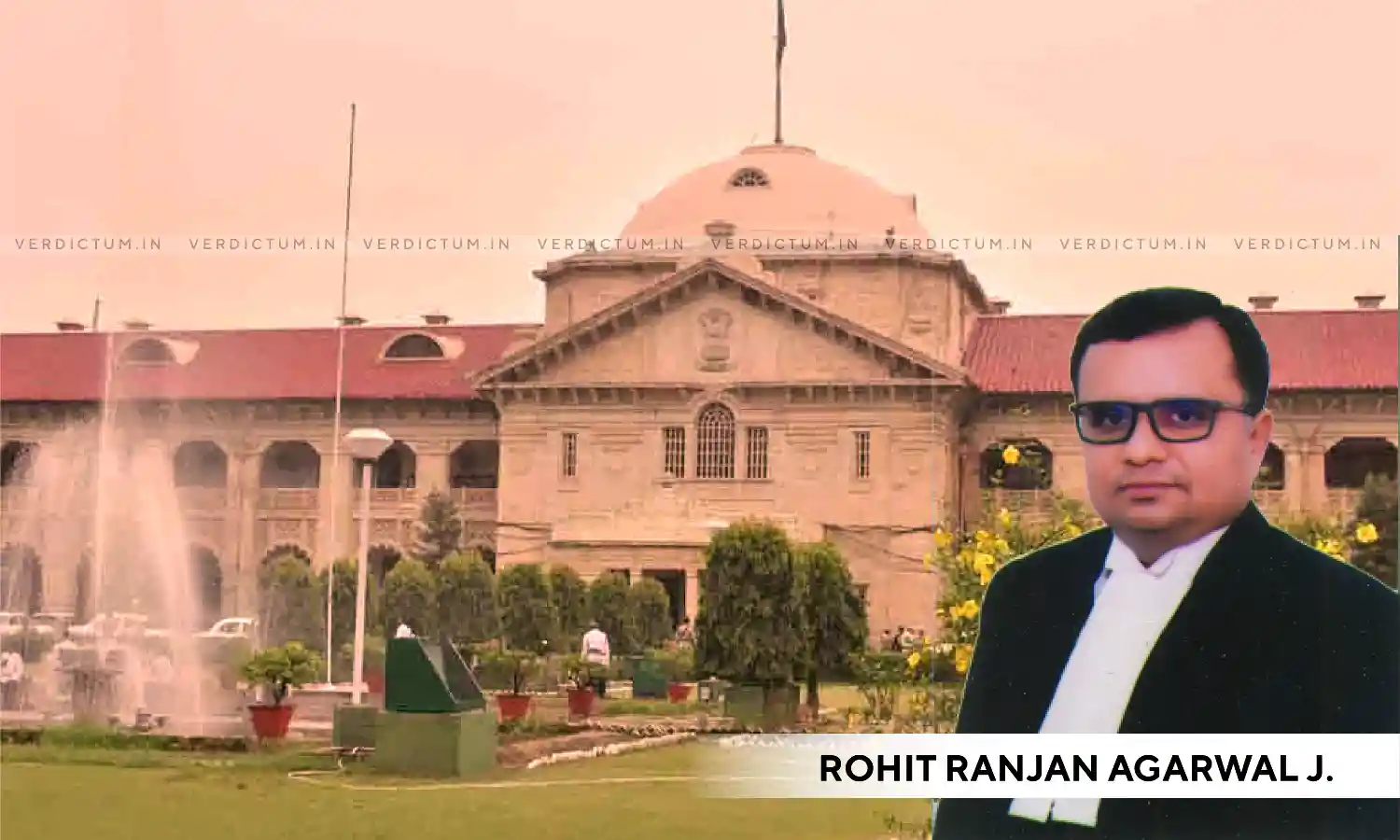
The Allahabad High Court has observed that the Rent Authority constituted under the Uttar Pradesh Regulation of Urban Premises Tenancy Act, 2021 (“the Act of 2021”), can entertain eviction applications even if a written tenancy agreement does not exist or was not intimated to the authority.
The Court emphasized that the State Legislature’s conscious decision to omit the "fatal consequences" found in the Central Model Tenancy Act ensures that landlords are not deprived of their right to seek expedient eviction due to technical documentation failures.
The Bench of Justice Rohit Ranjan Agarwal observed, “This provision leads to conclusion that jurisdiction of rent authority under the Act of 2021 cannot be narrowed down only in cases of written agreement and its intimation to rent authority. Had the Legislature thought of giving limited access to landlord or tenant to approach rent authority only in cases of written agreement or its intimation, then proviso to sub-section (5) of Section 9 would not have been there in the Statute Book…The intention of Legislature cannot be ascertained merely on the basis of single provision, and regard must be given to other sections as well as the context, subject-matter and the object of the provision… Thus, the question which has been posed stands answered that rent authority constituted under the provisions of the Act of 2021 has jurisdiction to entertain application filed by landlord in cases where tenancy agreement has not been executed, and landlord having failed to intimate particulars of tenancy to the authority.”
Senior Advocate Rakesh Kumar Singh and Advocate Krishna Mohan Asthana appeared on behalf of the Petitioners, whereas Advocate Kunal Shah appeared for the Respondents.
Facts of the case
The issue in the writ petitions was whether the rent authority, constituted as per the Act of 2021, has the jurisdiction to entertain applications filed by the landlords in cases where a tenancy agreement has not been executed, if not executed, the landlord having failed to file particulars of tenancy with the rent authority.
Contention of the Parties
Counsel for the petitioners argued that S.C.C. (‘Small Cause Courts’) suits are barred under Section 38 of the 2021 Act and that the lower courts misapplied the Amit Gupta precedent to dismiss challenges to maintainability. Conversely, respondents contended that for tenancies predating the Act where no new agreement was submitted to the Rent Authority, the S.C.C. retains jurisdiction. They emphasized that since the Rent Authority requires a "unique identification number" (generated only upon registering an agreement) to process eviction applications in Form 7, landlords with unwritten or older tenancies would be left without a remedy if the S.C.C. were barred.
A secondary point of contention involves the perceived conflict between the Amit Gupta and Amarjeet Singh judgments regarding the necessity of a written agreement. Some counsel argued that the two rulings operate in distinct areas—one addressing the survival of S.C.C. suits and the other focusing on whether informing the Rent Authority is a mandatory prerequisite for eviction under Section 21(2).
Landlords argued that the 2021 Act was intended to balance the rights of owners and tenants; they maintained that the legislature deliberately omitted the "consequences" for failing to intimate an agreement to ensure landlords aren't stripped of their right to seek eviction. Essentially, they argue that the Rent Authority should handle disputes even in unwritten tenancies to prevent the law's objectives from being frustrated by technicalities.
Observations of the Court
The Court said, “In earlier paragraphs while considering Model Tenancy Act prepared by Central Government, and the Act of 2021 enacted by State Legislature, I found that there is a conscious departure as to mandatory character of tenancy agreement and its intimation to rent authority in case of execution and also non execution…On the one hand, Model Tenancy Act expressly provides in sub-section (6) of Section 4 that on ground of failure of parties to intimate about execution or non execution of tenancy agreement, would both preclude landlord and tenant from claiming any relief. While on the other hand, State Legislature while adopting Model Tenancy Act to certain extent has chosen to omit prescription of such consequences, debarring failure of parties to intimate about execution or non execution of tenancy agreement to rent authority.”
The Court observed that the tenancy agreement as envisaged in Section 4 under the Act of 2021 is divided into two parts, firstly, a mandatory nature concerning fresh tenancy entered after enforcement of the Act. While the Legislature was conscious of the fact that old tenancy consists of both written and unwritten agreements, it thus provided that in case of a written agreement, it was to be jointly presented to the rent authority, while in case no agreement was entered into, parties were required to enter into an agreement and intimate the rent authority.
It was further added that the proviso further clarified the position to the extent that, in case of failure to present the agreement jointly or failing to reach an agreement, only particulars submitted separately with the rent authority by the parties would suffice as to tenancy.
“Section 4 only envisages different types of situation in which a tenancy agreement is arrived between the landlord and tenant. It nowhere restricts any right of the parties who admit the status of landlord and tenant. Had the intention of Legislature was to restrict the parties to only approach rent authority in case of execution of agreement or intimation, then it would have adopted sub-section (6) of Section 4 of Model Tenancy Act…The conscious omission on part of State Legislature would not provide fatal consequences depriving the right of landlord to expedient eviction under the Act of 2021. I have already in previous paragraph nos. 31 to 39 dealt with expression “shall” occurring in sub-section (3) of Section 4, as it caters to limited purpose regarding providing for information of tenancy to rent authority. Once there is no dispute as to landlord-tenant relationship, no mileage could be drawn out of the expression “shall” employed therein.”, the Court observed.
Conclusion
Applying this principle to the various petitions, the Court dismissed the tenants' challenges in cases where the Small Cause Court suits were held to be maintainable, specifically ruling that the 2021 Act does not bar suit.
For cases where eviction was sought directly under the new Act, the Court set aside orders that had previously deemed such applications non-maintainable due to a lack of written agreements. While some matters were remanded for fresh decisions, others resulted in eviction orders; notably, in certain petitions, tenants were granted a six-month grace period to vacate the premises, provided they submit a formal undertaking and clear all financial dues.
Accordingly, the Court allowed the writ petitions partly.
Cause Title: Canara Bank Branch Office and Anr. v. Sri Ashok Kumar @Heera Singh and Ors. [Neutral Citation: 2025:AHC:225540]
Appearances:
Petitioners: Senior Advocate Rakesh Kumar Singh, Advocates Krishna Mohan Asthana,
Respondents: Advocate Kunal Shah