

Time To Remember Bapu | When A Grievance Becomes A Riot
A lesson Rashtrapita Mahatma Gandhi taught us a century ago.

“Indiscriminate resistance to authority must lead to lawlessness, unbridled license and consequent self-destruction.”
— Mahatma Gandhi, Young India, 2 April 1931, p. 58
In late September, a few hundred high-school students in the suburbs of Paris began protesting crumbling classrooms, a shortage of teachers and buildings left without relief after a punishing summer. Their grievance was specific and reasonable.
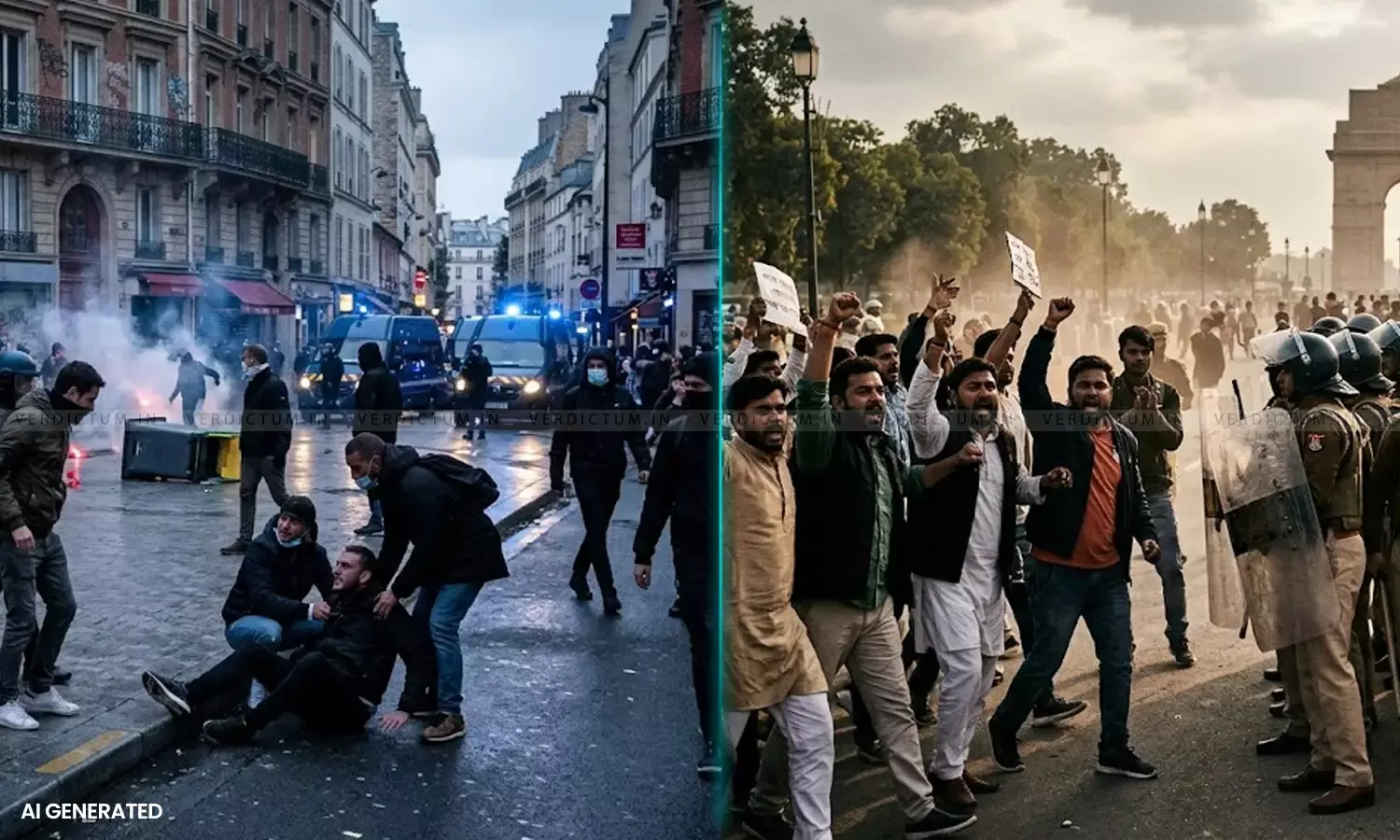
Within three weeks it had become something else. More than a thousand schools were disrupted, and thousands were arrested, most of them minors. On 17 October the student agitation merged with a nationwide cost-of-living mobilisation. As night fell, groups of masked youths torched property, looted shops and attacked police. Even town halls and prefecture buildings were not spared. Some 1,200 people were arrested in a single day and around 150 police personnel were injured. Young protesters lost their hands to crowd-control grenades. The demand for better schools disappeared behind the smoke.
The sequence is now familiar from Nairobi to Kathmandu and from Jakarta to Paris. A small, legitimate protest is called and amplified on social media. It draws in elements with no stake in the original cause. Clashes follow, then a harder crackdown, then wider anger. In the end, those who called the protest no longer control it, and those who joined it bear no responsibility for it.
None of this is new. More than a hundred years ago, Bapu saw the same danger and acted on it.
In November 1921, during the Non-Cooperation Movement, the boycott of the Prince of Wales’s visit to Bombay descended into rioting, assaults and the looting of shops. Bapu did not blame the colonial government for the violence of his own followers. He condemned it publicly and undertook a fast until the city returned to peace.
Three months later, on 4 February 1922, a crowd at Chauri Chaura set fire to a police station, and twenty-two policemen were killed. The movement was then at its height. Within days Bapu called it off, against the wishes of many of his own colleagues, and fasted again in penance. He had said earlier that launching mass civil disobedience before people were disciplined enough for it had been a “Himalayan miscalculation.” His point was simple: a leader who cannot guarantee that a protest will stay peaceful has no business calling it.
It is a bitter irony that many who take to the streets today invoke Bapu’s name, carry his portrait and claim his legacy of satyagraha, yet conveniently forget the very discipline that defined it. They borrow his symbols but discard his conditions. Bapu never treated non-violence as a tactic to be used when it suited and dropped when it did not; for him it was the precondition of every protest. His warning in the opening lines of this note was addressed not to the Government but to satyagrahis themselves. Those who call a march in his name and then look away when it turns to arson and plunder have not followed Bapu; they have used him.
That is the standard against which organisers of protest must be judged today. The right to assemble and to dissent is precious, and in India it is guaranteed by Article 19(1)(a) and (b) of the Constitution. But the same Article makes these rights subject to reasonable restrictions in the interest of public order. Our courts have read the two together. In In re: Destruction of Public and Private Properties and Kodungallur Film Society v. Union of India, the Supreme Court held that those who call a protest that results in damage to property may be made liable for that damage. In Amit Sahni v. Commissioner of Police, the Court held that dissent must be expressed in designated places and cannot be used to occupy public ways indefinitely.
The French episode is therefore a warning to every organiser, whether a student union, trade body, political party or civil society group. The following duties should be treated as non-negotiable:
- Seek permission and keep to the route, time and place agreed with the authorities.
- Appoint responsible marshals and keep identifiable leadership present throughout.
- Exclude masked and anonymous participants, and keep no one in the crowd who is not answerable to the cause.
- Call off the protest at the first sign of violence, as Bapu did, rather than hand it over to those waiting to exploit it.
- Expect to be held accountable, in law and in conscience, for what happens under one’s banner.
The State, too, carries an obligation. A disproportionate response against teenagers only feeds the cycle it seeks to break. But excessive policing does not excuse those who light the fuse. A grievance about classrooms cannot justify a looted shop, and a demand for reform cannot be pursued by burning the very public institutions it seeks to improve.
Bapu understood that the moral authority of a protest lies in its discipline. Once a movement turns to arson and plunder, it has already lost the argument it set out to win. A century on, that lesson remains the surest test of whether a protest is an exercise of a constitutional right or an abuse of it.
Author is a Senior Advocate.
[The opinions expressed in this article are those of the author.]