

The Folly Of Overreach: A Critique Of The Karnataka Hate Speech And Hate Crimes (Prevention And Control) Bill, 2025

Introduction: A Constitutional Balancing Act
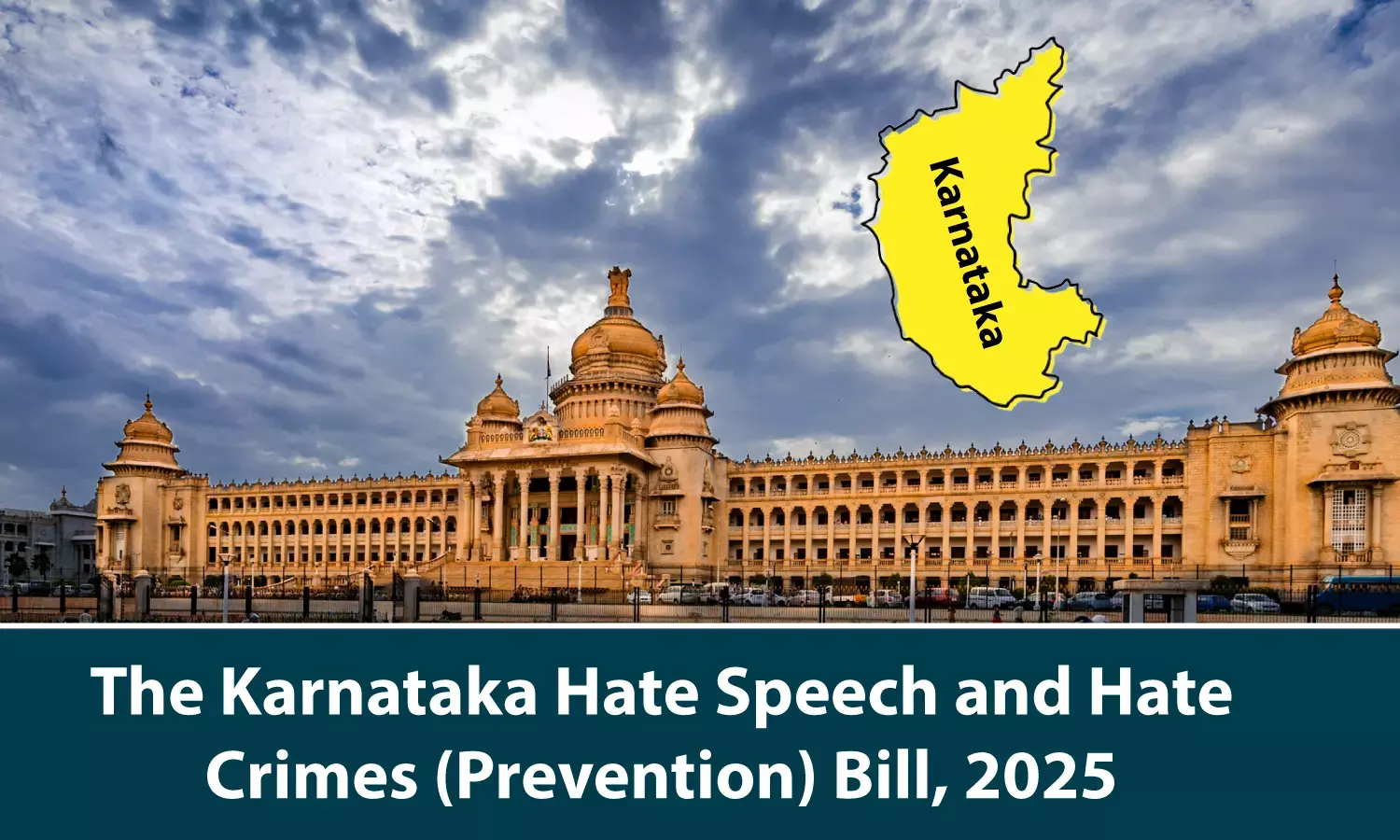
The recent clearance of the Karnataka Hate Speech and Hate Crimes (Prevention and Control) Bill, 2025 by the Karnataka Assembly on December 12, 2025 represents a significant development in India’s legal landscape. While the legislation is stringently aimed at curbing the rising tide of social discord and provocative content, it has sparked a rigorous debate regarding the balance between maintaining public order and preserving civil liberties. A close examination suggests that the Bill may inadvertently erode the constitutional safeguards that protect free speech. By introducing a rigid framework in a domain already governed by central statutes and established Supreme Court jurisprudence, the State Government’s approach raises fundamental questions about the necessity and safety of such tools in a democracy.
Democratic governance requires a delicate equilibrium between the right to free expression and the state's duty to maintain order. Legal critics argue that this Bill risks abandoning that balance in favour of suppression. The concerns primarily revolve around three legal infirmities: the use of ambiguous terminology that grants expansive police discretion; the imposition of disproportionately severe penalties; and the authorization of preventive arrests without a predicate offense. Consequently, the Bill faces scrutiny for potentially violating Article 19(1)(a) of the Constitution by penalizing speech based on subjective hurt rather than the objective standard of incitement to violence.
This legislative shift suggests a move from a "Public Order Model," where intervention is reserved for threats of violence, and legal actions can be triggered by offence, to "Sentiments Model," where the legal action seems inevitable even in absence of threats of violence, motive and commission of offence as the latter focusses on personal constructions and interpretations. Such a transition is not merely technical; it fundamentally alters the relationship between the state and the citizen, potentially impacting the ability of journalists and critics to function without fear of legal reprisal.
The Challenge of Ambiguity: Defining "Disharmony"
A foundational principle of criminal law is clarity; a citizen must know precisely where the line between legal conduct and criminal behaviour lies. The Karnataka Bill, however, defines "Hate Speech" broadly, criminalizing expression intended to cause "injury, disharmony, or feelings of enmity, hatred, or ill-will."
The legal difficulty lies in the subjectivity of these terms. In a vibrant democracy, political and social debates are often contentious. Discussions regarding reservation policies, religious practices, or governance often generate discomfort. Under the Bill’s broad definitions, such discomfort could theoretically be classified as "disharmony." Similarly, "ill-will" is an internal emotional state rather than an external act. Penalizing such subjective feelings risks what scholars term the "weaponization of law," where law enforcement officials may be empowered to interpret "offense" based on personal or political predilections.
The Precedent of Shreya Singhal: This issue of vagueness was centrally addressed by the Supreme Court in Shreya Singhal v. Union of India (2015). In striking down Section 66A of the IT Act, the Court held that undefined terms like "annoyance" were unconstitutional because they cast a net wide enough to entrap innocent citizens. The Karnataka Bill risks repeating this legal error. By using terms like "disharmony," it fails to establish a direct "proximate nexus" between the provocative speech leading to actual public disorder. This ambiguity creates a "chilling effect," where citizens may self-censor legitimate expression to avoid the risk of misinterpretation by authorities.
Statutory Conflict: Central Law vs. The State Bill
The necessity of the Bill is further questioned given the recent enactment of the Bharatiya Nyaya Sanhita (BNS), 2023 by the Parliament. The BNS already contains robust provisions to address hate speech. A comparative analysis reveals that the State Bill does not merely supplement the central law but fundamentally diverges from its legal logic.
Intent vs. Outcome Criminal liability is traditionally anchored in Mens Rea (guilty mind).
- The BNS Standard: The central law upholds this principle. For instance, Section 299 criminalizes insults to religion only if they are "deliberate and malicious." This requirement acts as a safeguard for artists, historians, and journalists who may cause incidental offense without malicious intent.
- The State Bill Standard: The Bill appears to shift focus to the outcome—specifically, the creation of "disharmony." This effectively transfers the locus of liability from the speaker’s intent to the audience’s reaction. If an audience reacts volatility, the speaker may be held liable, potentially granting a "heckler's veto" to intolerant groups.
The Question of Proportionality: The doctrine of proportionality dictates that punishment must be commensurate with the crime.
- Law Commission’s Advice: It may also be noted that the Law Commission of India in its Report No. 267 on hate crimes has suggested punishment extend upto 2 years and a fine of Rs. 5000. The offences are (Cognizable for S. 153C IPC; Non-cognizable for S. 505A IPC)
- The BNS Standard: The BNS, 2023 (Ss. 196, 299) prescribes a maximum sentence of three years for standard offenses, extending to five years only for aggravated cases, and generally the offences are cognizable and non-bailable. This reflects a judicial recognition that speech offenses, while harmful, are distinct from physical violence.
- The Karnataka State Bill Standard: In contrast, the subject bill has significantly escalates the legal consequences for expression by classifying hate speech and hate crimes as cognizable and non-bailable offenses, to be adjudicated by a Judicial Magistrate First Class. During the Bill's introduction, Home Minister G. Parameshwara detailed a punitive framework where initial convictions carry a mandatory minimum of one year and up to seven years of imprisonment, plus a ₹50,000 fine. The severity intensifies for repeat offenders, who face an increased minimum sentence of two years and a fine of ₹1 lakh.
The Burden of Proof: Perhaps the most significant procedural deviation is the shift in the burden of proof. The "golden thread" of criminal jurisprudence is the presumption of innocence.
- The Reverse Onus: The Bill introduces a mechanism where, once a statement causing disharmony is established, the court may presume guilt. The burden then shifts to the accused to prove a lack of malicious intent. While such provisions exist for specific severe crimes (e.g., dowry death or terror offenses), applying this to speech crimes places an onerous burden on the individual, requiring them to effectively prove a negative to avoid incarceration.
Divergence from Judicial Precedent
The Bill also appears to be in tension with several landmark Supreme Court judgments that define the limits of free speech.
The "Incitement" Standard (Kedar Nath Singh): In Kedar Nath Singh v. State of Bihar (1962), the Supreme Court clarified that criticism of the government is not sedition unless it incites violence or public disorder. The Karnataka Bill, by criminalizing "ill-will" without a mandatory requirement of incitement to violence, arguably lowers the constitutional threshold for restricting speech.
The "Spark in a Powder Keg" Test (S. Rangarajan): In S. Rangarajan (1989), the Court established that speech can only be restricted if the threat to public order is proximate and immediate—like a "spark in a powder keg." Section 4 of the Bill, which authorizes preventive action based on the mere "likelihood" of an offense, undermines this proximity test, allowing for state intervention based on speculation rather than imminent danger.
The "Intent and Harm" Test (Amish Devgan): In Amish Devgan (2021), the Court ruled that hate speech must be judged by the standard of a "reasonable, strong-minded person," not the easily offended. The Bill’s focus on "disharmony" arguably caters to the subjective sensitivities of the populace rather than this objective legal standard.
Protection of Dissent (Patricia Mukhim): In Patricia Mukhim (2021), the Court protected journalistic critique, stating that disapprobation of government inaction is not hate speech. The Bill lacks explicit exceptions for journalism or political criticism, leaving reporters vulnerable to prosecution for reporting on communal tensions if such reporting is deemed to cause "enmity."
Conclusion: Differing Visions of Democracy
The divergence between the BNS and the Karnataka Bill reflects two distinct legal philosophies. The BNS adheres to a "Public Order Model," facilitating freedom of expression by conserving equilibrium between democratic way of expression and maintaining peace and tranquillity of the society. On the tangential, the Karnataka Bill adopts a "Sentiments Model," that is pivoted on restricting public opinion and expression to abstain occurrence of a potential offence which leaves no room for public contentions, feedback and discussions even on the subjects of importance.
While the objective of fostering social harmony is laudable, the Karnataka Hate Speech and Hate Crimes (Prevention and Control) Bill, 2025 attempts to achieve this through means that many legal experts view as disproportionate. The foundation of a healthy democracy rests on the principle that the criminalisation of speech should be limited to instances where there is a direct incitement of violence and a consequent disruption of public order, peace, and tranquillity. This approach preserves the equilibrium between free expression and societal harmony, ensuring that individuals retain the right to express dissent and criticisms without undue fear of prosecution, unless their words pose a real and immediate threat to communal safety. Indefinite and broad terms in a statute provides large room for construing solely on personal judgements and thereby risking targeting of individuals on personal liking. The Bill risks stifling the very diversity of opinion that characterizes Indian democracy. Ultimately, the passage of such legislation could restrict the publication of critical analyses and limit the space for robust governmental critique, effectively placing a gag on democratic dialogue.
The Author is an Advocate on Record in the Supreme Court of India.
[The opinions expressed in this article are those of the author.]