

Freedom Of Conscience And “Propagate”
What the Framers Intended and What the Law Must Now Secure.

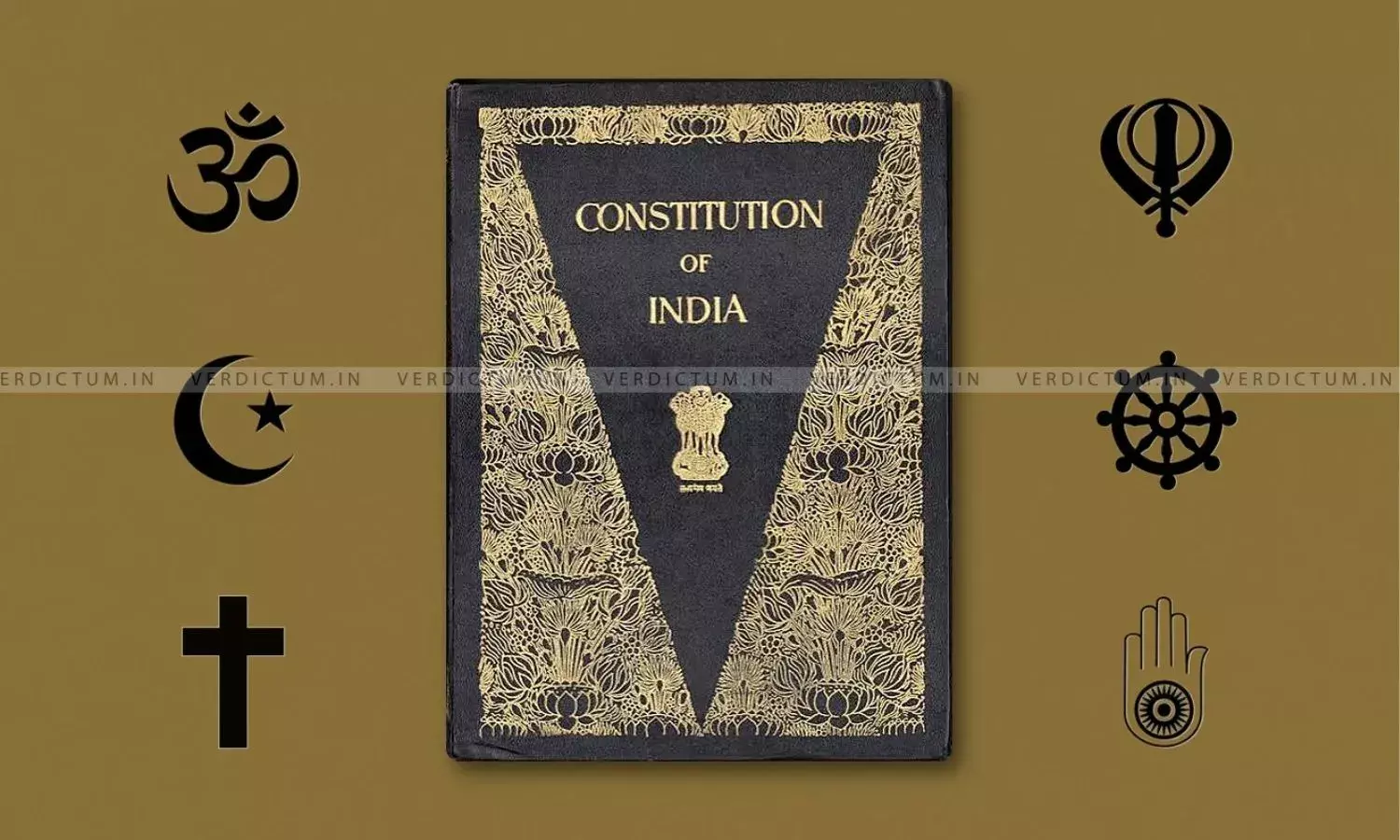
Speaking in the Constituent Assembly on 1 May 1947, in the debate on the clause dealing with conversions, Sardar Vallabhbhai Patel said:
"Sir, this is not a matter free from difficulties. There is no point in introducing any element of heat in this controversy. It is well known in this country that there are mass conversions, conversions by force, conversions by coercion and undue influence, and we cannot disguise the fact that children also have been converted, that children with parents have been converted and that orphans have been converted. Now, we need not go into all the reasons or the forces that led to these conversions, but if the facts are recognised, we who have to live in this country and find a solution to build up a nation, we need not introduce any heat into this controversy to find a solution."[1]
The time has come to find a solution. For the last eighty years, the word "propagate", which generated heat in the Constituent Assembly, has remained in the Constitution, generating more friction and heat.
The word "propagate" was among the most contested words in the Constituent Assembly, and was the subject of lengthy debate. Despite differing opinions on its inclusion in the Constitution, and particularly among the fundamental rights, there was near-unanimous agreement that there is no right, much less a fundamental right, to convert another person by force, fraud, inducement or undue influence. The right to "propagate" religion in Article 25(1) was accepted in the Constituent Assembly on a clear understanding that propagation meant the exposition of a faith. It did not extend to conversions brought about by force, fraud, inducement or undue influence. The Assembly dropped a separate clause on such conversions (clause 17 of the Interim Report on Fundamental Rights) only because every member agreed that they were already unlawful and that the legislature would deal with them. Assurances were given in the Assembly, including by its Christian members, that the right would not be used for such conversions, and they were repeated by Christian leaders in 1955. This article examines the Constituent Assembly Debates, the evidence recorded by the Niyogi Committee in 1955, the judgments of the Supreme Court and the experience since 1950. The analysis clearly shows that the assurances have not been kept, and that the law the framers expected must now be enacted where it is absent and strictly enforced where it exists. It also argues that, in practice, "propagate" has operated less as a right than as a power, exercised by organised bodies over those least able to resist it, and asks whether the tenet of particular faiths sits comfortably among the fundamental rights of a secular Constitution.
I. Introduction
Article 25(1) of the Constitution provides that, subject to public order, morality and health and to the other provisions of Part III, all persons are equally entitled to freedom of conscience and the right freely to profess, practise and propagate religion. Of these words, "propagate" was the most contested in the Constituent Assembly. It has remained the most contested since.
The word has proved troublesome, and its consequences have been far-reaching. The word was not adopted because the Assembly believed in it. It was a concession made by the majority community, on assurances given by the minority (Christian) community and its leaders that it would not be used to proselytise.
Conversions may be brought about by force, coercion, threat, fraud, misrepresentation, undue influence, material inducement or similar means. In each case, the change of faith does not come from the free conviction of the convert. It is procured by another. In this article, all such conversions are referred to together as "procured conversions".
Considering that there was general agreement that free India would be a secular democracy, the word "propagate" ought not to have found a place in the Constitution, let alone among the fundamental rights. The debates reflect this position. Secularism essentially means that every individual has freedom of conscience. He may follow any religion, change it by conviction, or follow none. A person who changes his faith by his own conviction exercises that freedom, and his choice deserves the same respect as the choice of one who keeps his faith. But no one has a right, or a power in the garb of a fundamental right, to convert another. Where one person sets out to convert another, the other has an inherent right to protest and to resist that attempt by lawful means. This conflict generates friction and heat in the society and a solution must be found to prevent this unwarranted and avoidable friction. This article is not directed against any faith or its followers. Its concern is with procured conversions, by whichever faith they are made.
The question examined is narrow. What did the framers understand by "propagate", and how and why did it remain in the Constitution? The answer is drawn from the Constituent Assembly Debates. The article also explores consequences of the word remaining in the Constitution, the evidence recorded by the Christian Missionary Activities Enquiry Committee of Madhya Pradesh in 1954 and 1955 (the Niyogi Committee Report), the judgments of the Supreme Court, and the record of practice since 1950.
II. The Text and Its Origins
The Sub-Committee on Fundamental Rights, in its report of 16 April 1947, proposed: "Conversion from one religion to another brought about by coercion or undue influence shall not be recognized by law and the exercise of such coercion shall be an offence."[2]
The Advisory Committee placed two clauses before the Assembly in its Interim Report. Clause 13 provided: "All persons are equally entitled to freedom of conscience, and the right freely to profess, practise and propagate religion subject to public order, morality or health, and to the other provisions of this Chapter." Clause 17 provided: "Conversion from one religion to another brought about by coercion or undue influence shall not be recognised by law."[3] The word "propagate" in clause 13 was the result of a compromise with the minorities, on which, as K.M. Munshi later told the House, the Indian Christian community "laid the greatest emphasis".[4] Clause 17 was its counterpart. The two were meant to complement and balance each other.
III. Clause 17: Agreement that Procured Conversions are Unlawful
A. The debate of 1 May 1947
Clause 13 was adopted on 1 May 1947 without a debate on the word "propagate". The debate came on clause 17. K.M. Munshi moved a substitute clause: "Any conversion from one religion to another of any person brought about by fraud, coercion or undue influence or of a minor under the age of 18 shall not be recognised by law." He explained its effect:
"The only effect of non-recognition by law would mean that even though a person is converted by fraud or coercion or undue influence or be converted during his minority he will still in law be deemed to continue to belong to the old religion and his legal rights will remain unaffected by reason of his conversion. The idea behind this proposal is that very often, if there are conversions by fraud or undue influence or during minority, certain changes in the legal status take place, certain rights are lost."[5]
When Rohini Kumar Chaudhari asked whether "undue influence" carried its meaning under the Contract Act, Munshi replied that it was difficult for him to say, but that "'fraud' is fraud all the world over and in all systems of jurisprudence".[6] P.R. Thakur, speaking for the Depressed Classes, described the problem the clause was meant to meet:
"Sir, I am a member of the Depressed Classes. This clause of the Fundamental Rights is very important from the standpoint of my community. You know well, Sir, that the victims of these religious conversions are ordinarily from the Depressed Classes. The preachers of other religions approach these classes of people, take advantage of their ignorance, extend all sorts of temptations and ultimately convert them. I want to know from Mr. Munshi whether 'fraud' covers all these things. If it does not cover, I should ask Mr. Munshi to re-draft this clause so that fraud of this nature might not be practised on these depressed classes. I should certainly call these 'fraud'."[7]
The principal objection to Munshi's amendment came from the Christian members, and it was confined to the position of minors. On the principle of the clause itself, they were in full agreement. Frank Anthony said:
"I agree that conversion under undue influence, conversion by coercion or conversion by fraud should not be recognised by law. I am only interested in this question, Sir, on principle. My community does not propagate. We do not convert, nor are we converted. But I do appreciate how deeply, how passionately millions of Christians feel on this right to propagate their religion."[8]
He went on to remind the House of the safeguard it had provided:
"You have your safeguards. You have provided that conversion by undue influence, conversion by fraud, conversion by coercion shall not be recognised by law."[9]
Rev. J.J.M. Nichols-Roy, who opposed any age limit on grounds of conscience, said:
"I know there are those who change their religion being influenced by material considerations, but there are others who are converted being under the influence of spiritual power. ... I am against any conversion by undue influence or by fraud or coercion. When we make a law against all these evils we should be careful to see that that law does not oppress the consciences of the youths who also need freedom."[10]
Purushottam Das Tandon explained what the right of propagation had been understood to mean:
"What we gave them with our right hand is that they have a right to convert others by an appeal to reason and after honestly changing their views and outlook. The three words, 'coercion', 'fraud' and 'undue influence' are included as provisos and are meant to cover the cases of adult converts."
"Sir, I am astonished at the manner in which some Christian friends have advanced the claim to convert minors. We have agreed to the right of conversion. Generally, we, Congressmen do not think it at all right, I say so frankly, that people should strenuously go about trying to convert peoples of other faith into their own, but we want to carry our Christian friends with us, friends who feel that they should have the right to make conversions, and we have agreed on their insistence to retain this formula about 'propagation'. They know that we are opposed to it, yet we have agreed."
"I know that most Congressmen are opposed to this idea of 'propagation'. But we agreed to keep the word 'propagate' out of regard for our Christian friends."[11]
D.N. Datta disputed Tandon's account of the Congress members' view.[12] Rev. Jerome D'Souza, however, confirmed the spirit of the arrangement from the minority side:
"As far as the minority rights are concerned, I can only say this, that the way in which clause 13 has been handled by this House is so reassuring and so encouraging to the minorities that we have no reason at all to quarrel or to ask for stronger assurances. That attitude must provoke on the part of the minorities an equally trustful attitude which I hope will inspire future relations and future discussions."[13]
Jagat Narain Lal said that clause 13 went "to the farthest limit", that no modern constitution conceded a right to propagate, and that "the amendment tabled by Mr. Munshi becomes essential if the right to propagate is conceded".[14] Algu Rai Shastri put the same point plainly: "convert only those who can be legitimately converted. Improper conversions would not be right."[15]
Dr. Ambedkar opposed only the bar on minors. He accepted that a child under lawful guardianship should not be converted without the knowledge of the guardian, calling it "a simple proposition to which there can be no objection". He then said:
"The mere fact that we have made no such reference in clause 17 of the Fundamental Rights does not in my judgment prevent the legislature when it becomes operative from making any law in order to regulate this matter."[16]
Sardar Patel closed the debate with the statement quoted at the beginning of this article. He acknowledged that "it is well known in this country that there are mass conversions, conversions by force, conversions by coercion and undue influence", including conversions of children and orphans, and asked that the clause be referred back for one more effort.[17]
The clause was referred back to the Advisory Committee.
B. The debate of 30 August 1947
When the clause returned on 30 August 1947, Patel said:
"The Committee discussed this and there were several other suggestions made by the House and the clause was referred back to the Committee. After further consideration of this clause, which enunciates an obvious principle, the Committee came to the conclusion that it is not necessary to include this as a fundamental right. It is illegal under the present law and it can be illegal at any time."[18]
Ananthasayanam Ayyangar responded:
"It is unfortunate that religion is being utilised not for the purpose of saving one's soul but for disintegrating society. ... What has religion to do with a secular State? Our minorities are communal minorities for which we have made provision. Do you want an opportunity to be given for numbers to be increased for the purpose of getting more seats in the Legislatures? That is what is happening."[19]
R.V. Dhulekar strongly advocated retaining the clause. He said:
"I submit that we cannot now tolerate things of this nature. We are being attacked, and we do not want that India’s population, the numerical strength of the Hindus and other communities should gradually diminish, and after ten years the other people may again say that “we constitute a separate nation”. These separatist tendencies should be crushed.
Therefore I request that section 17 may be retained in the same form as is recommended by the Advisory Committee."[20]
Patel replied:
"Much of this debate may be shortened if it be recognised that there is no difference of opinion on the merits of the case that forcible conversion should not be or cannot be recognised by law; on that principle there is no difference of opinion. The question is only whether this clause is necessary in the list of fundamental rights. Now, if it is an objective for the administration to act, it has a place in the Second Part which consists of non-justiciable rights. If you think it is necessary, let us transfer it to the Second Part of the Schedule because it is admitted that in the law of the land forcible conversion is illegal. We have even stopped forcible education and, we do not for a moment suggest that forcible conversion of one by another from one religion to another will be recognised. But suppose one thousand people are converted, that is not recognised. Will you go to a court of law and ask it not to recognise it? It only creates complications, it gives no remedy. But if you want this principle to be enunciated as a seventh clause, coming after clause 6, in the Second Schedule, it is unnecessary to carry on any debate; you can do so. There is no difference of opinion on the merits of the case. But at this stage to talk of forcible conversion on merits is absurd, because there cannot be any question about it."[21]
Dhulekar said: "I agree that it may be transferred there." Patel said: "It will be transferred."[22] Hussain Imam then added:
"Sir, what I came to suggest was that this is such a fundamental thing, that there is no need to provide for it. According to the law everything which has been done under coercion is illegal. Anything done by reason of fraud can never stand. Forcible conversion is the highest degree of undesirable thing. But it is not proper, as the Sardar himself has admitted, to provide it in the justiciable fundamental rights."[23]
The President put the motion "That this should not be put in the Fundamental Rights", and it was adopted.[24] No motion was put to place the principle anywhere else. Sir B.N. Rau's draft of October 1947 contains no conversion clause, either among the fundamental rights or among the directive principles.[25]
Two conclusions follow. Clause 17 was dropped not because the Assembly approved of procured conversions, but because every member who spoke on clause 17, in May and August 1947, Hindu, Muslim and Christian, agreed that they were already unlawful. And the assurance that the principle would be placed elsewhere in the Constitution was not carried out.
IV. The Legislature Was Expected to Act
The framers did not leave the matter open. Introducing the Supplementary Report on 30 August 1947, Patel said the Committee had "thought it better to leave it to the legislature".[26] Dr. Ambedkar said on 1 May 1947 that the omission of the clause would not prevent the legislature from regulating the matter. Patel offered the clause a place among the directive principles so that the administration would act on it. Hussain Imam said the law already made such conversions void. On 6 December 1948, K. Santhanam put the position in terms that leave no room for doubt:
"Sir, some discussion has taken place on the word 'propagate'. After all, propagation is merely freedom of expression. I would like to point out that the word 'convert' is not there. Mass conversion was a part of the activities of the Christian Missionaries in this country and great objection has been taken by the people to that. Those who drafted this Constitution have taken care to see that no unlimited right of conversion has been given. People have freedom of conscience and, if any man is converted voluntarily owing to freedom of conscience, then well and good. No restrictions can be placed against it. But if any attempt is made by one religious community or another to have mass conversions through undue influence either by money or by pressure or by other means, the State has every right to regulate such activity."[27]
The framers therefore expected two things. Procured conversions would remain unlawful. The State would regulate them by law. That was the premise on which the word "propagate" was allowed to remain.
V. December 1948: Propagation as Exposition
When Draft Article 19 (now Article 25) was taken up, Lokanath Misra moved to drop the word "propagate". He said:
"But this unjust generosity of tabooing religion and yet making propagation of religion a fundamental right is somewhat uncanny and dangerous. ... Let everybody live as he thinks best but let him not try to swell his number to demand the spoils of political warfare."
"If people should propagate their religion, let them do so. Only I crave, let not the Constitution put it as a fundamental right and encourage it. Fundamental rights are inalienable and once they are admitted, it will create bad blood. I therefore say, let us say nothing about rights relating to religion. Religion will take care of itself. Drop the word 'propagate' in article 19 at least."[28]
Prof. K.T. Shah moved a proviso to protect those most exposed to influence:
"Provided that no propaganda in favour of any one religion which is calculated to result in change of faith by the individuals affected, shall be allowed in any school or college or other educational institution, in any hospital asylum or in any other place or institution where persons of a tender age, or of unsound mind or body are liable to be exposed to undue influence from their teachers, nurses or physicians, keepers or guardians or any other person set in authority above them, and which is maintained wholly or partially from public revenues, or is in any way aided or protected by the Government of the Union, or of any State or public authority therein."[29]
Rohini Kumar Chaudhari had no objection to propagation as such. He said:
"Another point is the propagation of religion. I have no objection to the propagation of any religion. If anyone thinks that his religion is something ennobling and that it is his duty to ask others to follow that religion, he is welcome to do so. But what I would object to is that there is no provision in this Constitution to prevent the so-called propagandist of his religion from throwing mud at some other religion. For instance, Sir, in the past we remember how missionaries went round the country and described Sri Krishna in the most abominable terms. They would bring up particular activities of Sri Krishna and say, “Look here, this is your Lord Krishna and this is his conduct”. We also remember with great pain how they used to decry the worship of the idols and call them names. Sir, in the new Constitution we must make it perfectly clear that no such thing will be tolerated. It is not necessary in the course of propagating any particular religion to throw mud at other religions, to decry them and bring out their unsatisfactory features according to the particular supporters of a particular religion. There should be a provision in the law, in the Constitution itself that such conduct will be met with exemplary punishment."[30]
All the amendments to delete or qualify the word were, however, negatived.
The defence of the word rested entirely on the distinction between exposition and procurement. Pandit Lakshmi Kanta Maitra said:
"The point of my whole contention is that the Christian community in India has not done that proselytising work with that amount of zeal and frenzy with which some of our friends have associated it. ... Propagation does not necessarily mean seeking converts by force of arms, by the sword, or by coercion. But why should obstacles stand in the way if by exposition, illustration and persuasion you could convey your own religious faith to others?"[31]
Shri L. Krishnaswami Bharathi, who spoke after Pandit Maitra, added that "the Christian community have not transgressed their limits of legitimate propagation of religious view", and that "it is not to be understood that when one propagate[s] his religion he should cry down other religions. It is not the spirit of any religion to cry down another religion."[32]
T.T. Krishnamachari said:
"It is perfectly open to the Hindus and the Arya Samajists to carry on their Suddhi propaganda as it is open to the Christians, the Muslims, the Jains and the Buddhists and to every other religionist, so long as he does it subject to public order, morality and the other conditions that have to be observed in any civilised government. ... The fact that many people in this country have embraced Christianity is due partly to the status that it gave to them. ... So I feel that any undue influence that might be brought to bear on people to change their religion or any other extraneous consideration for discarding their own faith in any particular religion and accepting another faith will no longer exist."[33]
K.M. Munshi gave the decisive defence:
"In 1937 when the first Congress Ministry came into power in Bombay, the Christian missionaries who till then had great influence with the Collectors of the Districts and through their influence acquired converts, lost it and since then whatever conversions take place in that part of the country are only the result of persuasion and not because of material advantages offered to them. In the present set up that we are now creating under this Constitution, there is a secular State. There is no particular advantage to a member of one community over another; nor is there any political advantage by increasing one's fold. In those circumstances, the word 'propagate' cannot possibly have dangerous implications, which some of the Members think that it has."
"Moreover, I was a party from the very beginning to the compromise with the minorities, which ultimately led to many of these clauses being inserted in the Constitution and I know it was on this word that the Indian Christian community laid the greatest emphasis, not because they wanted to convert people aggressively, but because the word 'propagate' was a fundamental part of their tenet. Even if the word were not there, I am sure, under the freedom of speech which the Constitution guarantees it will be open to any religious community to persuade other people to join their faith. So long as religion is religion, conversion by free exercise of the conscience has to be recognised. The word 'propagate' in this clause is nothing very much out of the way as some people think, nor is it fraught with dangerous consequences."
"Speaking frankly, whatever its results we ought to respect the compromise."[34]
Dr. Ambedkar's reply was confined to two sentences: "I have nothing to add to the various speakers who have spoken in support of this article. What I have to say is that the only amendment I am prepared to accept is amendment No. 609." When H.V. Kamath protested that he should reply to the points raised, the Vice-President ruled: "I am afraid we cannot compel Dr. Ambedkar to give reasons for rejecting the various amendments."[35]
The Assembly was divided, therefore, only on whether the distinction between exposition and procurement would be respected in practice. Those who supported the word trusted that it would be. Those who opposed it doubted that it would. No member argued that propagation included the right to procure conversions. In the result, the word "propagate" remained as a compromise on the basis of assurances that it would not be used to proselytise.
A tenet of faith in a secular Constitution
Munshi's defence of the word rested on one ground. The word was "a fundamental part of their tenet".[36] It was added to give constitutional recognition to the tenet of particular faiths which require their followers to seek converts.
That raises a question which the Assembly did not answer. Several of India's faiths do not, as a matter of doctrine, seek converts. A fundamental right framed around the tenet of the faiths that do seek converts does not operate equally between faiths. Lokanath Misra saw this when he spoke of the "unjust generosity of tabooing religion and yet making propagation of religion a fundamental right".[37] Ananthasayanam Ayyangar asked: "What has religion to do with a secular State?"[38] A secular State is neutral between faiths. It protects the freedom of every person to hold, practise and change his faith. It does not follow that neutrality requires the State to guarantee, as a fundamental right, the doctrinal mission of some faiths to enlarge their following.
It may be said that reconversion, or "ghar wapsi", shows that the right is used by all faiths alike. That is not so. A return to one's former faith is not proselytisation. It does not seek to enlarge a following by drawing persons away from another faith. It restores a person to the faith from which he was drawn, and it is usually a reaction by a community seeking to stall conversions that it regards as procured. The law recognises the difference. The Uttar Pradesh Prohibition of Unlawful Conversion of Religion Act, 2021 provides that if any person re-converts to his immediate previous religion, "the same shall not be deemed to be a conversion under this Act".[39] The test, however, is the same for all. A reconversion procured by force, fraud or inducement would be as objectionable as any other procured conversion.
The real asymmetry lies elsewhere. Article 25 confers on the faith that seeks converts a positive right to propagate. It confers on the faith whose followers are sought no corresponding right to protect them. One side holds a positive right. The other side has, at most, a negative freedom to be left alone, which it cannot enforce against a private propagator. One faith has the power to convert. The other does not even have a right to prevent it. The community whose members are the object of organised conversion has no constitutional remedy of its own. Its only protection is the law of the State. That is why the framers' expectation that the legislature would act was not incidental. It was the only counterweight to the right they conferred.
That counterweight was never put in place. Despite strong opposition, the word "propagate" remained among the fundamental rights. Despite the assurance that clause 17 would be transferred from the fundamental rights to the non-justiciable part, which became the Directive Principles of State Policy, that was not done. The expectation of the framers that proper law would be enacted has not been met in most States. Where such laws have been enacted, they have faced serious opposition, both to their enactment and to their implementation.
Freedom of conscience is not a one-sided freedom. It belongs equally to the person who is approached and to the community to which he belongs. If one person may seek to change another's faith, that other person, and the members of his family and community, have an equal and inherent right to protest, to counsel against the change and to resist the attempt by lawful means. The freedom is equally that of the person who, after reflection, chooses another faith. His family and community may counsel him, but they cannot coerce him. Resistance by threat, social boycott or violence is as much a violation of conscience as conversion by inducement. Those who are steeped in a tenet that requires them to convert others often cannot see this point of view. To them, propagation is a duty and resistance is persecution. That inability to see the other side is a principal cause of the friction which conversion campaigns have produced in society and even within families.
VI. The Majority's Concession and the Assurances of the Christian Leaders
The word "propagate" was a concession made by the majority community. Tandon told the House that, though most Congressmen were opposed to it, they had agreed to retain the word "on their insistence" and "out of regard for our Christian friends".[40] Jagat Narain Lal said the House had already gone "to the farthest limit".[41] Munshi, who had been a party to the compromise from the beginning, asked the House to respect it "whatever its results".[42] The concession was given in exchange for assurances. Those assurances were given on the floor of the House, including by Christian members, and were later restated by the leaders of the Christian community before the Niyogi Committee.
The word was retained on the strength of specific assurances, given on the floor of the House:
First, by Frank Anthony and Rev. Nichols-Roy, speaking from the Christian benches, that conversions by fraud, coercion or undue influence should not be recognised by law.
Second, by Rev. Jerome D'Souza, that the handling of clause 13 "must provoke on the part of the minorities an equally trustful attitude".[43]
Third, by Munshi, that the Christian community valued the word as part of its faith and "not because they wanted to convert people aggressively", and that in a secular State conversion would bring no political or material advantage.[44]
Fourth, by Krishnamachari, that with social equality guaranteed, the incentive and the undue influence that drew the depressed classes to conversion "will no longer exist".[45]
Fifth, by Maitra and Santhanam, that propagation meant exposition and persuasion, and that mass conversion through money or pressure could be regulated by the State.
The majority accepted those assurances. It retained the word over strong objections, and Munshi asked the House to respect the compromise "whatever its results".[46]
VII. The Christian Community's Own Statements, 1955
Seven years later, the Christian community's own leaders restated both the distinction and the assurances before the Christian Missionary Activities Enquiry Committee, appointed by the Government of Madhya Pradesh on 14 April 1954 under the chairmanship of Dr. M. Bhawani Shankar Niyogi, retired Chief Justice of the Nagpur High Court.[47] Their statements are recorded in Volume II, Part B of the Report.
A. The Catholic Bishops' Conference of India
On 15 February 1955, the Standing Committee of the Catholic Bishops' Conference of India wrote to the Chief Minister of Madhya Pradesh, Pandit Ravi Shankar Shukla:
"The allegation that conversions are made by force, fraud or by offer of material inducement cannot be levelled against our Missionaries. They derive no personal advantage by preaching the Gospel of Christ. Their only object is to spread the Christian teaching in regard to God, man's relations with his fellowmen and future life. No one can be converted against his will. Every person is free to choose his way of life according to his own lights and convictions. Whoever desires to embrace the Catholic faith has to undergo a course of religious instruction and one can be received into the Church only when one is convinced of the truths of Christianity and manifests a sincere and persevering desire to accept the faith and practise it. Conversion is a personal act of free will. Utmost care is exercised to respect the freedom and the conscientious convictions of every individual."[48]
The Bishops added that every community had the right to spread its religion "by legitimate and peaceful means". They recalled their own declaration of October 1945 that the Church "has always respected and will always respect the religious convictions of non-Catholic students. She never has, and never will, impose her teaching on them." They relied on the Constituent Assembly itself. They cited Pandit Maitra's description of the Indian Christians as the most inoffensive community. They recalled that the Christian community had voluntarily surrendered separate representation and reserved seats, which Frank Anthony had described as an act of faith in the majority community.
B. The Christian Association, Nagpur
The Christian Association of Nagpur told the Committee in February 1955:
"In the conviction that these constitutional guarantees of Religious Freedom were adequate for a minority which had no other ambition, Christians surrendered all their seats in the State Legislatures and in Parliament, and appointed the Hindus to be the guardians of their rights and interests."[49]
The same memorandum asserted that the right to propagate "is not limited by any other conditions save those expressly mentioned in the Constitution", and that every citizen may propagate "FREELY". The limits on which the Assembly's trust had rested were not acknowledged.
C. Christian witnesses on the meaning of propagation
Dr. D.G. Moses, Principal of Hislop College, Nagpur, gave evidence on 20 September 1955:
"It consists in telling all and sundry what great things the Lord has done to you. The motive is to express infinite thankfulness to God for what he has done. The idea of converting people to my faith is not inherent in the concept of propagating my religion. In fact I do not place any importance on mere numbers although if I come across a person who having heard me 'bear witness' wishes to join my faith I would rejoice. ... The possibility of improper motives entering into the minds of Christians for converting people merely for the sake of numbers is there, as it is present amongst any other section of the community. But this I would not classify as propagation of such religion. If masses are induced to become Christians only to add to the numbers for secular objects and on false pretences, that is not propagation of religion."
"If there is a body which declares its intention to convert 600,000 villages to Christianity with material resources then I would not call it as propagation of religion. If such activities are checked by society I would say that the action would be justified as it aims to prevent growth of ill-feeling amongst various sections of community."
"If a school or a hospital is used mainly as an instrument for conversion to Christianity it is not evangelism."[50]
Rev. Canon Kurian of the Cathedral House, Nagpur, said:
"There is difference between conversion and proselytization. Proselytization means only adding to the numbers. ... The preaching does not mean attacking any other religion or the persons who are venerated by them. If somebody were to say that unless he became a Christian he would go to hell it is not called propagation."[51]
Dr. L. Jiwanmall, a Christian physician who had served fourteen years in a mission hospital, said:
"I am of opinion that hospitals should not be used as means of propagation, because the life of the Christian doctor is a very potent Christian. I am not in favour of Bible being taught in schools. I am not in favour of hospitals being used for proselytising purposes."[52]
The distinction between propagation and proselytisation was therefore not a construction placed on Article 25 by its critics. It was stated, in terms, by Christian leaders themselves. By their own standard, mass inducement, the use of schools and hospitals as instruments of conversion, and threats of damnation are not propagation.
VIII. The Record of Practice
A. Evidence before the Niyogi Committee
The same volume records evidence that the assurances were not being uniformly observed even in 1955. Shri Laxman Shrawan Bhatkar of Chikhli, a social worker of the Mahar community, a member of the provincial legislature from 1938 to 1942, a sitting Member of Parliament and a former member of the Constituent Assembly, said:
"To the best of my knowledge and experience there are very few people who change their religion out of conviction. As I have already said that the Harijans are poor and ignorant they are naturally induced to become Christians if they are offered the post of a preacher or teacher."[53]
A leprosy patient, Ukarda Govinda Dhangar, stated:
"I am suffering from leprosy for the last one year. After some slight treatment I went to Ellichpur leper asylum which is conducted by the Baptist Mission. A doctor drew blood from one or two places of my body and asked me to stay in the boarding. He asked me to come into his religion if I wanted treatment. In other words he said that I should become a Christian. I refused and came out. Now I am getting treatment from the Municipal leper clinic."[54]
Many converts also told the Committee that they had changed their faith freely. That evidence must be acknowledged. But the record shows that procured conversions were already a matter of concern within a decade of the Constitution.
B. Healing meetings, miracle cures and mass baptisms
In recent years, "changai sabhas" (healing meetings) have become a prominent feature of evangelical activity. Press reports describe large gatherings at which pastors claim to cure cancer, paralysis, blindness and other chronic illnesses by prayer, and to cast out evil spirits.[55] Some ministries offer baptism in which followers are made to take a dip in "holy water". Others claim cures through anointing oils and holy water. Claims of cures are recorded on camera and circulated on social media to draw further crowds.[56]
These practices are exactly what the Christian community said, in 1947 and 1948 and again in 1955, that it would not do. They are also the "mass conversions" that Patel recognised in 1947 as a known fact.[57] A promise of a cure for a disease is a material inducement. A public demonstration of a "miracle" before a crowd of the sick and the poor is an exploitation of their vulnerability. Mass baptism at such gatherings is conversion procured in numbers. By Dr. Moses's own test, it is "not propagation of religion".[58] By Dr. Jiwanmall's test, healing is being used as a means of propagation. By the Bishops' own assurance, conversion was to be "a personal act of free will" after religious instruction and conviction, not a response to the promise of a cure.
Those who attend such meetings are, in most cases, the sick and the desperate. The promise of a cure is held out by those who have the power to make it. Those to whom it is made are rarely in a position to resist it. This is propagation operating as a power, not as a right.
C. Demographic change
At the national level, the share of Christians in the population has remained broadly steady, at 2.34 per cent in 2001 and about 2.3 per cent in 2011.[59] The national figure, however, conceals sharp regional change, much of it among Scheduled Tribes. In Arunachal Pradesh, Christians formed 0.79 per cent of the population in 1971 and 30.26 per cent in 2011. In Manipur, the share rose from 19.49 per cent in 1961 to 41.29 per cent in 2011. In Meghalaya, it rose from 70.3 per cent in 2001 to 74.6 per cent in 2011.[60] Natural growth and migration account for part of these changes. A change of this order within a few decades, however, cannot be explained without conversion on a large scale.
The national figure is also likely to understate the true position, for the reason discussed below.
D. Reservation and undeclared conversion
Paragraph 3 of the Constitution (Scheduled Castes) Order, 1950 confines Scheduled Caste status to persons professing the Hindu, Sikh or Buddhist religion. A Scheduled Caste person who converts to Christianity loses that status. There is, therefore, a strong incentive not to declare the conversion. In C. Selvarani v. Special Secretary-cum-District Collector, the Supreme Court considered the case of a person who was baptised and practised Christianity but claimed Scheduled Caste status as a Hindu for appointment to a reserved post. The Court held that conferring such status on a person who continues to profess Christianity, but claims to be Hindu only to avail reservation in employment, "would go against the very object of reservation and would amount to fraud on the Constitution".[61]
The position of Scheduled Tribes is different. Scheduled Tribe status under Article 342 is not dependent on religion. A tribal who converts retains that status, together with the benefits available to a member of a religious minority. This has given rise to a widely voiced grievance among tribal communities that converts enjoy the benefits of both, while the tribal institutions and customary practices that justify Scheduled Tribe status are weakened.
E. Social division
The consequence has been the friction that the critics of the word foresaw in 1948. Villages and families have divided along lines of faith. Tribal communities have seen their customary institutions split. Competing campaigns of conversion and reconversion have followed. Thirteen States have now enacted laws to regulate conversion, the most recent being the Maharashtra Freedom of Religion Act, 2026. Challenges to several of these laws are pending before a three-Judge Bench of the Supreme Court in Citizens for Justice and Peace v. State of Uttar Pradesh.
The friction is not confined to communities. It reaches into families. A convert in a household is often encouraged to bring the rest of the family into the new faith. Members who decline are treated as obstacles to salvation. Those who object are seen as opponents of a religious duty. Disputes over worship, rituals, marriage, funerals and inheritance follow. In such cases, the right to propagate operates within the family itself, and those who resist it have no protection whatsoever.
IX. The Judicial Position
The Supreme Court settled the meaning of "propagate" in Rev. Stainislaus v. State of Madhya Pradesh, upholding the Madhya Pradesh and Orissa Freedom of Religion Acts. A Constitution Bench held:
"What the Article grants is not the right to convert another person to one's own religion, but to transmit or spread one's religion by an exposition of its tenets. It has to be remembered that Article 25(1) guarantees 'freedom of conscience' to every citizen, and not merely to the followers of one particular religion, and that, in turn, postulates that there is no fundamental right to convert another person to one's own religion because if a person purposely undertakes the conversion of another person to his religion, as distinguished from his effort to transmit or spread the tenets of his religion, that would impinge on the 'freedom of conscience' guaranteed to all the citizens of the country alike."[62]
The Court did not refer to the Constituent Assembly Debates. Its conclusion, however, is precisely what the framers understood in 1948 and what Dr. Moses told the Niyogi Committee in 1955.
The law as declared is therefore clear. There is no right to procure a conversion, much less a fundamental right. What has been lacking is not clarity of law but legislation and enforcement.
X. Conclusion
On the basis of the Constituent Assembly Debates and the material examined above, the following conclusions may be drawn.
First, the framers distinguished between propagation and proselytisation. Propagation meant the exposition of a faith. It did not include procuring conversions.
Second, the framers expected the legislature to enact law against procured conversions. Patel's assurance that the principle would be placed in the non-justiciable part, which became the Directive Principles of State Policy, was never carried out.
Third, the view of the framers was clear: law would be enacted. Patel told the House that the Committee had “thought it better to leave it to the legislature”. Dr. Ambedkar said that the legislature was free to regulate the matter. Santhanam said that the State “has every right to regulate” mass conversions through undue influence. That law has not been enacted in most States, and where it has been enacted, it has met serious opposition.
Fourth, every member of the Assembly who spoke on the subject agreed that conversions procured by force, fraud, inducement or undue influence were unlawful. Clause 17 was dropped from the Fundamental Rights only because that was thought too obvious to need a constitutional provision.
Fifth, the word "propagate" was retained as a compromise with the minorities, on assurances given in the Assembly, including by its Christian members, and restated by Christian leaders in 1955.
Sixth, the practices now widely reported, including healing meetings, miracle cures, holy water baptisms and mass conversions among the poor and the tribal, are the very practices which those assurances excluded and which Christian witnesses themselves told the Niyogi Committee were not propagation.
Seventh, undeclared conversions to retain reservation benefits have been held by the Supreme Court to be a fraud on the Constitution.
Eighth, the word "propagate" was a concession by the majority, given on the strength of assurances by the leaders of the Christian community. It gave constitutional status to the tenet of particular faiths, in a Constitution that is otherwise neutral between faiths.
Ninth, in practice the word has operated less as a right than as a power, exercised by organised bodies over those least able to resist it. The faith that propagates holds a positive right. The faith whose followers are sought has no corresponding right to protect them. Its only protection is the law of the State. Reconversion to one's former faith is not proselytisation, and the law treats it differently.
In a secular Constitution, there is no place for procured conversions. Despite the assurances, the word "propagate" has been misused extensively, resulting in demographic changes and disrupting the peace in societies and families. The framers did not leave procured conversions unregulated by choice. They left the task to the legislature. Nearly eight decades later, that task remains incomplete. Law to prevent the misuse of the word "propagate" must be enacted where it is absent, and enforced where it exists. Such law must apply equally to every faith. That would not curtail the freedom granted by Article 25. It would give effect to the understanding on which the word "propagate" was allowed to remain in the Constitution, and make the working of the Constitution genuinely secular.
The author is a Senior Advocate.
[1]CAD, Vol. III, p. 502 (1 May 1947).
[2]Report of the Sub-Committee on Fundamental Rights, 16 April 1947, clause 22; B. Shiva Rao, The Framing of India's Constitution: Select Documents, Vol. II (1967), p. 174.
[3]Interim Report on Fundamental Rights, Advisory Committee, April 1947; Constituent Assembly Debates ("CAD"), Vol. III, p. 485 (1 May 1947).
[12]CAD, Vol. III, pp. 494–495 (1 May 1947). Datta stated that a majority of the Congress members had favoured keeping the word.
[25]Draft Constitution prepared by the Constitutional Adviser, October 1947, Draft Articles 20 and 31 to 41.
[39]Uttar Pradesh Prohibition of Unlawful Conversion of Religion Act, 2021, section 3(2) and Explanation ("immediate previous religion" means the religion in which the person had faith, belief or was practiced by the person voluntarily and freely). The Uttarakhand Freedom of Religion and Prohibition of Unlawful Conversion of Religion Act, 2018 (as amended in 2022) contains a similar provision.
[47]Reply of the Government of India in the Lok Sabha (Lok Sabha Digital Library, eparlib.sansad.in, document 26249). The Committee submitted its Report on 18 April 1956.
[48]Report of the Christian Missionary Activities Enquiry Committee, Madhya Pradesh, 1956 ("Niyogi Report"), Vol. II, Part B, pp. 43–47 at 45.
[55]"Cure cancer, undo death: Punjab's Christian 'prophet, pastors' offer miracles, compete with deras", ThePrint (2021); "Faith dealers: dedicated teams out to attract people to independent churches", The Tribune, Jalandhar.
[60]Census of India, 1961, 1971 and 2011 (religion tables); see also Pew Research Center, Religious Composition of India (2021).
[61]C. Selvarani v. Special Secretary-cum-District Collector, 2024 INSC 900, [2024] 11 SCR 1504 (decided 26 November 2024), per Pankaj Mithal and R. Mahadevan, JJ.
[62]Rev. Stainislaus v. State of Madhya Pradesh, (1977) 1 SCC 677 (Constitution Bench).
[The opinions expressed in this article are those of the author.]