Appears To Be A Case Of Regime Change Revenge: Calcutta High Court Upholds Order Setting Aside Mizoram Government's Land Sale Cancellation
The Court dismissed Mizoram’s appeal and upheld the direction to execute the sale deed, granting the State eight weeks to comply.
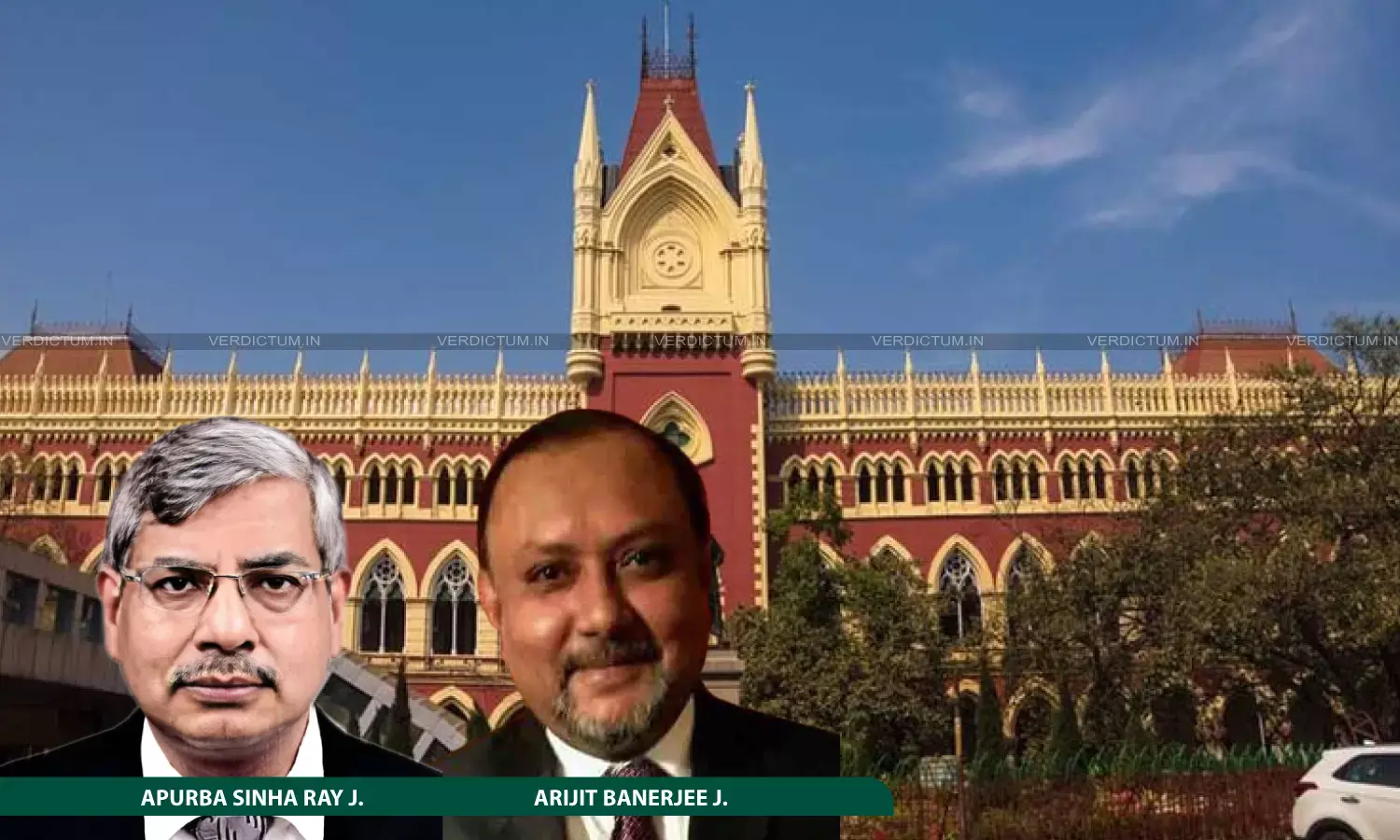
Justice Apurba Sinha Ray, Justice Arijit Banerjee, Calcutta HC
The Calcutta High Court has observed that the Mizoram Government’s cancellation of a concluded land-sale process after a change in political dispensation appeared to be a case of “regime revenge”, while upholding the order setting aside the cancellation.
The Court held that the Government could not renege on a promise acted upon by a citizen to his detriment merely because of a change in regime.
The Court was hearing the State of Mizoram’s appeal against a Single Judge’s decision setting aside the cancellation of an e-tender-cum-e-auction for the sale of Government land in Kolkata. The Single Judge had directed the State to execute and register the sale deed under the agreement entered into with the successful bidder.
A Division Bench of Justice Arijit Banerjee and Justice Apurba Sinha Ray observed: “It does appear to us that this is a case of ‘regime revenge’. The Government cannot renege on a promise made and acted upon by a citizen to his detriment, only because there is a change in regime.”
Advocate General Biswajit Deb appeared for the State of Mizoram, while Senior Advocate S.N. Mookherjee appeared for the successful bidder.
Background
The Government of Mizoram invited bids for the sale of land in Kolkata that had earlier housed a Mizoram Government guest house. The respondent company emerged as the highest bidder. The Government issued a letter of intent, exchanged drafts with the company and executed an agreement for sale after deliberations over its terms.
The company paid the entire consideration of approximately ₹38.30 crore, apart from penal interest for delayed payment. The Government accepted the amount without reservation, issued a letter of award and approved modifications to the draft sale deed. Only execution and registration of the conveyance remained.
When elections were imminent, the Government informed the company that the sale process would be carried forward after the election. Following a change in Government, the new administration cancelled the entire tender process, including the agreement for sale, citing public interest and representations from organisations referring to the property’s historical and sentimental importance.
The company challenged the cancellation. The Single Judge found it arbitrary, set it aside and directed the State to execute the sale deed. In appeal, Mizoram argued that it had reserved the right to cancel the tender before execution of the conveyance, that the proposed purchaser had acquired no title and that public interest justified the decision. It also relied on alleged non-compliance with Government financial rules and the availability of arbitration and a civil suit.
The company maintained that a binding agreement had been concluded after full payment and extensive correspondence. It argued that the Government had failed to demonstrate any overriding public interest and had acted arbitrarily after the change in political dispensation.
Court’s Observations
Arbitration Clause Did Not Bar Writ Jurisdiction
The Court rejected the State’s objection that the company should have pursued arbitration or instituted a suit for specific performance. It held that the availability of an alternative remedy did not deprive the High Court of jurisdiction under Article 226 of the Constitution, particularly where the challenged State action was alleged to be arbitrary and illegal.
The Bench observed: “We, therefore, see that existence of an alternative remedy does not affect the High Court’s jurisdiction to issue an appropriate writ under Article 226 of the Constitution of India. It is the discretion of the Court whether or not to exercise such jurisdiction in a given fact scenario.”
The Court found no error in the Single Judge’s exercise of discretion because the material facts were not disputed and the cancellation had been found arbitrary. It also held that a writ court could, in an appropriate case, direct an authority under Article 12 of the Constitution to honour a solemn undertaking.
Tender Cancellation Power Could Not Be Exercised Arbitrarily
The Court accepted that the tender terms reserved the State’s right to cancel the process before execution of the conveyance. However, it held that this power remained subject to the State’s obligation under Article 14 of the Constitution to act fairly, reasonably and without arbitrariness, including in commercial matters.
It observed: “It is true that the relevant clauses in the tender documents reserve the right to the appellant State to cancel the entire tender process prior to execution of conveyance; however, such right cannot be exercised arbitrarily or unfairly or unreasonably, vis-a-vis a citizen.”
The Bench noted that the parties had taken extensive steps to conclude the transaction. The State had accepted the complete consideration and penal payment without protest, finalised the agreement and deferred only the formal conveyance because of the election. The succeeding Government then cancelled the transaction without first entering into a dialogue with the company.
No Overwhelming Public Interest Justified Cancellation
The Court held that private interest must yield to public interest, but the public interest relied upon to escape a concluded contractual obligation had to be overwhelming and demonstrable.
It stated: “There is no doubt that private interest must give way to public interest. However, such public interest must be overwhelming and demonstrable.”
The Bench found that the two representations relied upon by the Government did not establish an overriding public interest sufficient to cancel a transaction that was nearing completion. It also noted that the State did not allege that the property had been undervalued or that completing the transaction would cause a loss to the exchequer.
The Court held that execution of the agreement and payment of the full consideration created, at least in equity, a right in favour of the company to obtain the conveyance and imposed a corresponding obligation upon the State. It observed: “The only way the appellant could wriggle out of such contractual obligation was by establishing overwhelming public interest. It has failed to do so.”
Internal Irregularity Could Not Defeat Accrued Contractual Rights
The Court rejected the State’s reliance on alleged non-compliance with financial rules. It observed: “Whether or not the Government followed its financial rules, is an internal matter for the Government of Mizoram. A third party dealing with the Government is entitled to proceed on the basis that official acts of the Government have been regularly performed.”
The Bench found no demonstrated breach of the Business Rules and held that internal irregularity could not defeat accrued rights under a binding contract.
Conclusion
The Division Bench held that the cancellation was unfair, unjust, arbitrary and contrary to Article 14 of the Constitution. It found no justification or demonstrated public interest for the succeeding Government’s unilateral cancellation of the tender process and agreement for sale after accepting the full consideration.
The Court dismissed Mizoram’s appeal and declined to interfere with the Single Judge’s direction to execute and register the sale deed. It granted the State eight weeks to comply with that direction and made no order as to costs.
Cause Title: State of Mizoram and Others v. Excel Vincom Private Limited and Another
Appearances
Appellants: Biswajit Deb, Advocate General, Mizoram; Sayan Dev Kumar, Priyakshi Banerjee, Sourav Ghosh and Priyanka Ghosh, Advocates
Respondents: S.N. Mookherjee, Senior Advocate; Rajarshi Dutta, Shaunak Mukhopadhyay, Shubrajyoti Mukherjee, Neelesh Choudhury and Anuradha Poddar, Advocates