

Calcutta High Court Stays ECI’s “Blanket Direction” Labelling 800 Citizens As “Trouble-Makers”; Says Action Can Be Taken Under BNS By Competent Authorities
The Court held that the Election Commission’s powers under Article 324 cannot override statutory provisions governing election offences and police action.
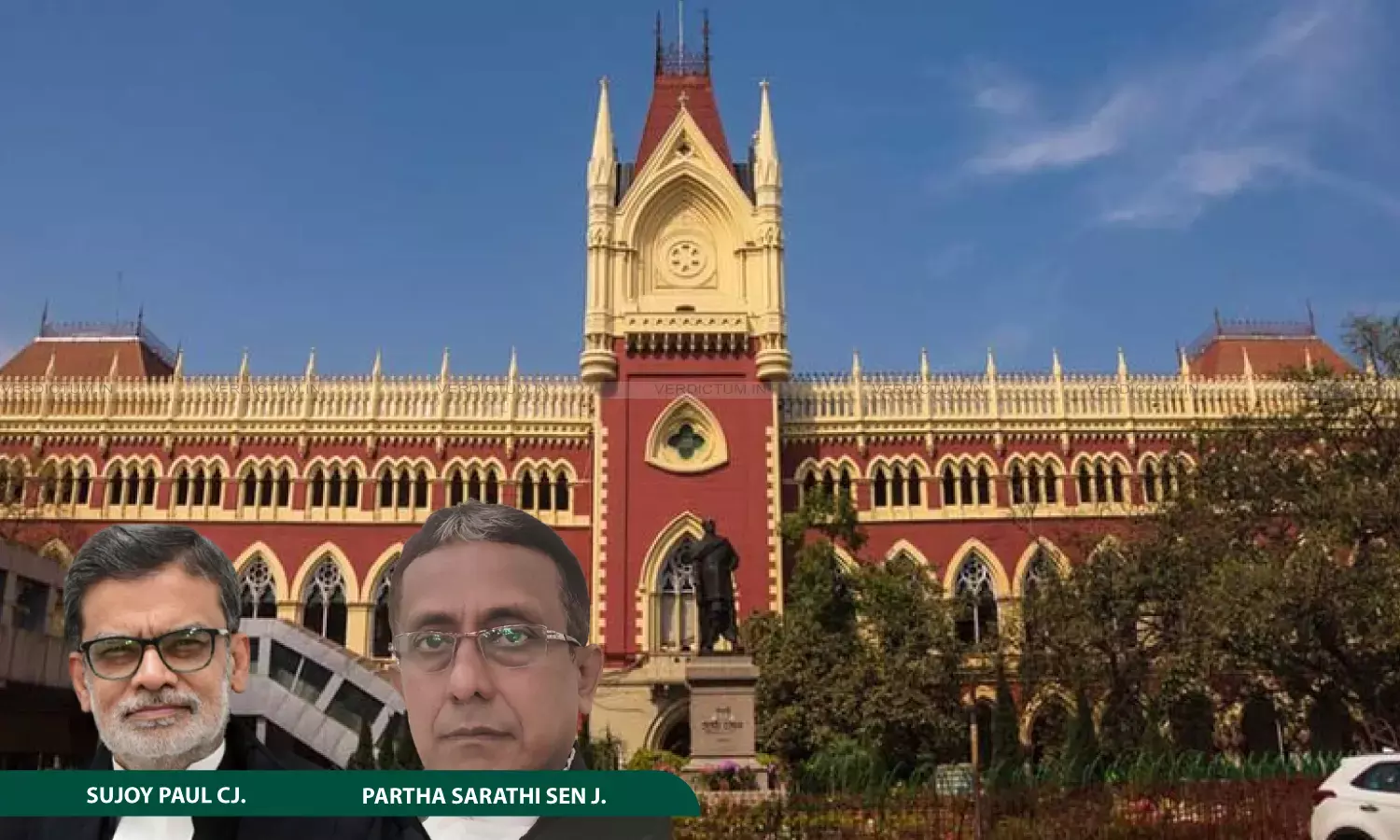
The Calcutta High Court has held that the Election Commission cannot issue blanket directions labelling citizens as trouble-makers and that any action in relation to alleged election offences must be taken strictly in accordance with the Bharatiya Nyaya Sanhita and the Representation of the People Act, 1951, by the competent statutory authorities, leading the Court to stay the impugned direction affecting around 800 individuals.
The Court was hearing a public interest writ petition challenging a direction issued by a Police Observer in the office of the Chief Electoral Officer, West Bengal, whereby certain individuals were identified as “trouble-makers” and directions were issued for action against them.
A Bench of Chief Justice Sujoy Paul and Justice Partha Sarathi Sen observed that “when the election-related offences are prescribed in B.N.S. and R.P. Act, 1951, the authorities entrusted therein alone are competent to take action as per their own discretion if any such offence is committed”.
The Bench therefore held that “the general power of superintendence and control of ECI under Article 324 of the Constitution is subject to other law, … and in our prima facie view, the police observer in the office of Chief Election Officer, West Bengal has erred in issuing a blanket direction by treating certain citizens as trouble-makers”.
Senior Advocate Kalyan Bandyopadhyay appeared for the petitioner, while with Advocate General Kishore Datta, Senior Advocates Dama Sheshadri Naidu & Joydip Kar appeared for the respondents
Background
The petition challenged a communication issued by the Police Observer attached to the office of the Chief Electoral Officer, West Bengal, which contained a list of approximately 800 individuals alleged to be involved in voter intimidation and disturbance of the electoral process.
The impugned communication directed authorities to take action against such persons, many of whom were stated to be elected representatives, including Members of Parliament, Members of Legislative Assembly, and local body representatives.
The petitioner contended that the classification of individuals as “trouble-makers” had no statutory basis and that the direction amounted to an arbitrary exercise of power, violating fundamental rights under Articles 21 and 22 of the Constitution.
It was further contended that offences relating to elections are specifically governed by the Bharatiya Nyaya Sanhita, Bharatiya Nagarik Suraksha Sanhita, and the Representation of the People Act, 1951, which prescribe a complete statutory framework for dealing with such offences.
The Election Commission defended the direction by submitting that it was issued to ensure free and fair elections and in furtherance of its constitutional mandate under Article 324.
Court’s Observation
The Court examined the scope of Article 324 and held that while the Election Commission is vested with wide powers to ensure free and fair elections, such powers are not unbridled.
The Court relied on precedent to hold that where statutory provisions exist governing a particular field, the Commission cannot act in a manner inconsistent with such provisions.
“This is trite that if a statute prescribes a thing to be done in a particular manner, it has to be done in the same manner and other methods are forbidden”, the Bench reiterated.
The Court noted that offences relating to elections are comprehensively covered under the Bharatiya Nyaya Sanhita and the Representation of the People Act, 1951. It held that action against individuals for such offences must be taken strictly in accordance with the procedure prescribed under these statutes.
It was observed that the authorities entrusted under these statutes alone are competent to take action, and such action must be based on independent application of mind.
“A conjoint reading of Articles 21, 22 of the Constitution with Entry – 9 of List – I and Entry -3 List – III of the Seventh Schedule of the Constitution of India makes it clear that freedom of a citizen can be curtailed only in accordance with the procedure prescribed under the law”, the Bench further added.
Conclusion
The High Court held, prima facie, that the impugned direction issued by the Police Observer was not in conformity with statutory and constitutional requirements.
Accordingly, the Court stayed the operation of the impugned order dated 21.04.2026 till the end of June 2026 or until further orders, while clarifying that authorities remain free to act against any person in accordance with law.
While granting interim relief, the Court clarified that its order would not prevent authorities from taking action against individuals who commit offences under applicable law.
Cause Title: Md. Danish Farooqui v. Election Commission of India & Ors
Appearances
Petitioner: Senior Advocate Kalyan Bandyopadhyay; Advocates Rahul Kumar Singh, Ratikanta Pal, Deshma Ghosh
Respondents: Senior Advocate Dama Sheshadri Naidu; Advocates Anamika Pandey, Abhinabha Thakur, Ghanashyam Pandey; Advocate General Kishore Datta; A.G.P. Swapan Banerjee; Advocates Sumita Shaw, Diptendu Narayan Banerjee, Soumen Chatterjee; Senior Advocate Joydip Kar; Advocates Biswaroop Bhattacharya, Sandip Dasgupta, Saaqib Siddiqui
