

Bombay High Court Asks Centre To Consider Setting Up Appellate Tribunal For Motor Accident & Railway Claims
The Bombay High Court was considering an appeal filed by an Insurance Company challenging the order passed by the Motor Accident Claims Tribunal.

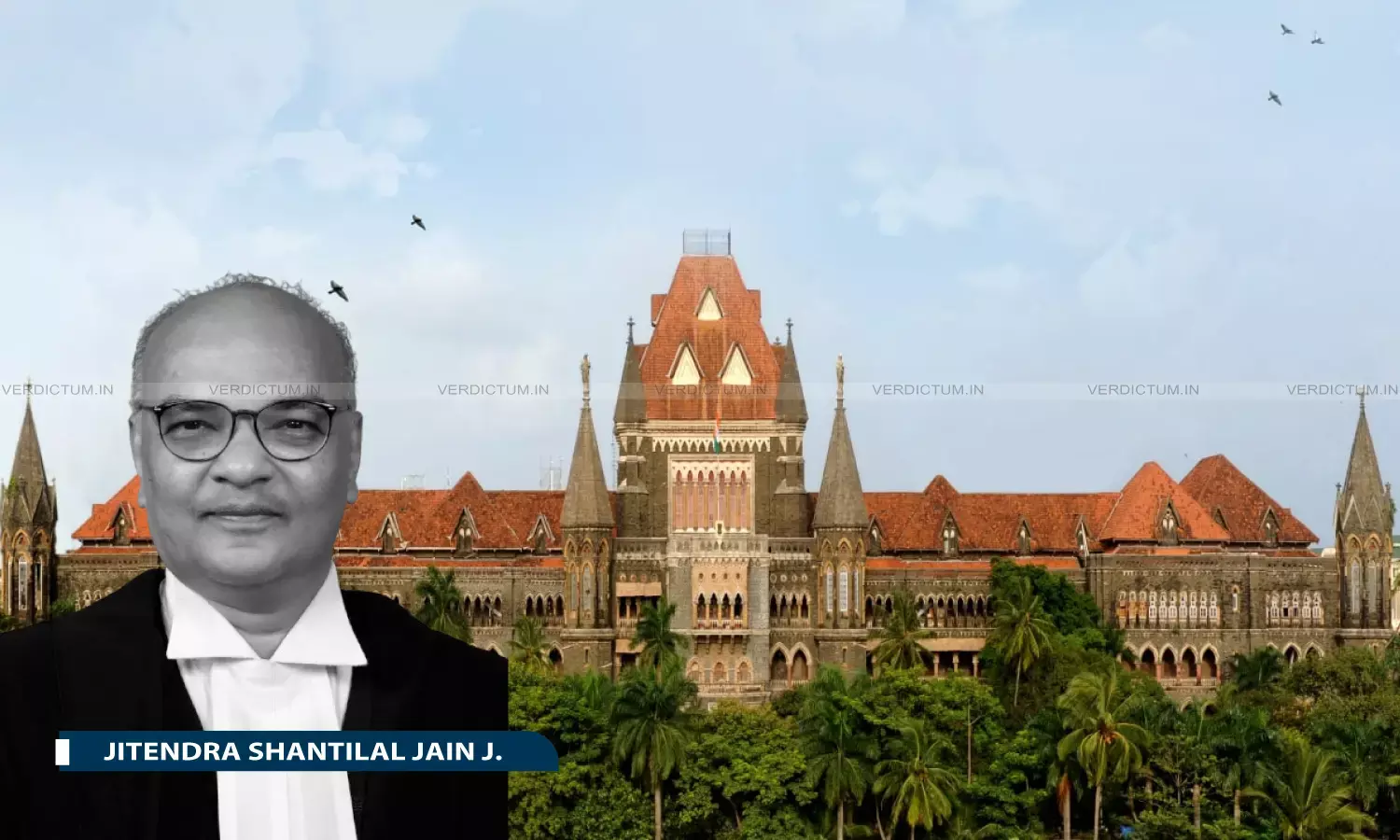
Justice Jitendra Jain, Bombay High Court
Taking note of the huge backlog and pendency of cases, which frustrates the whole purpose of granting compensation in motor accident and railway claim cases, the Bombay High Court has asked the Union Government to consider setting up the Appellate Tribunal for resolving the disputes arising from the orders passed by the Court of first instance, instead of appeals to the High Court.
The appeal before the High Court was filed by the Insurance Company challenging the order passed by the Motor Accident Claims Tribunal, Mumbai (Tribunal), whereby Rs 74,422 was awarded to the original applicant on account of accidental injuries sustained by him in an accident which took place in the year 1996.
The Single Bench of Justice Jitendra Jain ordered, “In view of above discussion, the Union of India should consider, keeping in mind the object for which the compensation under the Motor Vehicles Act, 1988 is granted, whether an alternate Appellate Forum can be constituted for challenging the orders of the Tribunal. Such Appellate Tribunal will be a specialized body and would be in a position to dispose of the appeal in a much shorter span of time than what is generally taken by the High Court. This step would achieve the object for which the provisions of compensation are engrafted in the Motor Vehicles Act, 1988. This would also relieve the High Court from utilizing its resources on matters where the stake involved is only few lakhs and the resources if freed, can be utilized for other matters which require priority. The said Appellate Forum can also hear appeals from the Railway Claims Tribunal under the Railways Act, 1989 and should be headed by a Retired High Court Judge.”
“In my view, it is high time that the Union of India should consider setting up the Appellate Tribunal for resolving the disputes arising from the orders passed by the Court of first instance, instead of appeals to the High Court”, it added.
Advocate Devendranath S. Joshi represented the Appellant.
Factual Background
As per the Insurance Company, the accident occurred on October 19, 1996, whereas the policy had expired on August 26, 1996. It was claimed that on the date of the accident, the policy had lapsed and, therefore, no liability could be imposed upon the Insurance Company. The Tribunal had given a finding that the Insurance Company failed to prove that the vehicle was not insured with them, but on the contrary, the evidence led by the Insurance Company and the Regional Transport Office (RTO), showed that the vehicle was validly insured.
Reasoning
On a perusal of the facts of the case, the Bench noted that the Tribunal had considered every piece of evidence before concluding that the Insurance Company had failed to prove the vehicle was not insured. The Bench noticed that there was no evidence to show that these findings of fact given by the Tribunal were contrary to the material on record. “I agree with the reasoning in paragraphs 16 to 27 of the impugned order for rejecting the contention of the Insurance Company that the vehicle was not insured”, it held.
The Bench thus upheld the order of the Tribunal and dismissed the appeal filed by the Insurance Company.
Dealing with the issue of the forum of adjudication of the appeal filed to challenge the orders passed by the Tribunal, the Bench explained that the appeal under the Motor Vehicles Act, 1988, from the order of the Tribunal lies to the High Court. The Bench took note of the fact that the claimants do not get the compensation immediately on the date of the accident, but have to file their claim before the Tribunal. Because of the huge pendency, the Tribunal takes at least 5 to 7 years to dispose of the original petition, and even after disposing of the petition, the claimants do not see the colour of the compensation, since the orders passed by the Tribunal are subject to challenge by filing an appeal to the High Court.
Taking note of the stark realities, the Bench further highlighted, “In the State of Maharashtra itself, around 86,000 original petitions are pending before the Motor Accident Claims Tribunal as of April 2026 and around 18,000 appeals are pending before the Bombay High Court, 12,500 appeals before the Andhra Pradesh High Court, 14,500 appeals before the Telangana High Court, 34,000 appeals before the Kerala High Court, etc. These figures do justify taking steps to constitute specialised Appellate Tribunal for speedy disposal, if not quick disposal. Similar figures with regard to appeals under the Railways Act, 1989 reinforces justification for setting up the Appellate Forum.”
The Bench also considered the successful functioning of the Tribunal over a period of more than 50 years while dealing with appeals under various other enactments, e.g. Income Tax Appellate Tribunal (ITAT), Customs, Excise & Service Tax Appellate Tribunal (CESTAT), National Consumer Disputes Appellate Forum, the Telecom Disputes Settlement and Appellate Tribunal (TDSAT), etc. The Bench thus suggested setting up of the Appellate Tribunal for resolving the disputes arising from the orders passed by the Court of first instance.
“Copy of this order is to be sent to the Ministry of Law and Justice and Finance Ministry for appropriate discussion and consideration on setting up of Appellate Tribunal to hear appeals from orders passed by the Motor Accident Claims Tribunal and the Railway Claims Tribunal”, it directed.
Cause Title: The Oriental Insurance Co. Ltd. v. Mast. Sandeep Sunder Kolhe (Neutral Citation: 2026:BHC-AS:19245)