

Immoral Trafficking Is An Offence Against Humanity; Minor Contradictions Cannot Defeat Prosecution Case: Bombay High Court Upholds Brothel Operator’s Conviction
The Court said that because traumatized minor trafficking victims often fear for their lives and refuse to testify, the prosecution's case rests heavily on police and panch witnesses.

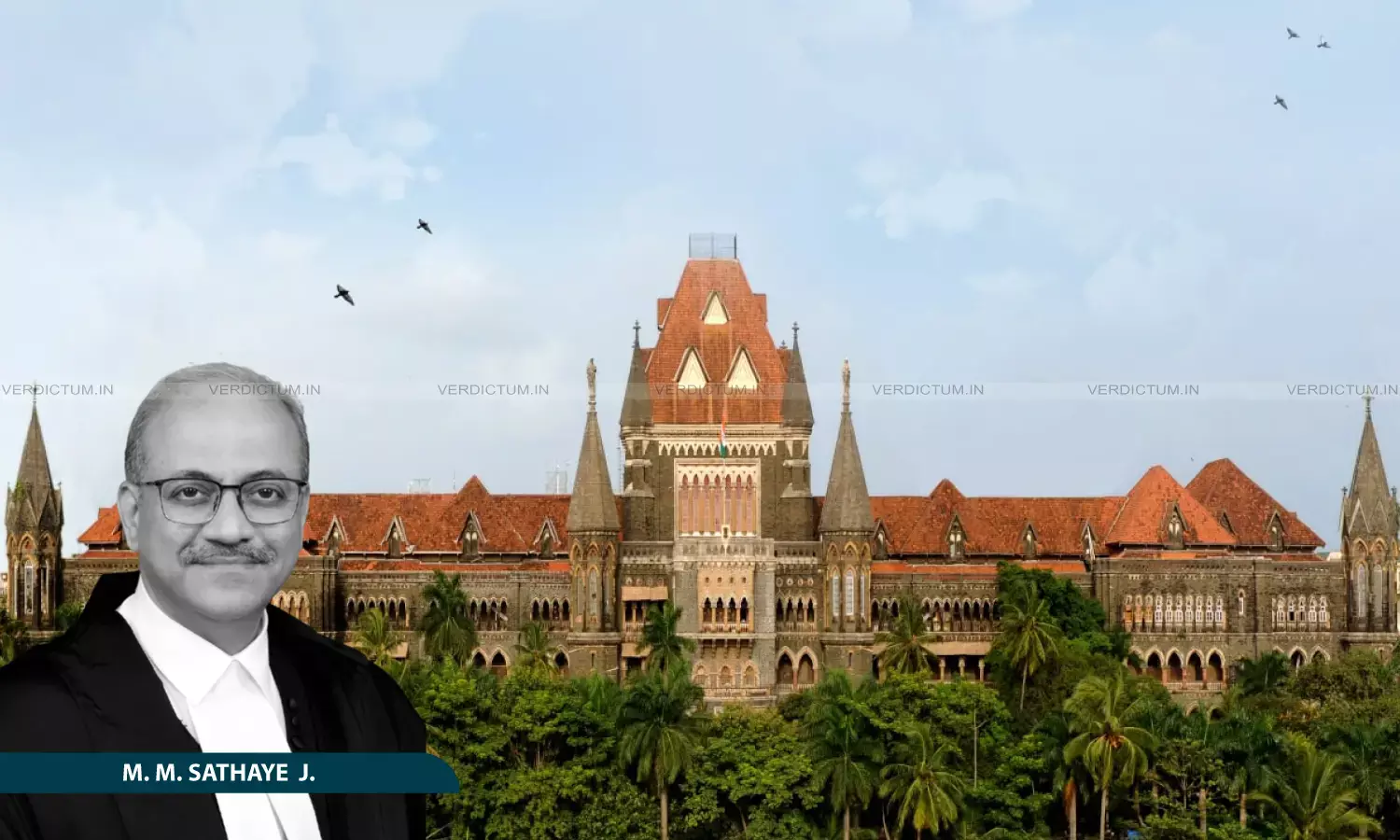
Justice M.M. Sathaye, Bombay High Court
The Bombay High Court has observed that human trafficking under the Immoral Traffic (Prevention) Act, 1956 (PITA) is a heinous offence against humanity and society at large, and therefore, judicial adjudication must place significant weight on the credible testimonies of police and independent panch witnesses rather than dismissing cases over minor procedural contradictions.
Recognising the severe psychological trauma, confinement, and threats faced by rescued victims, particularly minors, the Court held that victims may be unwilling or unable to testify. In such cases, minor contradictions or procedural delays in the raid or documentation cannot defeat the prosecution when the core case stands corroborated.
Justice M.M. Sathaye while dismissing a criminal revision application that sought to overturn concurrent findings of conviction against a brothel operator, observed, “It is necessary to note that the offence under PITA is a very serious offence which is against humanity and the society at large. Human trafficking involves brutal methods adopted by the traffickers including kidnapping, abduction, torture, threat to life, confinement and many other inhuman treatment of the victims involved. The offence of trafficking when perpetrated against minors makes it even worse and heinous…”.
“…Often, the victims who are rescued are suffering from trauma and are not in a position to given clear statements. For obvious reasons as the victims fear for their own lives and lives of their near-ones, are not willing to give statements to police, much less stand in the Court for that. Therefore, much depends on the prosecution witnesses such as police officers and panchas. Therefore, ‘minor contradictions’ in the evidence of prosecution witnesses can not be held as fatal to the prosecution’s case”, the Bench further said.
Advocate Himanshu Indise appeared for the applicant and Advocate Manisha R. Tidke appeared for the respondent.
The prosecution's case emerged from a targeted raid supervised by an Assistant Commissioner of Police at the third floor of the Rele Building on Shamrao Vithal Marg in Mumbai. Acting on specific intelligence regarding an active commercial sex racket, the law enforcement team, accompanied by two independent female panchas, discovered two minor girls confined in a room under the direct charge of the applicant. Although the victims were subsequently sent to a children's home and repatriated by the Juvenile Board before they could be examined at trial, the fact of their physical recovery from the brothel was firmly established by the public witnesses.
Thereafter, the Metropolitan Magistrate’s 18th Court at Girgaon, which convicted the applicant under Section 6 of PITA on January 16, 2003. This judgment, which imposed a sentence of two years of rigorous imprisonment, was subsequently upheld in appeal by the Additional Sessions Judge for Greater Mumbai on April 7, 2003, leading to the filing of the present revision application.
Affirming the lower courts' findings, the High Court held that the statutory presumption under Section 6(2) of PITA triggers automatically once a minor is found with an accused inside a brothel, shifting the onus to the defense to rebut the charge.
The Court brushed aside technical objections regarding the lack of a formal ossification test, noting that the medical officer's reliance on joint X-rays and physical indicators sufficiently verified that the victims were minors. It further clarified that the slight variance in dates between the testimonies of the panch and police witnesses was a natural consequence of a raid that commenced before midnight and concluded in the early hours of the following morning.
Holding that there was no manifest error of law or procedural defect resulting in a miscarriage of justice, the Court dismissed the revision application and discharged the rule. The trial court was directed to take immediate legal steps to secure the presence of the applicant so she may undergo the remainder of her sentence.
Cause Title: Rita Dilip Ghosh v. State of Maharashtra (Revision Application No. 227 of 2003)
Appearances:
Applicant: Himanshu Indise, Sujay Shingade and Abhishek Kunchikor, Advocates.
Respondent: Manisha R. Tidke, APP, PSI Deepak Pol.