

State Failed In Its Duty To Take Sufficient Care: Bombay High Court Awards ₹22 Lakh Compensation For Death Of Schizophrenic Patient In Yerwada Mental Hospital
Underling the several faults, the Court held that the need to provide lifelong care to son with 90% mental disability justified higher compensation.

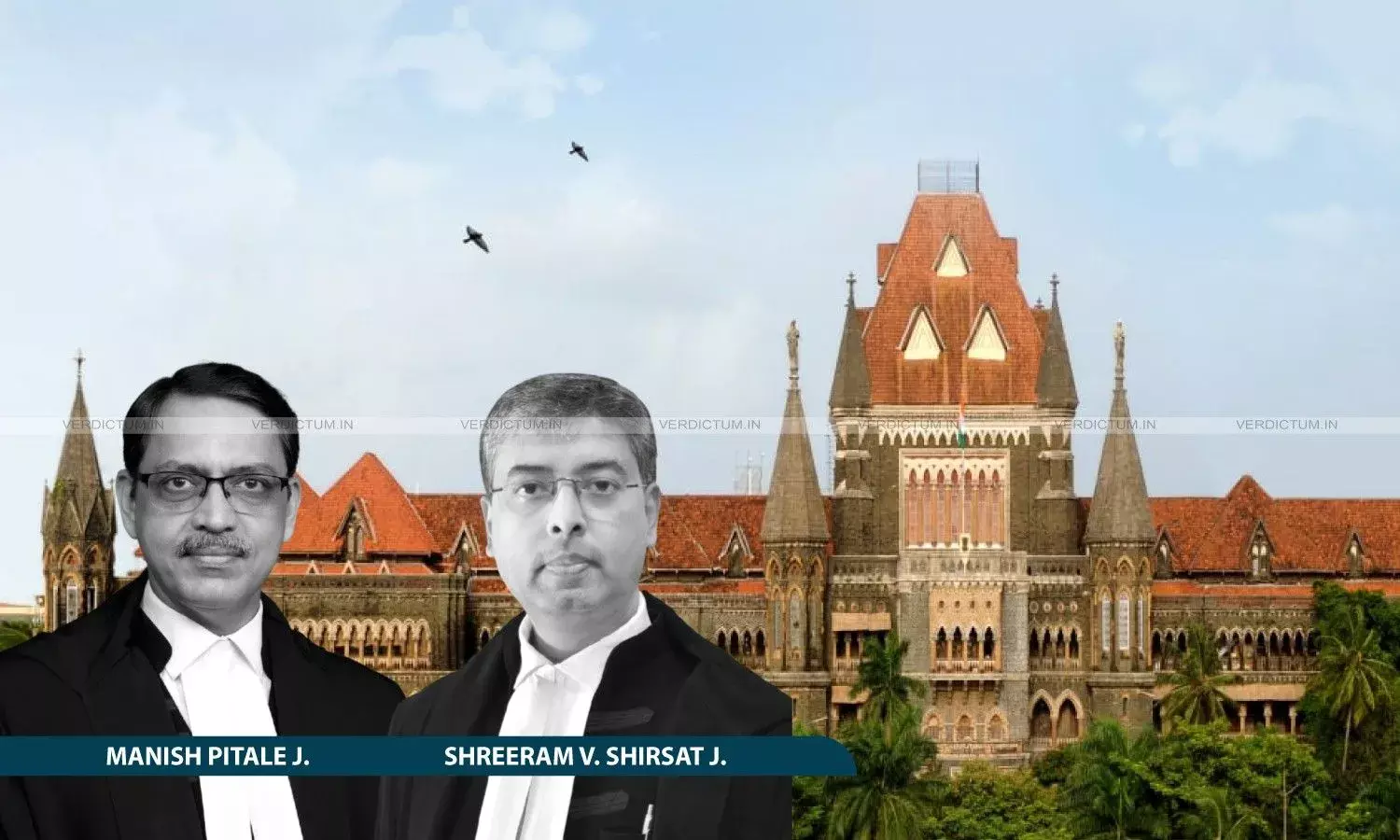
Justice Manish Pitale, Justice Shreeram V. Shirsat, Bombay High Court
The Bombay High Court has held the State of Maharashtra liable for the death of a patient admitted to the government-run Yerwada Mental Hospital, Pune, after he was fatally assaulted by another inmate. Pertinently, three attendants were on duty for the 72 patients in the observation ward that night.
Holding that the State failed in its constitutional duty to ensure the safety and care of patients under its custody, the Court awarded ₹22 lakh compensation to the deceased's widow and children, observing that violation of the right to life under Article 21 of the Constitution of India entitles victims and their families to monetary compensation as a public law remedy.
The writ petition was filed by the widow and children of a real estate agent who died while undergoing treatment at Yerwada Mental Hospital in November 2013.
A Division Bench of Justice Manish Pitale and Justice Shreeram V. Shirsat observed, “The husband of petitioner No.1 was in the care and custody of the respondent-State and therefore, the State is clearly responsible for the violation of fundamental rights of the said deceased and consequentially, the rights of the petitioners as the deceased was the only breadwinner of the family.…We are unable to agree with the respondents about their claim that there was no lapse of administration on the part of the hospital authorities. We find that gross negligence on their part is evident from the admitted facts, requiring no further evidence in the matter. The petitioner No.1 had to move under the Right to Information Act, 2005, to obtain information with regard to the number of doctors and attendants on duty at the relevant time. Her pleas fell on deaf ears and she was not granted any relief despite the shocking incident and the consequent adverse impact on the petitioners, as the surviving widow and children of the deceased”.
“…Since the petitioners were required to pursue this writ petition for the past nine years in this Court, we are of the opinion that the initial amount of Rs.1,00,000/- already paid to the petitioner No.1 need not be adjusted. In other words, the aforesaid amount of Rs.22,00,000/- shall be payable in its entirety, in the aforesaid stipulated period of time…”, the Bench further observed.
Advocate Vrushali L. Maindad appeared for the petitioner and N. C. Walimbe, Additional. G. P. appeared for the respondent, while Advocate Mayur Khandeparkar appeared as amicus.
The deceased, who was suffering from schizophrenia, had been admitted to the hospital on medical advice on November 19, 2013. Two days later, his wife was informed that he had been killed by another patient, Deepak Suravase, who allegedly became violent and assaulted him as well as another inmate. Both victims succumbed to severe head injuries. The postmortem report recorded the cause of death as head injury and throttling.
The petitioners contended that the death would not have occurred but for the gross negligence of the State authorities responsible for managing the mental hospital. Information obtained under the Right to Information Act revealed that there was inadequate staff on duty at the time of the incident and that similar incidents had occurred earlier.
In its affidavit, the State admitted that only three attendants were on duty during the night for 72 patients housed in the observation ward. It also acknowledged that the assailant suffered from psychosis associated with substance addiction and had displayed violent tendencies.
Examining the material on record, the Court found that the State had failed in its duty of care towards patients under its custody. Referring to the State Mental Health Rules, 1990, the Bench noted that the required attendant-to-patient ratio was one attendant for every five patients, whereas the observation ward was severely understaffed on the night of the incident.
The Court further observed that authorities had failed to segregate a patient known to exhibit violent behaviour from other inmates, thereby exposing vulnerable patients to foreseeable harm.
“…It was also conceded that there were only three attendants on duty at night for the 72 patients in the observation ward. It is obvious that the strength of the attendants was woefully inadequate, apart from the fact that it violated the ‘minimum facilities’ for patients in the mental hospital. On this score itself it is evident that the respondent-State failed in its duty to take sufficient care of the patients in the Yerwada Mental Hospital, including the deceased husband of petitioner No1”, the Bench noted.
“We find that the petitioner No.1 is not only faced with the difficult situation of fending for herself and her children due to the sudden demise of her husband, she is also required to take full time care of her son i.e. petitioner No.3, who is himself suffering from 90% mental retardation. This is evident from the document at Exhibit ‘H’, which is a certificate issued by a Committee of Government Doctors, certifying that he suffers from severe mental retardation of 90% and that he is unable to earn independently. The certificate also specifically states that his condition is permanent, non-progressive and unlikely to improve. This is another crucial aspect of the matter, which this Court is inclined to take into consideration while deliberating upon the aspect of determining compensation to be paid to the petitioners”, further noted.
Since no specific statutory framework exists for quantifying compensation in cases involving custodial deaths in government mental health institutions, the Court adopted principles evolved by the Supreme Court in motor accident compensation jurisprudence. Taking into account the deceased’s income tax returns, age, future prospects, dependency loss, consortium and other conventional heads, the Court assessed compensation at approximately ₹17 lakh.
The Bench then awarded an additional ₹5 lakh in view of the peculiar circumstances of the case, noting that the deceased’s son suffers from 90% permanent mental retardation and is incapable of independent livelihood.
Cause Title: NS v. The State of Maharashtra & Ors. (Neutral Citation: 2026:BHC-AS:22841-DB)
Appearances:
Petitioner: Vrushali L. Maindad a/w Manali P. Sawant and Akshada C. Mundhe, Advocates.
Respondent: N. C. Walimbe, Addl. G. P., a/w. Tanu N. Bhatia, AGP, Mayur Khandeparkar, Amicus Curiae, a/w Raghav Dharmadhikari, Advocates.
Click here to read/download the Judgment