

Sympathy Cannot Be A Substitute For Legal Entitlement; Writ Court Cannot Re-Write Academic Regulations: Bombay High Court Upholds Student's Low Attendance Debarment
The Court dismissed a psychology student's plea against debarment for low attendance due to psychiatric condition; holds writ court cannot assess medical records to substitute expert opinion.

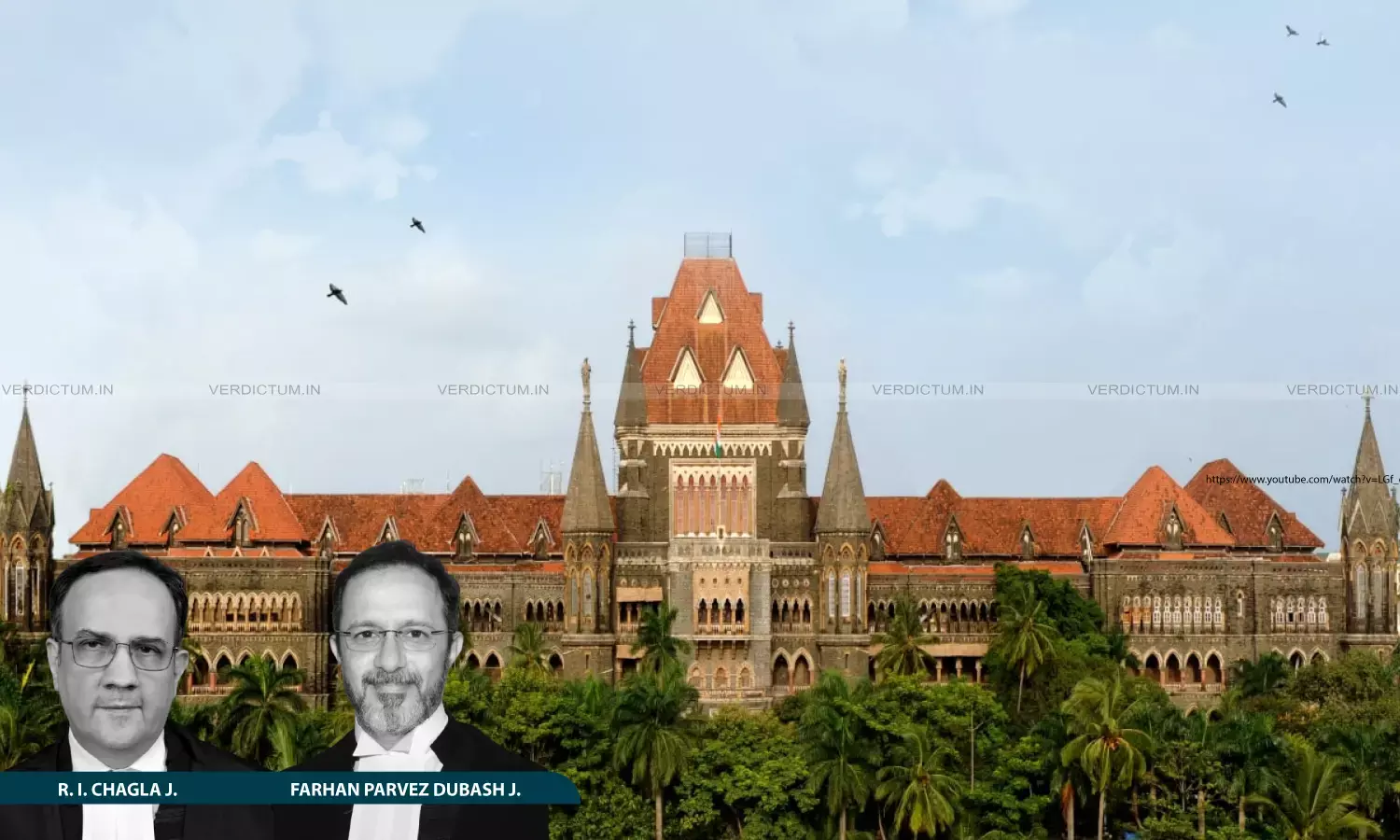
Justice R.I. Chagla, Justice Farhan P. Dubash, Bombay High Court
The Bombay High Court has held that sympathy cannot be a substitute for legal entitlement and that a writ court exercising jurisdiction under Article 226 of the Constitution of India is concerned with the legality of decision-making and not with rewriting academic regulations or creating exemptions that the governing framework itself does not contemplate.
The Court further held that courts are not medical experts and cannot be asked to read, interpret and independently assess medical records, blood reports or psychiatric evaluations so as to arrive at medical conclusions that would effectively substitute expert opinion, an exercise that travels far beyond the permissible contours of judicial review.
The Court additionally held that a precedent is not a licence to disregard factual distinctions and that attempting to transplant the result of a decision onto an entirely different factual foundation is impermissible, a precedent is an authority for what it actually decides and not for what may logically follow from it.
A Division Bench comprising Justice R.I. Chagla and Justice Farhan P. Dubash observed, “…The material placed before us indicates that she underwent a period of considerable medical difficulty. We extend our deepest sympathies to the Petitioner and her family. Sympathy, however, cannot be a substitute for legal entitlement. A writ court is concerned with legality of decision making and not with re-writing academic regulations or creating exemptions that the governing framework itself does not contemplate”.
Advocate Abhishek Salian appeared for the petitioner and Senior Advocate G.S. Godbole appeared for the respondent.
The petitioner, a third-year B.Sc. Applied Psychology student at NMIMS University, had maintained attendance above 85 percent across five semesters. In January 2026 she was diagnosed with a psychiatric condition and on March 09, 2026 suffered an acute episode involving suicidal ideation and hallucinations, following which she was hospitalised in Lucknow until March 20 2026.
After discharge, she did not return to the University, her parents reportedly apprehensive that her condition posed a risk to herself and others. The University debarred her for falling below the mandatory 80 percent attendance threshold in five subjects. She filed a writ petition seeking permission to appear in re-examinations scheduled for June 2026.
The Court found that the central explanation, that her parents consciously prevented her return after discharge, was unsupported by any contemporaneous communication to the University and surfaced for the first time in the writ petition.
The Court noted that the petitioner had physically appeared for her Thesis Defence on April 13 2026, creating a disputed factual question inconsistent with her claimed incapacity. These disputed questions of fact could not be resolved in writ proceedings on affidavits.
The Court also noted that over 350 other students had been similarly debarred and that a judicial direction relaxing attendance in one case without clear legal basis would have broader implications.
“…The present case raises serious disputed questions regarding the cause of the Petitioner's continued absence after 20th March 2026; questions which cannot be satisfactorily resolved in writ proceedings. Those decisions are therefore clearly distinguishable and no assistance to the Petitioner. We must also bear in mind that the attendance regulations apply uniformly to all students. Respondent No. 2 University has stated that more than 350 other students have also been rendered ineligible on account of shortage of attendance. Any judicial direction relaxing attendance requirements in an individual case, absent a clear legal or factual basis, would necessarily have implications extending beyond the present dispute”, the Bench noted.
While expressing deepest sympathies for the petitioner's medical difficulties, the Court dismissed the petition.
Cause Title: K v. University Grants Commission and Others Writ Petition (L) No. 18476 Of 2026
Appearances:
Petitioner: Abhishek Salian, Mayuresh Ingale, Kinnari Raut and Ayesha, Advocates instructed by Nyaaya Legal.
Respondent: Rui Rodrigues, G.S. Godbole, Senior Advocate, with Manorama Mohanty and Malika Mondal, Advocates instructed by S.K. Srivastav and Co.
Click here to read/download the Judgment