

Can’t Take Advantage Of Her Own Wrong: Bombay High Court Denies Maintenance To Woman Whose Second Marriage Was Annulled For Concealing Earlier Marriage
The Court held that "concealment & deceit vitiates the case”; distinguished live-in relationship precedents since cohabitation lasted barely over three months.

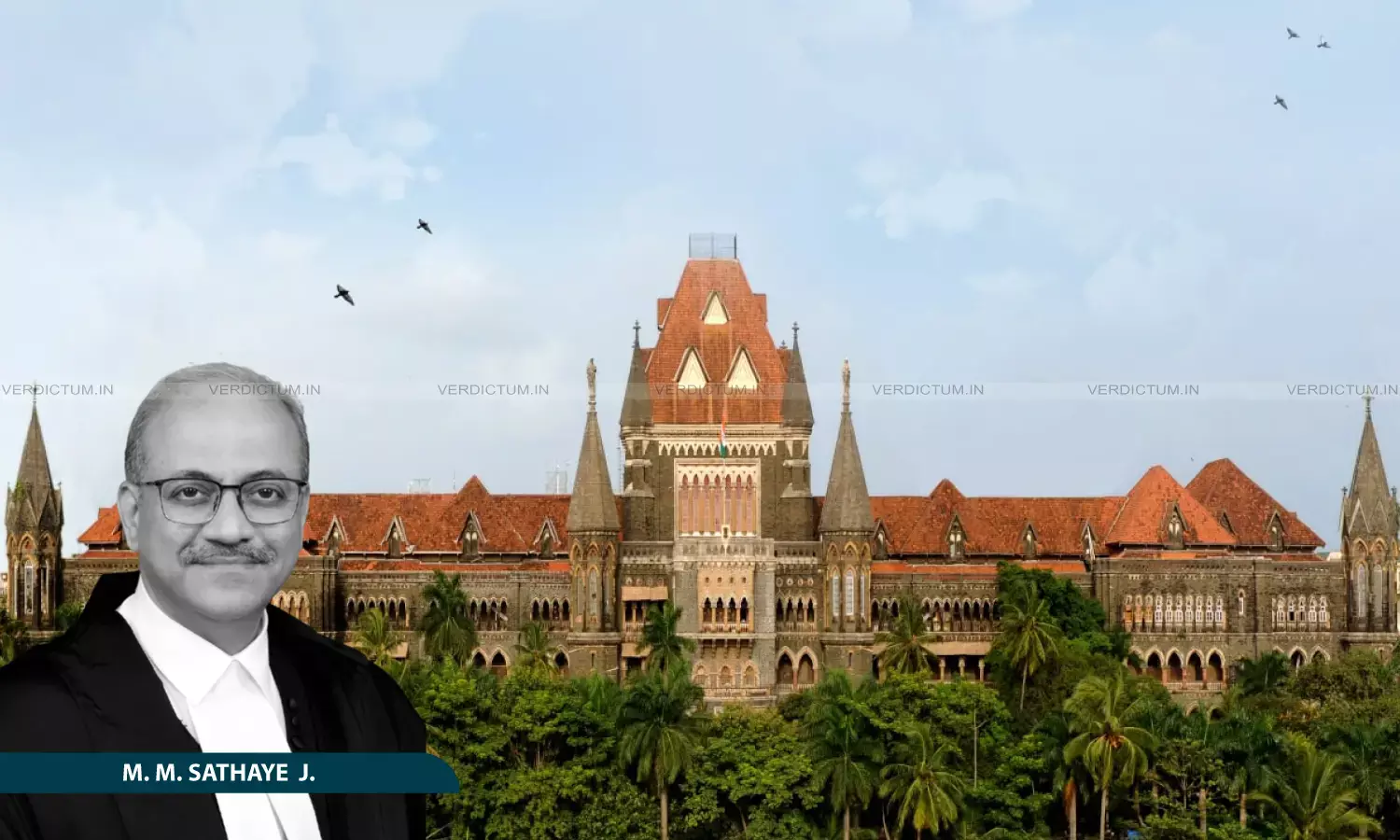
Justice M.M. Sathaye, Bombay High Court
The Bombay High Court has denied maintenance under Section 125 CrPC to a woman whose marriage was annulled after it emerged that she had concealed a subsisting earlier marriage from her second husband, holding that a party cannot be permitted to take advantage of her own wrong.
The Court held that the concealment and deceit practised by the petitioner vitiated her claim, and that the beneficial, secular remedy under Section 125 CrPC, though enacted to protect a neglected wife, could not be invoked in favour of a person who had acted deceitfully in contracting the marriage itself.
A Bench of Justice M.M. Sathaye, observed, “…the beneficial piece of legislation such as Section 125 of CrPC cutting across all religions and secular in nature, a party can not be permitted to take advantage of his/her own wrong. The concealment and deceit vitiates the case of the Petitioner No.1. In my considered view, provisions of Section 125 of Cr.P.C which are enacted with a view to provide summary remedy to neglected wife, can not be exercised in favour of Petitioner No. 1 who has acted deceitfully…”.
Advocate Sachin Dhakephalkar appeared for the petitioner and Manisha Tidke, APP appeared for the respondent.
The petition arose from a maintenance claim filed by a woman and her minor son under Section 125 CrPC. The husband contended that the marriage was void as the woman had concealed her subsisting first marriage, leading to a decree of nullity under Section 11 of the Hindu Marriage Act.
While the trial court granted maintenance to both the woman and the child, the Sessions Court set aside the maintenance awarded to the woman but retained the child's entitlement.
Rejecting the woman's reliance on Chanmuniya v. Virendra Kumar Singh Kushwaha Anr. (2011) 1 SCC 141 and Smt. N. Usha Rani & Anr. v. Moodudula Srinivas 2025 INSC 129, the Court held that Chanmuniya did not lay down binding law on void marriages and that the parties had cohabited for barely three months, insufficient to presume a marriage-like relationship.
“…it has came on record that Petitioner No.1 cohabited with the Respondent No.1 from 28.01.2009 till 07.05.2009 which is just a few days more than 3 months. The parties have been litigating against each other thereafter. In such circumstances, it is impossible to hold that Petitioner can qualify for a person in live-in-relationship, where a man and woman have been living together as husband and wife for a reasonably long period of time”, it noted.
It further distinguished N. Usha Rani, noting that unlike in that case, the respondent here had been deceived about the woman's subsisting first marriage.
The Court also drew support from the Supreme Court's observation in Vimala v. Veeraswamy (1991) 2 SCC 375 that where a husband seeks to negate a wife's claim by alleging she was already married, strict proof of the earlier marriage is required, and here, the earlier marriage and its concealment stood established.
Finding no perversity in the view taken by the Sessions Court, and holding that Section 125 CrPC could not be exercised in favour of a petitioner who had acted deceitfully in contracting the very marriage on which her claim rested, the Court declined to interfere with the denial of maintenance to the woman, while leaving undisturbed the maintenance awarded to the child.
The Court accordingly dismissed the writ petition, with no order as to costs.
Cause Title: J & Anr. v. P & Anr., Writ Petition No. 130 of 2023
Appearances:
Petitioners: Sachin Dhakephalkar, Surbhi V. Vadhavkar, Advocates.
Respondents: Vikas G. Ambetkar, Manisha Tidke, APP, Advocate.