

One-Time Benefit Granted By Supreme Court Applies To All Law Students Across States & Semesters Facing Attendance Shortfall: Bombay High Court
The Bench clarified that Supreme Court's interim protection cannot be restricted solely to final-year candidates or those who independently instituted judicial proceedings.

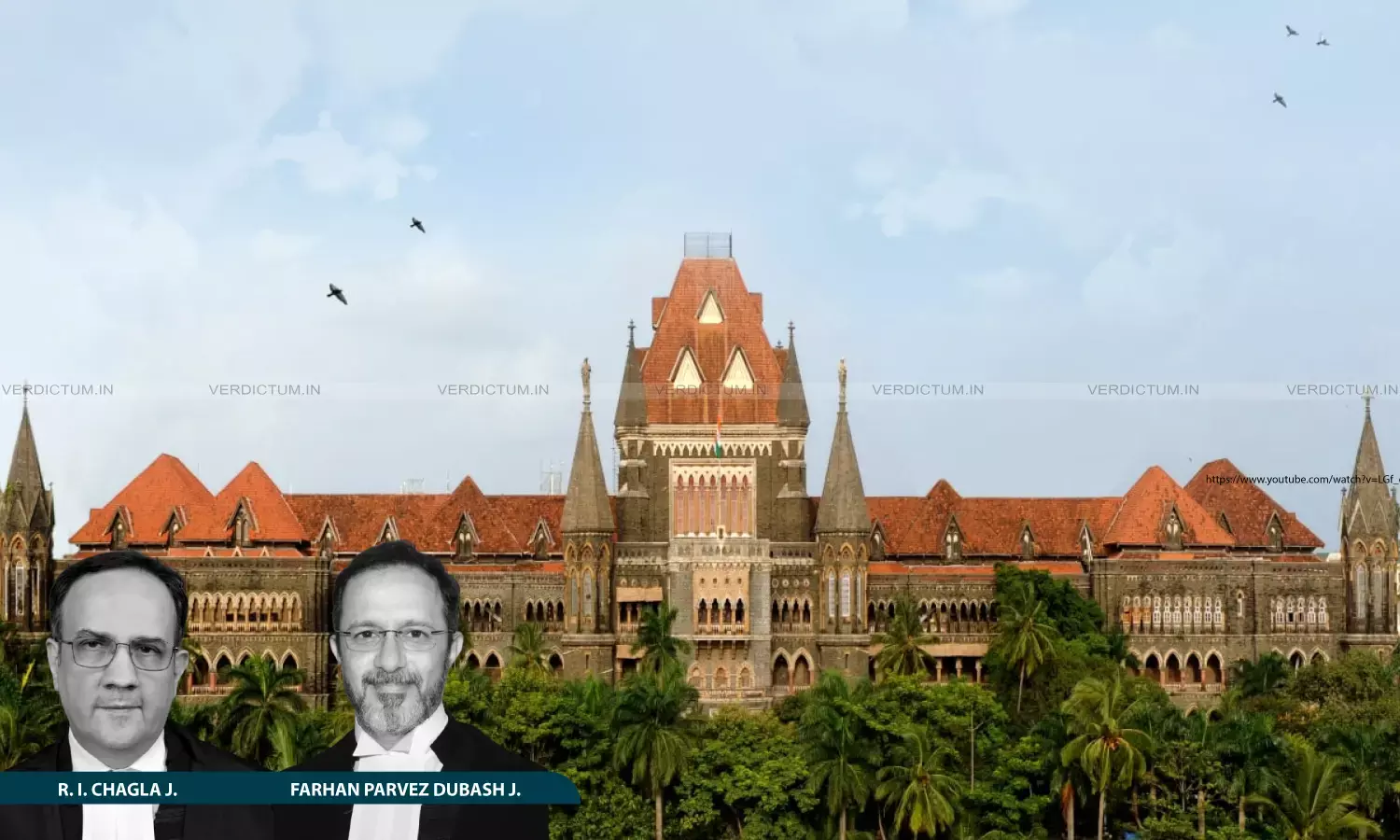
Justice R.I. Chagla, Justice Farhan P. Dubash, Bombay High Court
The Bombay High Court has held that the Supreme Court's interim order dated July 21, 2026 granting one-time relief to law students facing detention due to attendance shortfalls during the 2025–26 academic session operates uniformly across all States and law semesters. The Bench held that educational institutions and universities cannot restrict the scope of the Supreme Court's directions by confining the benefit only to final-year students or demanding proof that individual students independently relied on the Delhi High Court's judgment in Re: Courts on Its Own Motion in Re: Suicide Committed by Sushant Rohilla, Law Student of I.P. University 2025 SCC OnLine Del 7920 (Sushant Rohilla).
The Court clarified that the Supreme Court created an objective class of protected students enrolled in ongoing sessions when Sushant Rohilla was pronounced. Consequently, all law students facing detention during the 2025–26 session are entitled to take semester examinations or supplementary tests and progress academically, irrespective of territorial jurisdiction or contrary High Court rulings.
A Division Bench comprising Justice R.I. Chagla and Justice Farhan P. Dubash observed, “The order dated 21st July 2026 neither confines its operation to students within the territorial jurisdiction of the Delhi High Court nor excludes students studying in States where the concerned High Court had taken a contrary view. Equally, it does not reserve to individual institutions the power to determine whether the one-time protection granted by the Hon’ble Supreme Court should be extended to their students. Once the Hon’ble Supreme Court has identified the protected class without any territorial qualification, we see no basis to introduce such a qualification in respect of students pursuing legal education in the State of Maharashtra. The submission of the College and the University in this regard must, therefore, be rejected”.
Advocate Dr. Uday Warunjikar appeared for the petitioner and Senior Advocate Shiraz Rustomjee appeared for the respondent while Advocate Sharad Bansal appeared as amicus curiae.
The matter involved forty-one law students from ILS Law College, Pune, who were debarred from semester examinations due to attendance shortfalls ranging between 46% and 54.37%. Despite submitting examination forms, the college withheld admit cards and refused condonation under Savitribai Phule Pune University Ordinances 68 and 70.
The petitioners approached the High Court invoking the Delhi High Court's Sushant Rohilla ruling. While interim orders initially permitted exams, the Supreme Court prospectively stayed Sushant Rohilla on 26th May 2026, but subsequently issued a one-time protective order on July 21, 2026 for ongoing-session students.
The High Court reasoned that Supreme Court orders under Article 142 bind all authorities nationwide and cannot be narrowed by High Courts through additional eligibility conditions. The Bench held that giving effect to supervening Supreme Court directions does not require a reference to a larger Bench.
“…we find that the order dated 21st July 2026 of the Hon’ble Supreme Court applies to all the Petitioners before us, notwithstanding the shortfall in their attendance. It consequently follows that the controversy concerning the interpretation of Rule 12 of the Legal Education Rules and Ordinances of the University does not arise for determination in these Writ Petitions. We therefore refrain from expressing any view on the said controversy and leave all questions in that regard, including the respective rights and contentions of the parties, open for consideration in an appropriate case”, the Bench said.
“We make it clear, however, that the relief granted by this judgment does not proceed on the basis that the judgment of the Delhi High Court in Sushant Rohilla (supra) constitutes a binding precedent upon this Court. The said judgment forms part of the factual and legal background which led to the subsequent orders passed by the Hon’ble Supreme Court. The relief granted to the Petitioners flows from the order dated 21st July 2026 passed by the Hon’ble Supreme Court, which is binding upon this Court and upon the authorities and institutions concerned”, the Bench further noted.
The Court confirmed examination results and academic progression for petitioners protected by interim orders. For students who were denied interim relief, the Bench directed the university and college to conduct supplementary examinations within six weeks to allow eligible students to enter the 2026–27 academic year.
Cause Title: Aniruddha Gaurav Gursal & Anr. v. State of Maharashtra & Ors. (Writ Petition No. 6027 of 2026 with Interim Application No. 5058 of 2026).
Appearances:
Petitioners: Dr. Uday Warunjikar, Amrut Joshi, Advocates.
Respondents: Shailendra Kanetkar, Rajendra Anbhule, Shiraz Rustomjee (Senior Advocate), Sharad Bansal as Amici Curiae.