

“Further Attempt To Invoke Sympathy”: Bombay High Court Refuses To Entertain Litigant’s Post-Hearing Representations Alleging Counsel Did Not Argue Properly
The Court said that the representations to Chief Justice “cannot be countenanced” but discounts conduct as possibly born of frustration; sets aside School Tribunal order reinstating dismissed peon.

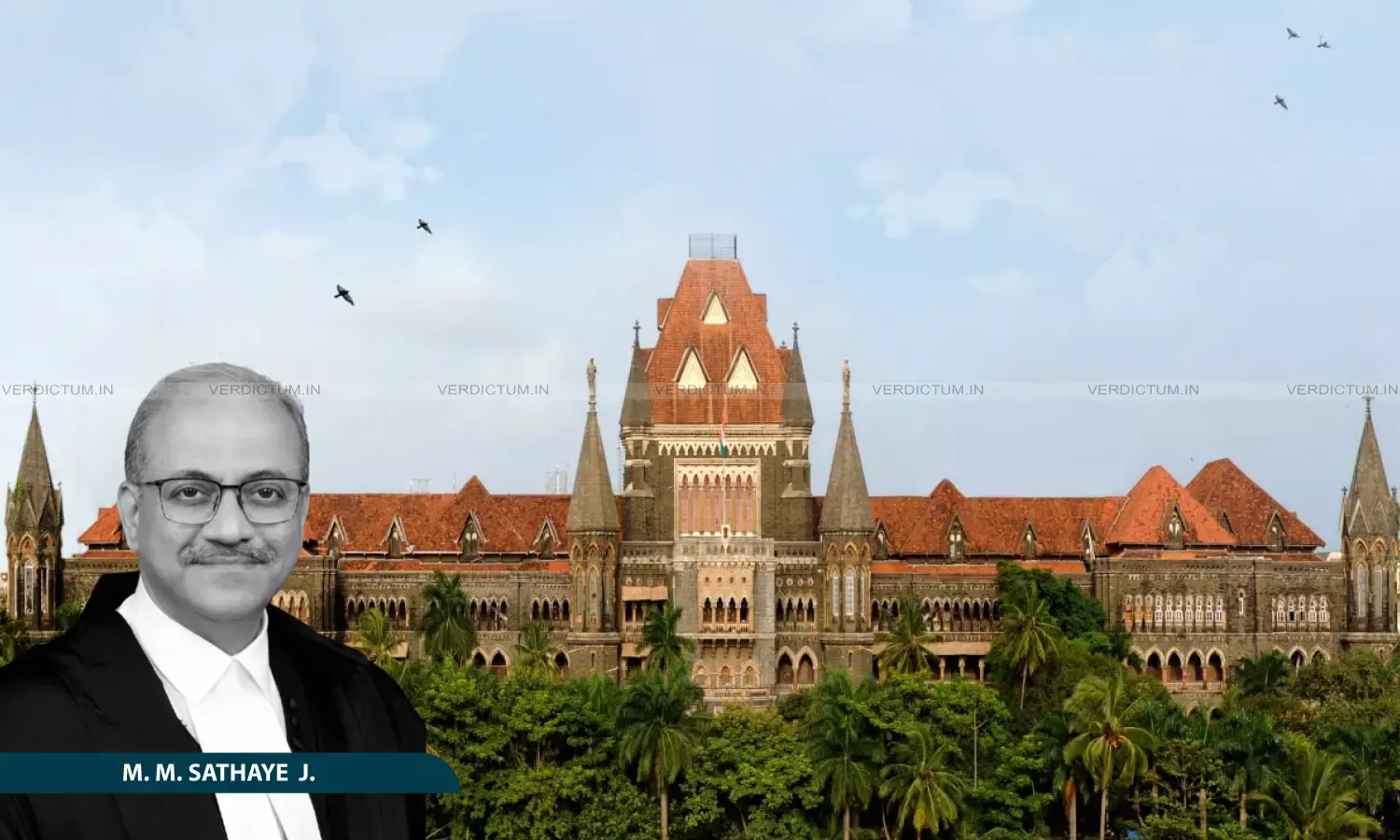
Justice M.M. Sathaye, Bombay High Court
The Bombay High Court has refused to entertain representations filed by a dismissed school peon after his case was closed for judgment, in which he alleged that his advocate had not argued properly. It observed that the attempt appeared to be nothing but a “further attempt to invoke sympathy and create confusion” in the mind of the Court.
Noting the representations that were addressed to the Chief Justice, the Court held that such conduct cannot be countenanced and cannot cloud its judgment, but chose to discount it, as the litigant might have acted in frustration. It then set aside the School Tribunal’s order reinstating him, holding that procedural lapses in an inquiry are not fatal unless real prejudice is shown.
A Single Bench of Justice M.M. Sathaye observed, “It has come on record that Respondent No. 1 had resorted to method such as giving notice of hunger strike etc. in the past and the present attempt to file multiple representations in a case closed for judgment, appears to be nothing but further attempt to invoke sympathy and create confusion in the mind of the Court. Although Respondent No. 1 may be in financially precarious condition and may have suffered loss of family members, the said aspects, assuming them to be true, cannot cloud the judgment of the Court which must be made on the basis of material on record that was considered by the Tribunal”.
Senior Advocate Kiran Bapat appeared for the petitioners and Advocate Kumud Bhatia appeared for the respondent.
“It is important to note that Respondent No. 1 has permitted his advocate to argue the matter fully and thereafter has chosen to not only to insist with the Court that he must be heard in person but has also chosen to file applications and representations addressed to the Chief Justice making allegation against his advocate that case is not properly argued. Such conduct cannot be countenanced, and in any case, cannot be permitted to cloud the judgment of the Court”, the Bench noted further.
Husen Kasam Shaikh was appointed a peon at a school in Pimpalgaon, Pune district, in 1997. After villagers complained against him, the management sought his explanation. He replied with allegations against the Management’s President and sent copies to Ministers, teachers’ associations, police and education authorities. He was charged with misconduct for bringing disrepute to the institution. An inquiry committee found him guilty by a 2:1 majority, his nominee dissenting, and he was dismissed on October 20, 2001.
The School Tribunal, Pune allowed his appeal on February 03, 2005, ordering reinstatement with full back-wages. The Management and the Principal challenged this under Articles 226 and 227 of the Constitution of India. The petition was admitted on August 12, 2005, and the order was stayed on deposit of the back-wages.
After his counsel had argued fully, Shaikh insisted on being heard in person, and the Court heard him briefly. He then filed three representations to the Chief Justice, alleging that his lawyer had not argued properly. He cited family hardship, offered to resign if reinstated with pension, claimed ₹2 crore as compensation, and said he would not file a defamation case if his request was accepted.
The Court held that general and omnibus submissions made after the case is closed cannot be entertained, and rejected the defamation offer, since his complaint and appeal against the Management’s President had already failed.
On merits, the Court applied State Bank of Patiala v. S.K. Sharma [(1996) 3 SCC 364] and State Bank of India v. Bidyut Kumar Mitra [(2011) 2 SCC 316], holding that interference requires real prejudice. It found that the Tribunal wrongly treated the alleged illicit relationship as the charge, when the charge concerned his publicising of baseless allegations. It held that the presence of a fourth member at one meeting and the sequence of the charge-sheet and nomination did not cause prejudice, and that he had a fair hearing. The Tribunal’s approach was termed perverse.
The Court quashed the Tribunal’s order and allowed the petition. Noting that the order had been stayed for 21 years, that Shaikh served about four years and one month, and that it was unclear whether he had been gainfully employed, it granted him liberty to withdraw the deposited amount with accrued interest, and no costs were ordered.
Cause Title: Ambegaon Taluka Vidya Vikas Mandal & Anr. v. Husen Kasam Shaikh & Ors. (Neutral Citation: 2026:BHC-AS:43276)
Appearances:
Petitioners: Senior Advocate Kiran Bapat with Advocate Samir Suryawanshi.
Respondent: Advocate Kumud Bhatia, Kavita N. Solunke, Additional G.P., S.L. Babar, AGP.