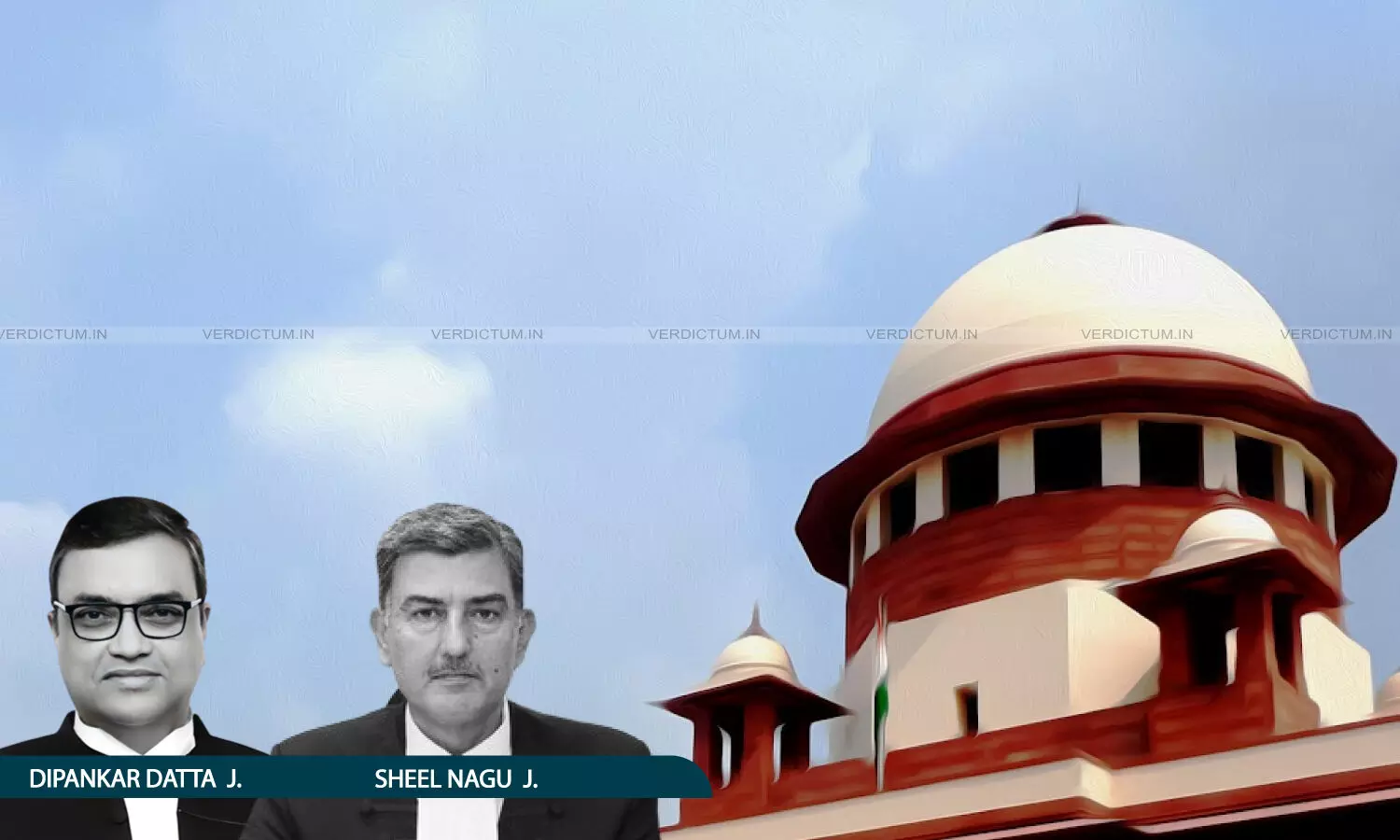
Justice Dipankar Datta, Justice Sheel Nagu, Supreme Court
Order Passed U/S.69 CGST Act Must Be Communicated To Accused: Supreme Court
 |
|The appeal before the Supreme Court was filed against the Bombay High Court order granting protection to Sunil Biyani in a tax-evasion case.
The Supreme Court has held that the order under Section 69 of the CGST Act (Central Goods and Services Tax Act), being a sine qua non to seek anticipatory bail, must be communicated to the accused. The Apex Court clarified that the communication of the order would not, in any manner, obstruct the investigation conducted by the department.
The appeal before the Apex Court was filed against the Bombay High Court order granting protection to the respondent Sunil Biyani who had applied for pre-arrest bail. While rejecting the respondent’s application, the High Court granted protection to him from arrest for a week from the date of intimation of the order under Section 69 of the Central Goods and Services Tax Act, 2017.
The Division Bench of Justice Dipankar Datta and Justice Sheel Nagu held, “We are inclined to accept the contention of Mr. Agarwal. The order under Section 69 of the CGST Act, as held, being a sine qua non to seek anticipatory bail, it would be an anomaly to hold that the order need not be communicated at all, much less, be communicated after the arrest of such person. In any case, communication of the order would not, in any manner, obstruct the investigation ensued by the department. On the contrary, it reinforces the right of the accused to seek anticipatory bail as stipulated in Sushila Aggarwal v. State (NCT of Delhi).”
AOR Gurmeet Singh Makker represented the Appellant while Senior Advocate Gaurav Agarwal represented the Respondent.
Factual Background
The Directorate General of GST Intelligence (DGGI), Mumbai Zonal Unit, was investigating M/s Alphaneon Techsolutions Pvt. Ltd. and its group entities allegedly for wrongfully availing and passing of Input Tax Credit (ITC) without actual supply of goods or services, circular invoicing, and non-payment of GST on import of services. During inspection of the registered premises, the respondent, Sunil Biyani, was found present and acknowledged the inspection. During the investigation, the Department issued three summonses under Section 70 of the CGST Act to the respondent. Instead of appearing, the respondent sought adjournments and thereafter filed an application for anticipatory bail before the Sessions Court, Mumbai. It was rejected on October 14, 2025. The respondent approached the High Court seeking pre-arrest bail. Pursuant to the High Court's interim directions, the respondent appeared before the Department. During the course of the hearing before the High Court, the Department filed an affidavit averring that no order under Section 69 had been passed as the investigation was still at a nascent stage.
The High Court rejected the application for anticipatory bail, noting that in the absence of an order under Section 69 of the CGST Act, there could be no apprehension of arrest and, hence, an application for anticipatory bail could not be entertained. However, the High Court granted relief through the protection order.
Reasoning
Considering that the respondent had merely been summoned when he unsuccessfully applied for pre-arrest bail, the Bench noted that rejection of such application by the High Court, though not under challenge, stood affirmed. The Bench referred to the judgment in Hema Mishra v. State of U.P. (2014) wherein it was held that no further interim relief could be granted while declining interference and dismissing a writ petition.
The Bench thus reiterated that even in cases where a petition seeking quashing of FIR or charge-sheet is dismissed, no interim relief can be granted by the High Courts.
Dealing with the issue revolving around the communication of the order passed by the Commissioner under Section 69 of the CGST Act, the Bench explained that Section 69 (1) grants the Commissioner the power to authorise any officer to arrest a person. “Such order must, as prescribed, be preceded by “reasons to believe”. Such reasons in turn, must refer to the material and evidence underlying such opinion and evince application of mind”, it added.
Holding that the order under Section 69 of the CGST Act must be communicated before arrest, the Bench stated, “This also further fortifies the accused’s right to challenge the order and the “reasons to believe” recorded by the Commissioner, which prompted the issuance thereof. Such order, being amenable to judicial review by the constitutional courts, may be tested on settled principles of law. If Section 69 were read as it is, without there being any requirement of disclosure of the “reasons to believe”, withholding of reasons could have drastic consequences on the right to liberty of the accused.”
Referring to Rule 8 of the Central Goods and Service Tax Rules, 2017 which mandates that a person seeking registration under the CGST Act must provide an email address and mobile number, the Bench clarified, “Thus, the order may be communicated through electronic means in addition to the mode, as permitted under the BNSS, as well as all other permissible modes of communication. This would enable an accused to seek remedy that the law provides to him, if so advised.”
The Bench thus disposed of the petition by asking the Commissioner to communicate the order under Section 69 of the GST Act to the respondent, whereafter he may pursue such remedy as he may be advised. “We reiterate, without such communication, question of arrest would not arise”, it clarified.
Cause Title: Union of India v. Sunil Biyani (Neutral Citation: 2026 INSC 849)
Appearance
Appellant: AOR Gurmeet Singh Makker
Respondent: Senior Advocate Gaurav Agarwal, AOR Arjun Garg, Advocates Arushi Kulshrestha, Saaransh Shukla, Muskan Bensla, Mrinmoyee Das