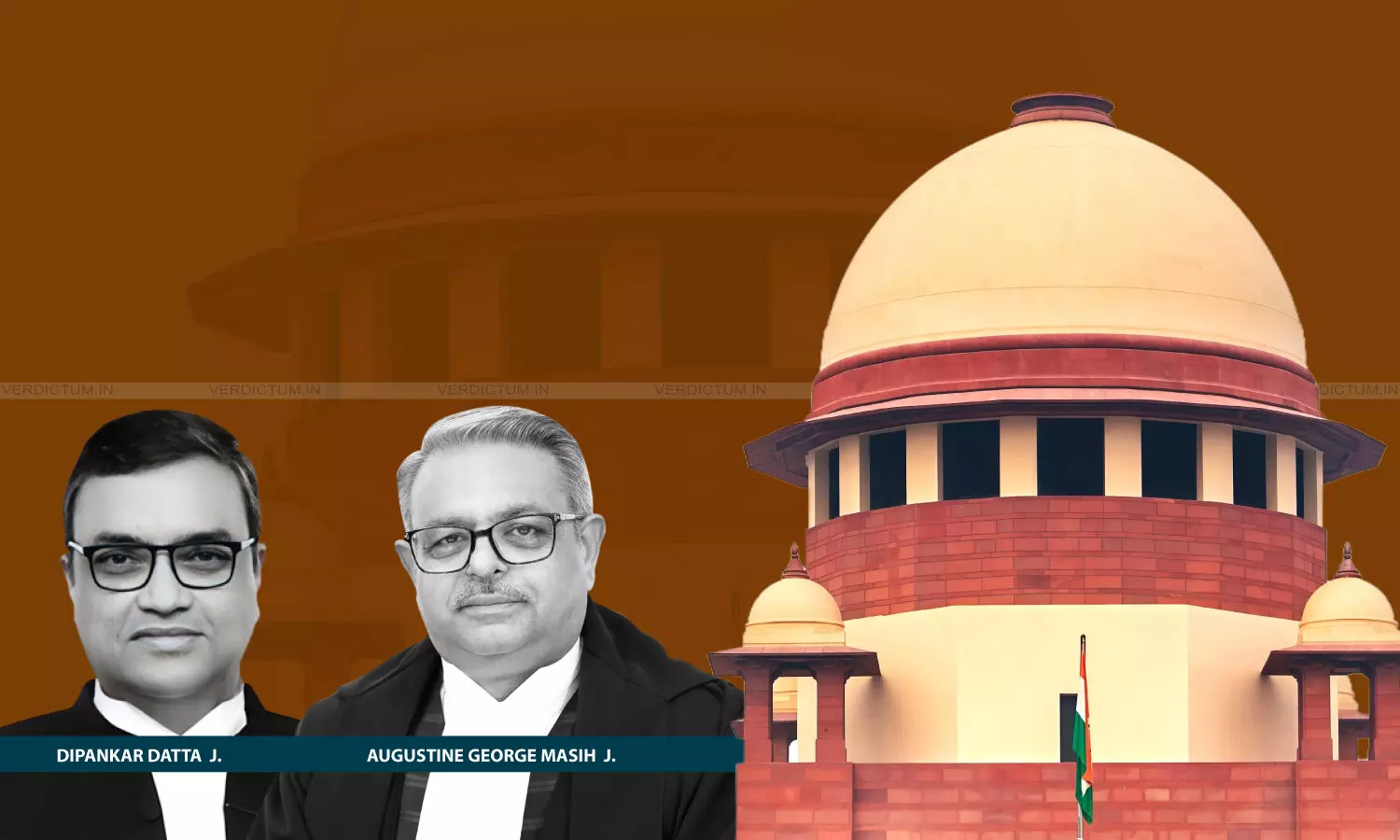
Justice Dipankar Datta, Justice Augustine George Masih, Supreme Court
Later Exemption Notifications Cannot Retrospectively Validate Void Ouster Orders: Supreme Court Dismisses Appeal, Grants ₹1.25 Crore To CRPF Constable
 |
|The Bench noted that exemption notifications issued under special provisions take effect prospectively and do not efface prior breaches of mandatory statutory protections.
The Supreme Court has held that an exemption notification under a beneficial social legislation cannot operate retrospectively to validate an otherwise void action. Deciding a decades-old dispute, the Court clarified that when a statutory right crystallizes on the date of an employee’s ouster, subsequent exemptions from that statutory mandate cannot efface the breach already committed.
While dismissing the civil appeal by the Union of India and the Central Reserve Police Force (CRPF), the Bench considered the fact that the CRPF Constable had already reached the age of superannuation during the decades of pending litigation, and therefore modified the operative directions.
Instead of actual physical reinstatement, the Court ordered the appellants to electronically transfer a consolidated lump-sum amount of Rs. 1,25,00,000/- (Rupees one crore twenty-five lakh only) to the respondent's bank account within eight weeks, covering back wages, interest, and costs. Given the respondent’s visual impairment, the Member-Secretary of the State or District Legal Services Authority was directed to assist him in safely investing a portion of the receipt in a high-yielding fixed deposit.
A Bench comprising Justice Dipankar Datta and Justice Augustine George Masih observed, “Turning attention now to the terms of the NOTIFICATION, it is clear from a bare perusal thereof that neither by express words nor by necessary implication was it made to apply retrospectively from the date the PwD Act was enforced. Also, the PwD Act being a beneficial legislation, any notification exempting an establishment from the duty imposed by Section 47 has to be strictly construed to protect the interests of disabled employees who acquire disability while in service”.
“…Respondent’s medical invalidation vide order dated 11th March, 1998 was made at a point of time when Section 47 of the PwD Act operated without any strings attached and the appellants were bound by its categorical mandate. The said order being ultra vires Section 47 read with Articles 14 and 21 of the Constitution as on date the same was made, the subsequent issuance of the NOTIFICATION cannot have retrospective effect so as to legitimise an act that is void ab initio. The right of the respondent crystallised on the date of ouster; and a later exemption from the statutory mandate cannot efface the breach already committed”, it noted further.
Vikramjit Banerjee, Additional Solicitor General (ASG) appeared for the appellant and Advocate Adtiya Dhawan appeared for the respondent.
The respondent, Bali Ram, was enrolled as a Constable (Driver) in the CRPF in 1985. In 1996, he developed a severe ophthalmic condition, resulting in complete blindness in his left eye and partial impairment in his right eye.
A Medical Invalidation Board in 1997 concluded that he was permanently incapacitated for further service in any capacity within the CRPF. Consequently, by an order dated March 11, 1998, the respondent was medically invalidated and discharged from service. His subsequent representations for full financial benefits were rejected by the competent authorities, prompting him to approach the High Court.
Thereafter, a Single Judge of the Himachal Pradesh High Court allowed the respondent's writ petition on August 11, 2008. Moving beyond the skeletal prayers, the Single Judge invoked Section 47 of the Persons with Disabilities (Equal Opportunities, Protection of Rights and Full Participation) Act, 1995 (PwD Act), quashed the invalidation, and ordered his reinstatement with full consequential benefits.
The Union of India challenged this before a Division Bench via a Letters Patent Appeal (LPA). After nearly seven years, the Division Bench dismissed the appeal, affirming that the mere grant of an invalid pension could not deny the statutory protection of Section 47. The appellants then moved the Supreme Court, where implementation was stayed in 2015.
The Supreme Court noted the prospective nature of a government notification dated September 10, 2002, which exempted combatant personnel of Central Para Military Forces from Section 47 of the PwD Act.
It completely rejected the appellants' argument on the doctrine of waiver, noting that a vulnerable employee’s lack of awareness or silence does not constitute an intentional relinquishment of a statutory welfare right.
“We, therefore, hold that so long as the proviso is not invoked by the appropriate Government for exempting an establishment from the provision of sub-section (1) of Section 47, the employer has a duty to offer an alternate post and the employee a right to be accommodated; however, once a notification is issued in terms of the proviso below sub-section (2) of Section 47 exempting an establishment from the provisions of the section, not only does the duty of the employer cease from the date the same takes effect, the employee would lose the statutory protection of continuity in service”, it said.
Furthermore, it ruled that under Article 226 of the Constitution of India, High Courts possess the equitable flexibility to mould reliefs and look past deficient or inelegant pleadings to prevent a statutory breach from defeating substantive justice.
Cause Title: Union of India & Ors. v. Bali Ram No. 850808321 (Neutral Citation: 2026 INSC 689)
Appearances:
Appellants: Vikramjit Banerjee, Additional Solicitor General (ASG), Arvind Kumar Sharma, AOR, Navanajay Mahapatra, Shantanu Sharma, Rajendra Singh Rana, Abhishek Singh, N. Visakamurthy-aor, Advocates.
Respondent: Adtiya Dhawan, Kiran Dhawan, Saurabh Duggal, Anirudh Negi, Aditya Gupta, Tushar Bukkle, Chander Shekhar Ashri, AOR, Advocates.