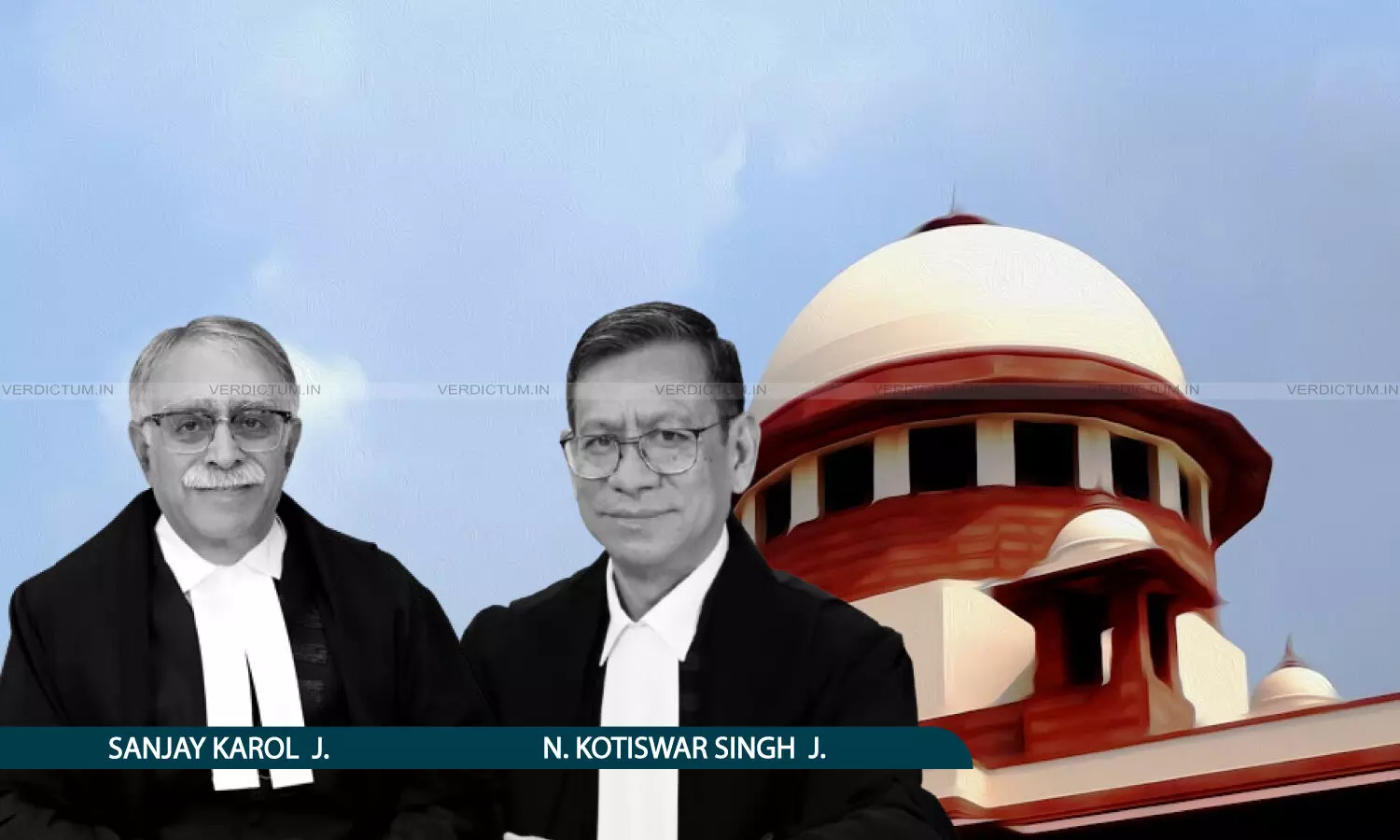
Justice Sanjay Karol, Justice N. Kotiswar Singh, Supreme Court
Issue Master Circular Standardising Cross-Border Coverage Clauses In Motor Insurance Policies: Supreme Court To IRDAI
 |
|The appeal before the Supreme Court was filed by an Insurance Company against an order passed in a motor accident case.
While asking an Insurance Company to pay compensation to the kin of a deceased victim of a cross border accident, the Supreme Court has advised the Insurance and Regulatory and Development Authority to consider issuing a master circular standardising cross-border coverage clauses across all motor insurance policies.
Emphasising the need for clearer judgments, the Apex Court held that the Motor Accident Claim Tribunal’s conclusion must be supported by adequate and clear reasoning.
The appeal before the Apex Court was filed by an Insurance Company against an order passed in a motor accident case.
The Division Bench of Justice Sanjay Karol and Justice Nongmeikapam Kotiswar Singh clarified, “IRDAI is advised to consider issuing a master circular standardising cross-border coverage clauses across all motor insurance policies.”
“The Tribunals are bodies that people approach, seeking compensation as a consequence of either accidents or deaths, both being entirely unwelcome scenarios. Then, it is only to be expected of the Tribunals that whatever their conclusion be, the same must be supported by adequate and clear reasoning. It is a matter of reality that at least one of the parties to such a dispute takes the matter in appeal to a higher forum. The clearer the reasoning and higher the fidelity to the judgments and orders passed by this Court in as much as it is the law that applies to the entirety of the country, the large gap between the date of institution and the date of disposal of such claim petitions will see reduction, as also the number of appeals”, it added.
AOR Sudhir Naagar represented the Appellant while AOR Ashutosh Ghade represented the Respondent.
Factual Background
As per the impugned order, the liability stood fastened upon the appellant, in connection with the accident of the vehicle which was bound from Durg to certain destinations in Nepal, for a religious tour. While it was on its way, it suffered a collision with a hill and three persons including the driver, Harish Yadav and one other unnamed victim, died. Before the Tribunal were the wife, children and mother of deceased Harish Yadav seeking compensation of Rs 48,99,776. Having considered the evidence presented, a compensation totaling Rs 32,67,000 was held payable to the claimants. The owner of the vehicle, the respondent was directed to pay the said amount along with interest. The High Court in terms of the impugned judgment held the insurer liable to pay the said amount instead of the owner.
Reasoning
On a perusal of the facts of the case, the Bench noted that the driver of the offending vehicle held a valid driving license issued by a competent licensing authority in India and the respondent-owner obtained a policy of motor insurance from the appellant-Insurance Company. It was further noticed that when the vehicle reached India-Nepal border, all relevant documents including driving license of the driver were properly verified by the competent authorities. Post such verification, the Bhansar Pragna Patra and Indian Tourist Passenger Checking Card were issued. The Bench took note of the existence of Treaty of Peace and Friendship between the Government of India and Government of Nepal which grants same privileges to the nationals of both the countries in the matter of movement.
The Bench stated, “It is trite in law to say that the insurance policy is a contract between the insured and the insurer. It is a wellrecognized principle of construction of contract that the contract must be read as a whole to determine the intent of the parties. The same principle extends to contract of insurance also; thus, policy as a whole should be seen, not a particular clause in isolation. Also, different clauses of the contract have to be read harmoniously and one cannot cherry pick one clause to base their claim on it, while rejecting other clauses of the document.”
The Bench noticed that the Insurance Policy provided coverage for use under a ‘permit’. The Bench was of the view that the clause “Limitations as to Use” is cast in general and unqualified terms; and does not impose any geographical limitation as to its use. “Once this permit is issued, the insurance company will cover the vehicles having valid permit irrespective of their geographical location where they are plied. Thus, by inserting this clause, the insurance companies restricted its coverage to only one condition, that is the existence of a permit under the Act”, it added.
As per the Bench, the existence of this clause did not render the clause “Geographical Area” redundant. “It will continue to cover those cases where the offending vehicle operates without a permit that extends to a foreign territory. Had the vehicle not possessed the permit as required by the MVA, this clause could have been invoked by the appellant-insurer to deny the coverage outside India. But since a permit existed that specifically authorised travel to Nepal, the “Limitations as to Use” clause, by its own terms, provided coverage for that use”, it further stated.
Holding that the provisions of MVA would be applicable in the case, the Bench held, “Section 139 provides power to the Government to make rules to grant a person authorization to take their vehicle out of India temporarily. Section 149 mandates insurers to oblige by foreign jurisdictions as though they were given by a Court in India. From a reading of both the Sections, it becomes clear that the statute is intended to be applicable regardless of whether the accident took place in India or in Nepal.”
The Bench thus dismissed the appeal while asking the appellant-insurer to pay the amount determined by the Tribunal along with the stipulated interest to the claimants.
Cause Title: The Oriental Insurance Co. Ltd. v. Durg Roadways Private Limited & Ors. (Neutral Citation: 2026 INSC 722)