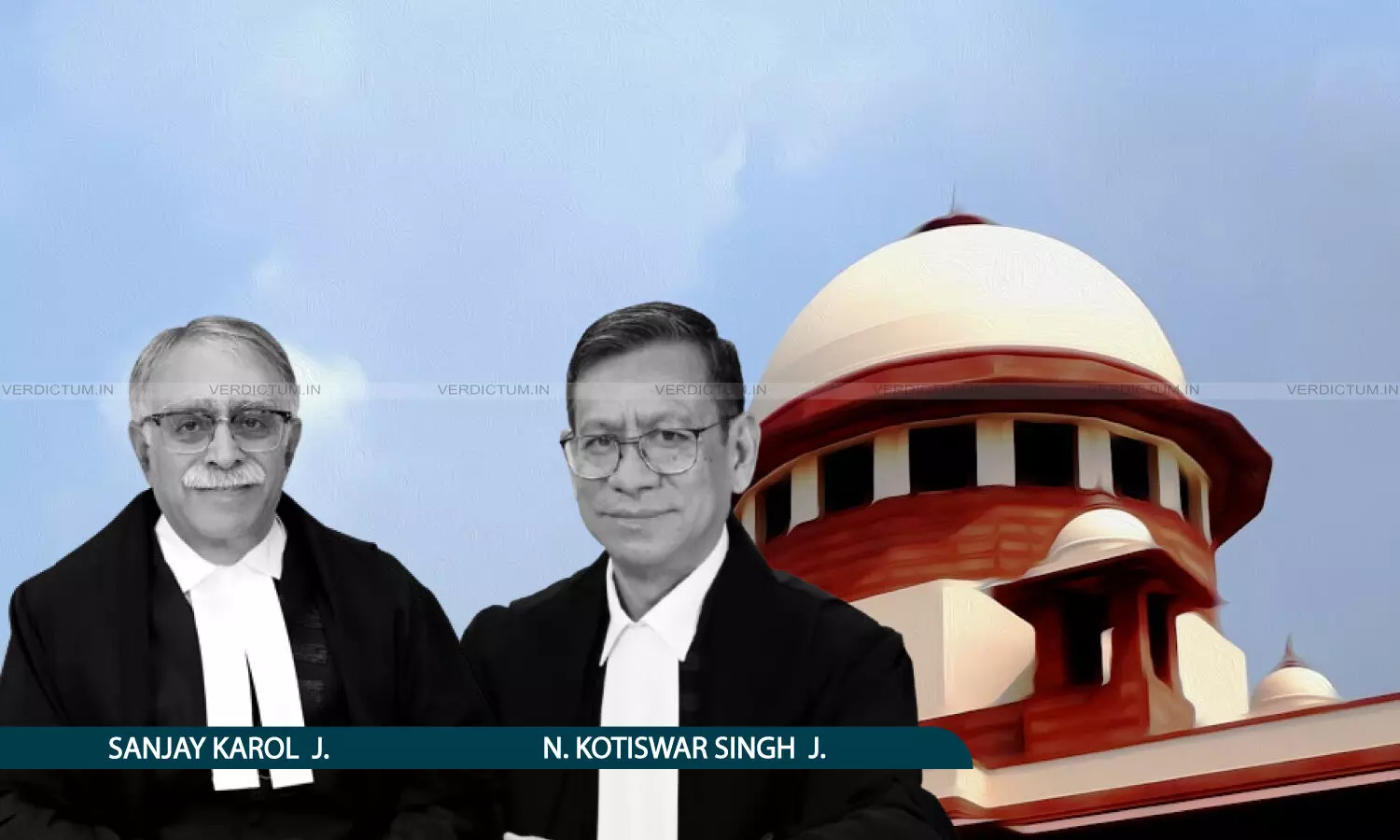
Justice Sanjay Karol, Justice N. Kotiswar Singh, Supreme Court
Sec.64VB Of Insurance Act Puts Embargo On Insurer From Taking Risk If Premium Isn’t Paid Prior To Assumption Of Such Risk: Supreme Court
 |
|The Supreme Court was considering the appeals filed under Section 23 of the Consumer Protection Act, 1986.
The Supreme Court has held that Section 64VB of the Insurance Act puts a statutory embargo on an insurer assuming risk if the premium has not been paid to them, either prior to such assumption or within the stipulated time period in which it is guaranteed to be paid. The Apex Court also clarified that the risk cannot be assumed earlier than the date on which the premium has been paid.
The Apex Court was considering the appeals filed under Section 23 of the Consumer Protection Act, 1986 challenging the correctness of the final judgment of the National Consumer Disputes Redressal Commission.
The Division Bench of Justice Sanjay Karol and Justice Nongmeikapam Kotiswar Singh held, “A perusal of the above reveals that there is a statutory embargo on an insurer assuming risk if the premium has not been paid to them, either prior to such assumption or within the stipulated time period in which it is guaranteed to be paid. Sub-section (2) also makes this clear that the risk cannot be assumed earlier than the date on which the premium has been paid. [See: Deokar Exports (P) Ltd. v. New India Assurance Co. Ltd.] Sub-sections (3) and (4) are procedural stipulations regarding refund, and the latter accounts for a situation where an agent collects the premium on behalf of the insurer. Sub-sections (5) and (6) grant power to the Central Government to relax requirements and for the Authority to specify the manner of receipt of payment by the insurer, respectively.”
Advocate Salil Paul represented the Appellant while Senior Advocate Joy Basu represented the Respondent.
Factual Background
The respondent, being an ongoing business concern involved in the trade of commodities, secured from the appellants a Marine Cargo Annual Turnover Policy, extending to INR 1200 Crores for the period January 1, 2010 to December 31, 2010. The premium thereon was payable in two equal instalments. About halfway through the year, the expected turnover of the respondent increased, and as such they set about communicating with the appellants regarding enhancement of the insurance coverage. There was apparently an assurance that coverage would continue as long as the instalments were paid on time. A fire broke out at the Container Freight Station on November 7, 2010, when the respondent had received 41,481 cotton bales and stored them. Smoke was seen emanating from the heaps, and while attempts were made to quell the fire, the appellants were informed about such incidents on the same day.
The surveyor appointed by the appellants assessed the damages at Rs.22,01,29,271. The appellants appointed a second surveyor, which was allegedly without the approval of the Insurance Regulatory and Development Authority. The Report produced by such second surveyor was alleged not to have been furnished to the respondents. The appellants sought the payment of additional premium to the tune of Rs.86,86,125 to enhance the coverage to INR 1500 crore. The said payment was made on December 17, 2010. The claim made by the respondent was eventually repudiated vide a letter, leading to the filing of the complaint before NCDRC. The NCDRC allowed the petition, ordering the appellants to pay the amount as assessed by the surveyor appointed by the appellants.
Reasoning
Referring to Section 64VB of the Insurance Act, the Bench explained that there is a statutory embargo on an insurer assuming risk if the premium has not been paid to them, either prior to such assumption or within the stipulated time period in which it is guaranteed to be paid. Sub-section (2) also makes this clear that the risk cannot be assumed earlier than the date on which the premium has been paid.
Holding that Section 64 VB of the Insurance Act would be attracted in the present case, the Bench noted that it was incumbent upon the respondent, in view of the clear stipulation under Section 64VB, to either extend the coverage by paying the amount based on estimated turnover or at least guaranteeing to pay the same within a particular time period.
The Bench further stated, “As such, since the Section clearly enjoins the assumption of risk by insurance companies such as the appellants before the amount is paid, the statement by the employee of the appellants would not have any value. Furthermore, the additional endorsement issued by the appellants accepting the additional premium paid by the respondent on 17.12.2010 clearly states that the effect of such acceptance would accrue from the said date. Accordingly, the argument by the respondent that a condition for the benefit of the insurer (Section 64 VB) can be, and has been in the present case, waived by conduct has to be negated because the appellants have assumed the risk arising out of the payment of additional premium only from the date of its payment and not prior thereto.”
Reiterating that a principal is liable for the actions of its agents, and the same should be done in accordance with the rules and regulations of the principal or, in the regular course of duty by the agent, the Bench stated, “It can only be expected, and reasonably so, by the appellants that its agent would be cognizant of the directives issued by it. In that view of the matter, no occasion arose for the Divisional Manager of the appellants to assure the respondent of extension of coverage.”
The Bench further held that the argument by the respondent that a condition for the benefit of the insurer (Section 64 VB) can be waived by conduct had to be negated because the appellants had assumed the risk arising out of the payment of additional premium only from the date of its payment and not prior thereto.
Concurring with the view of Justice Karol, Justice Singh made certain observations on the relationship of agent and principal and stated that assumption or continuation of the additional risk required compliance with Section 64VB; an agent cannot, by invoking actual or ostensible authority, confer upon the insurer a capacity which the statute itself withholds.
The Bench also stated that the principle qui facit per alium facit per se applies to acts within the agent’s authority; however, it does not enable an agent to confer upon the Principal a liability which the agent was neither authorised nor legally competent to assume on its behalf.
With such findings and observations, the Bench allowed the appeals.
Cause Title: The New India Assurance Company Limited & Ors. v. M/S Louis Dreyfus Commodities India Pvt. Ltd. (Neutral Citation: 2026 INSC 876)
Appearance
Appellant: Advocate Salil Paul, AOR Manjeet Chawla, Advocates Sahil Paul, Jyoti, Sandeep Dayal, Harmeet Singh Phillip, Kanupriya Mehta
Respondent: Senior Advocate Joy Basu, AOR Vinay Kumar Misra, Advocates Amrit Singh, Priya Misra, Anoop K George, Akshita Totla