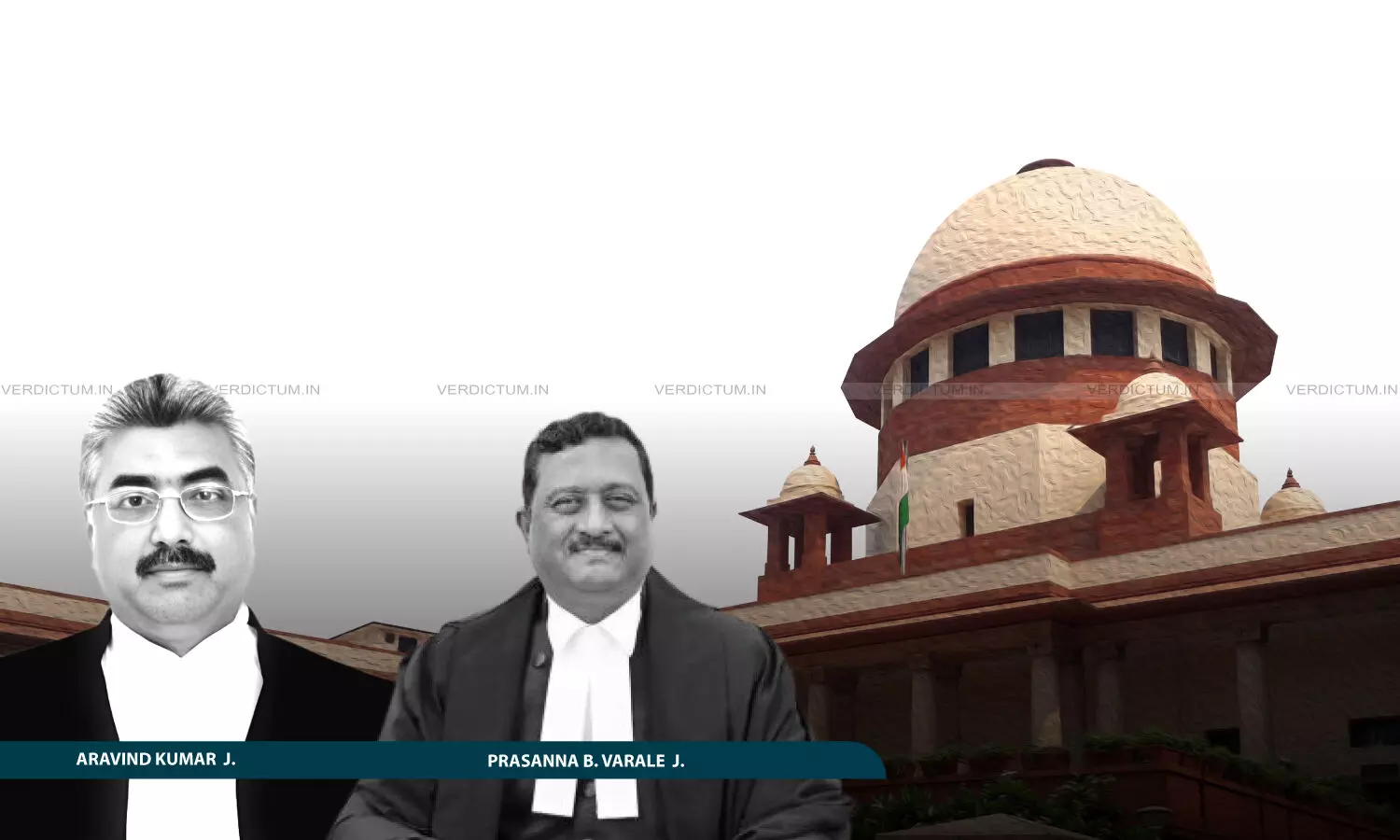
2020 Delhi Riots| Supreme Court Refers Scope Of Bail Under UAPA To Larger Bench; Grants Interim Bail To Tasleem Ahmed & Khalid Saifi
 |
|The Bench noted that they cannot be made to suffer continued incarceration merely because an important question of law has arisen for authoritative settlement.
The Supreme Court has referred to a larger Bench an important question concerning grant of bail under the Unlawful Activities (Prevention) Act, 1967, observing that there appears to be a divergence in how courts are applying the three-judge Bench judgment in Union of India v. K.A. Najeeb (2021) 3 SCC 713 while considering prolonged incarceration and delay in trial under Section 43D(5) of the statute.
While referring the broader legal issue for authoritative consideration by a Bench to be constituted by the Chief Justice of India, the Court granted interim bail to the Tasleem Ahmed and Khalid Saifi, for six months subject to stringent conditions. Both are an accused in the "larger conspiracy" case linked to the February 2020 Delhi riots.
A Division Bench of Justice Aravind Kumar and Justice Prasanna B. Varale observed, “…the controversy raises a broader question concerning the manner in which constitutional courts are to approach bail where prolonged incarceration is asserted in prosecutions governed by special statutes imposing restrictive bail conditions. In this background it would be imperative or in other words necessary for the appropriate bench that may be constituted by the Hon’ble Chief Justice of India, to clarify or expound the position of law laid down in K.A. Najeeb’s case, particularly in the backdrop of the rigour of 43D (5) which imposes restriction consciously and has received the assent of the Parliament, which obviously was brought in keeping in mind the valuable right enshrined in Article 21 of the Constitution of India”.
“We are, therefore, of the considered view that the issue requires consideration by Bench to be constituted by the Hon’ble Chief Justice of India. This is necessary not merely for the present batch of matters, but to settle the correct approach to bail under special statutes where Article 21, prolonged incarceration and statutory restrictions intersect”, the Bench further noted.
Senior Advocate Rebecca John appeared for the appellant Suryaprakash V Raju, A.S.G. appeared for the respondent.
At the outset, the Court noted the submission of Additional Solicitor General S.V. Raju that different Benches of the Supreme Court appeared to have adopted varying approaches while interpreting K.A. Najeeb, particularly on whether prolonged incarceration by itself can justify grant of bail despite the statutory embargo under Section 43D(5) of the UAPA.
“The issue, as projected before us, is not a narrow one concerning the bail prayer of the present appellants alone. It concerns the proper constitutional approach to be adopted where prolonged incarceration and delay in conclusion of trial are pressed as grounds for bail notwithstanding the statutory restraint contained in Section 43D(5) of the UAPA”, it had noted.
The Bench clarified that K.A. Najeeb remains a binding and authoritative pronouncement preserving the constitutional guarantee of personal liberty under Article 21 of the Constitution of India, while also recognising Parliament’s legislative intent behind imposing strict bail conditions in terror-related prosecutions.
“The ratio of K.A. Najeeb (supra), therefore, is neither a charter for indefinite incarceration under the cover of Section 43D(5), nor a mathematical command that the mere passage of time, divorced from all surrounding circumstances, must automatically result in bail”, it said.
Referring extensively to the recent ruling in Gulfisha Fatima v. State (Govt. of NCT of Delhi) (2026 INSC 2), the Bench held that Article 21 remains a continuing constitutional safeguard even in prosecutions under special statutes, but the inquiry into delay and incarceration must be contextual and accused-specific. The Court noted that factors such as the nature of allegations, the role attributed to the accused, prima facie material, stage of trial, causes of delay, witness protection concerns, public order and national security implications cannot be ignored while deciding bail.
The Bench also took note of a later coordinate Bench decision in Syed Iftikhar Andrabi v. National InvestigationAgency, Jammu, (2026 INSC 503) where reservations had been expressed on certain aspects of Gulfisha Fatima and on the manner in which K.A. Najeeb had been understood. Observing that a coordinate Bench cannot effectively unsettle another Bench of equal strength through critical observations alone, the Court held that judicial discipline required the issue to be placed before a Bench of appropriate strength.
“The question is not whether Article 21 survives Section 43D(5). It undoubtedly does. The true question is how Article 21 is to be applied in a statutory field where Parliament has consciously imposed restrictions on bail”, the Bench observed.
“We deem it necessary to observe that disagreement between coordinate Benches, by itself, is neither unusual nor undesirable. The law has often grown through reasoned difference. What the discipline of precedent does not countenance, however, is a course by which an earlier coordinate Bench is subjected to reservations of a fundamental character, particularly on the alleged misapplication of a larger Bench decision, without the matter being placed before a Bench competent in strength to resolve the perceived conflict. A coordinate Bench may distinguish an earlier decision, may explain its own understanding of the law, and may, in an appropriate case, express doubt. But where the doubt goes to the root of the legal principle applied, the matter cannot be left at the stage of criticism. A doubt expressed in emphatic terms is still a doubt; it is not a declaration of law. Unless resolved by a Bench of appropriate strength, it only introduces uncertainty in the administration of justice”, it observed.
“The appellants cannot be made to suffer continued incarceration merely because an important question of law has arisen for authoritative settlement. Without expressing any opinion on merits, and subject to stringent safeguards, we are inclined to grant interim bail to the appellants pending further orders”, it noted further.
Accordingly, the Court directed their release on interim bail for six months on strict conditions, including execution of personal bonds of ₹2 lakh with two local sureties, surrender of passports, restriction on leaving the National Capital Territory of Delhi without prior permission, mandatory attendance before the trial court, periodic reporting to the investigating officer, and a complete prohibition on contacting witnesses or making public statements touching upon the merits of the pending case.
Cause Title: Tasleem Ahmed v. State Govt. Of NCT Of Delhi SLP (CRL) NO.2867/2026
Appearances:
Appellant: Rebecca John, Sr Adv., Rajat Kumar, Yash S. Vijay, AOR, Anushka Baruah, Shikhar Aggarwal, Joshua Tom Thomas, Mehmood Pracha, R. H. A. Sikander, AOR, Jatin Bhatt, Sanawar, Kshitij Singh, Sikander Raza, Nujhat Naseem, Kumail Abbas, Chirag Verma, Advocates.
Respondent: Suryaprakash V Raju, A.S.G., Mukesh Kumar Maroria, AOR, Kanu Aggarwal, Rajat Nair, Annam Venkatesh, Samrat Goswami, Alok Dubey, Dhruv Pande, Sairica Raju, Akshaja Singh, Aryansh Shukla, Satyarth Singh, Shikhar Yadav, S.N. Terdal (AOR), Advocates.