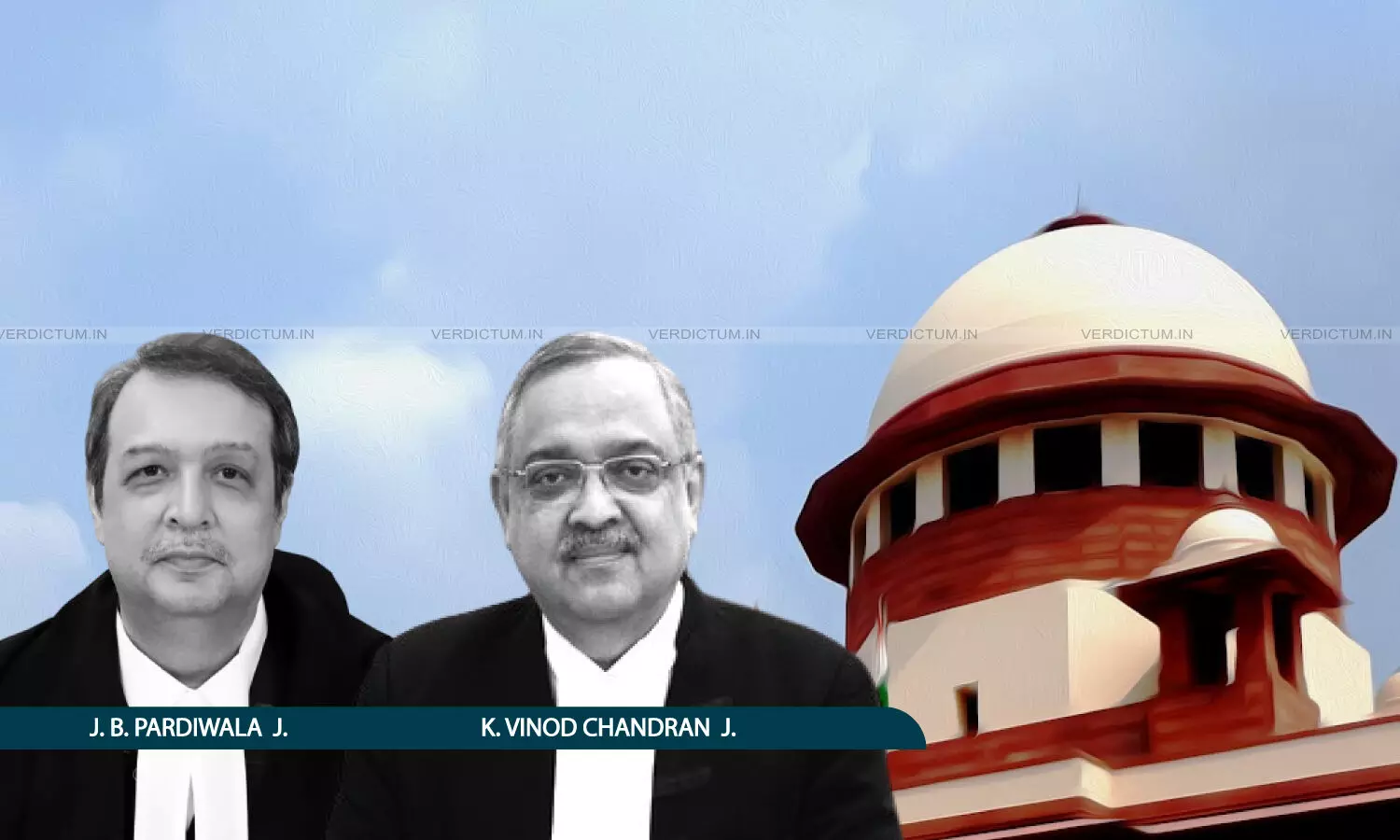
Justice J. B. Pardiwala, Justice K. Vinod Chandran, Supreme Court
Going To Movie After Witnessing Drowning Not Enough To Sustain Conviction: Supreme Court Acquits Two Men Accused Of Murdering Friend
 |
|The Court held that reprehensible conduct after witnessing a drowning could not be treated as an incriminating circumstance where the medical evidence and surrounding circumstances indicated accident rather than homicide.
The Supreme Court has acquitted two accused convicted for the murder of their friend, holding that the prosecution failed to prove the circumstances necessary to establish that the death was homicidal rather than an accidental drowning.
The Court held that the accused having fled from the spot, gone for a movie, and returned soda bottles after witnessing their friend drown was reprehensible, but could not by itself establish murder when the hypothesis of accidental drowning was more plausible from the evidence.
The Court was hearing a criminal appeal filed by two accused against the judgment of the Gujarat High Court confirming their conviction by the Trial Court under Sections 302, 34 and 201 read with Section 120B of the Indian Penal Code.
A Bench of Justice J.B. Pardiwala and Justice K. Vinod Chandran observed: “we also have to notice the High Court’s presumption that no person who saw his friend drowning would go to a movie or would take the trouble of bringing back empty soda bottles to the shop from where they purchased it. If such a presumption is accepted then it can be presumed that even after a premeditated murder, the accused would not conduct themselves in that manner. The human mind, as has often been held by this Court, is at the same time fickle, manipulative and imaginative and the actions, the result of a deprived or a foolish mindset, especially in the face of adversities, which cannot be predicted. The subsequent conduct on which the High Court found possible the prosecution story of murder rather than of drowning, in this case we are unable to accept. It is the hypothesis of an accidental drowning that looms large from the evidence led at the trial; more plausible than a homicide.”
The Bench further observed: “None of the circumstances having been proved, we are inclined to find the probable and more possible version of the accused, that the deceased drowned accidentally. The accused are guilty of having fled from the spot and not having attempted to rescue the drowning person, by crying out for help. Their conduct of having gone for a movie after witnessing their friend drowning, though reprehensible, cannot be found to be an incriminating circumstance, to establish murder rather than drowning. The hypothesis of innocence is crystal clear, and circumstances indicate an accident and not a premeditated murder.”
Senior Advocate Iqbal Syed appeared for the appellants, while Advocate Swati Ghildiyal appeared for the State of Gujarat.
Background
The prosecution case was that the deceased was taken from his house by the accused in the early morning on the pretext of going to Ankleshwar to play volleyball. When he did not return by evening, his family began searching for him. One of the accused was allegedly contacted and said that he was watching a movie. Later, clothes found on a riverbank were identified as belonging to the deceased.
The accused later came voluntarily to the deceased’s house. According to the deceased’s brother, they were questioned inside a car and said that they had gone swimming in the river, that the deceased had accidentally drowned, and that they had fled in panic before going for a movie. The body was recovered the next morning, and the post-mortem recorded death due to asphyxia by drowning.
The prosecution examined 20 witnesses and relied on motive, last seen together, presence of the accused near the river, alleged homicidal death, silence and conduct of the accused, their statement that they had dropped the deceased at Sahra Darwaja, and admissions said to have been made in the bail application.
The Trial Court convicted both accused and sentenced them to life imprisonment under Section 302 IPC, along with sentences under Sections 120B and 201 IPC. The High Court confirmed the conviction. Before the Supreme Court, the appellants argued that there was no evidence of homicidal death and that the defence version of accidental drowning was plausible. The State argued that the circumstances were fully established, including the purchase of four soda bottles, return of only three, and the accused being wet and inebriated when they returned the bottles.
Court’s Observations
The Supreme Court first examined whether the death was homicidal. It noted that the post-mortem report and the later report after chemical examination of viscera recorded the cause of death as cardio-respiratory arrest due to asphyxia by drowning. The Court also noted that the three injuries on the body were not grievous and, according to the doctor, could have been caused while taking a bath in the river or when the body was dragged in the flow of water and came into contact with a hard substance.
The Court observed: “A reading of the post-mortem report, juxtaposed with the testimony of the Doctor who conducted the post-mortem, PW-1, cannot lead to a finding that the death was homicidal. There is nothing to indicate that the victim was hit on the head, rendered unconscious and then drowned deliberately in the river, as the prosecution propounded before the Trial Court. The post-mortem report leans in favour of the defense version of an accidental drowning.”
The Bench rejected the State’s submission that the deceased had been struck with a broken soda bottle. It noted that no broken soda bottle was confronted to the doctor, no such glass fragments or broken bottle were shown to have been seized from the scene, and no broken soda bottle with bloodstains was sent for forensic examination.
On motive, the Court noted that the deceased was alleged to have had a relationship with the sister of one accused and that the other accused allegedly had a quarrel with him over a cricket match. However, the Court found that the family’s conduct did not support the prosecution’s version of hostility, since the deceased had gone with the accused in the morning and the brother and sister’s testimonies indicated a friendly relationship.
The Court observed: “The very conduct of the family members of the deceased, as coming out from the testimonies of PW-12 and PW-13, the brother and sister, indicates rather friendly relationship between the deceased and the accused.”
The Court also noted the delay in raising allegations against the accused. It found that even after the accused allegedly confessed that the deceased had drowned and after the body was recovered, no allegations were levelled until the First Information Statement was recorded months later.
The Bench stated: “As we noticed, there was gross delay in raising the allegations against the accused, who had admittedly accompanied the victim to the river for a bath and probably consumed alcohol. Even after the confession of the accused and recovery of the body, no allegations were levelled against the accused, till the date on which the FIS was recorded.”
On the evidence of the shop owner and the person managing a pan parlour, the Court noted that they identified the accused in court, but were not acquainted with them. It held that such dock identification could not be relied upon when no test identification parade was conducted after arrest, particularly where the allegation of murder was raised after four months.
The Court further found that the testimony of another witness who saw three persons at the river did not implicate the accused in murder. That witness had said the three jumped into neck-deep water after having drinks, and he then went away. The Court noted that the riverbank was not a lonely place and was frequented by people.
The Court observed: “As stated by PW-12 and as discernible from the testimony of PW-8, the riverbank where the accused and the deceased were found drinking, was not a lonely spot and it was frequented by people. It is very unlikely that the accused would have chosen such a spot for the premeditated murder of their friend, especially in broad daylight.”
The Court held that the last seen circumstance and presence near the scene were admitted by the accused, but their defence was that the deceased accidentally drowned. It further held that the medical evidence did not prove homicide and instead tilted towards accidental drowning.
The Bench observed: “The motive, as we observed, was an afterthought. The last seen theory and the presence of the accused near the scene of occurrence is admitted by the accused and their defense is that the deceased accidentally drowned. As for homicidal death, there was nothing coming out from the post-mortem report and the testimony of the Doctor, PW-1, in proof of homicide. On the contrary the medical evidence tilts the scales towards an accidental drowning.”
The Court also held that the silence of the accused and their failure to inform the deceased’s family could not be treated as incriminating in the circumstances, since such conduct was probable even in the event of accidental drowning. It found the reliance placed by the High Court on admissions in the bail application difficult to accept.
Conclusion
The Supreme Court held that none of the circumstances relied on by the prosecution had been proved and that the evidence indicated accident rather than premeditated murder.
The Court reversed the judgments of the Trial Court and the High Court and acquitted both accused.
It directed that the accused be released forthwith if not required in any other case. If already released on bail, their bail bonds were directed to stand cancelled.
Cause Title: Taher Vajiyuddin Rangwala & Anr. v. The State of Gujarat (Neutral Citation: 2026 INSC 859)