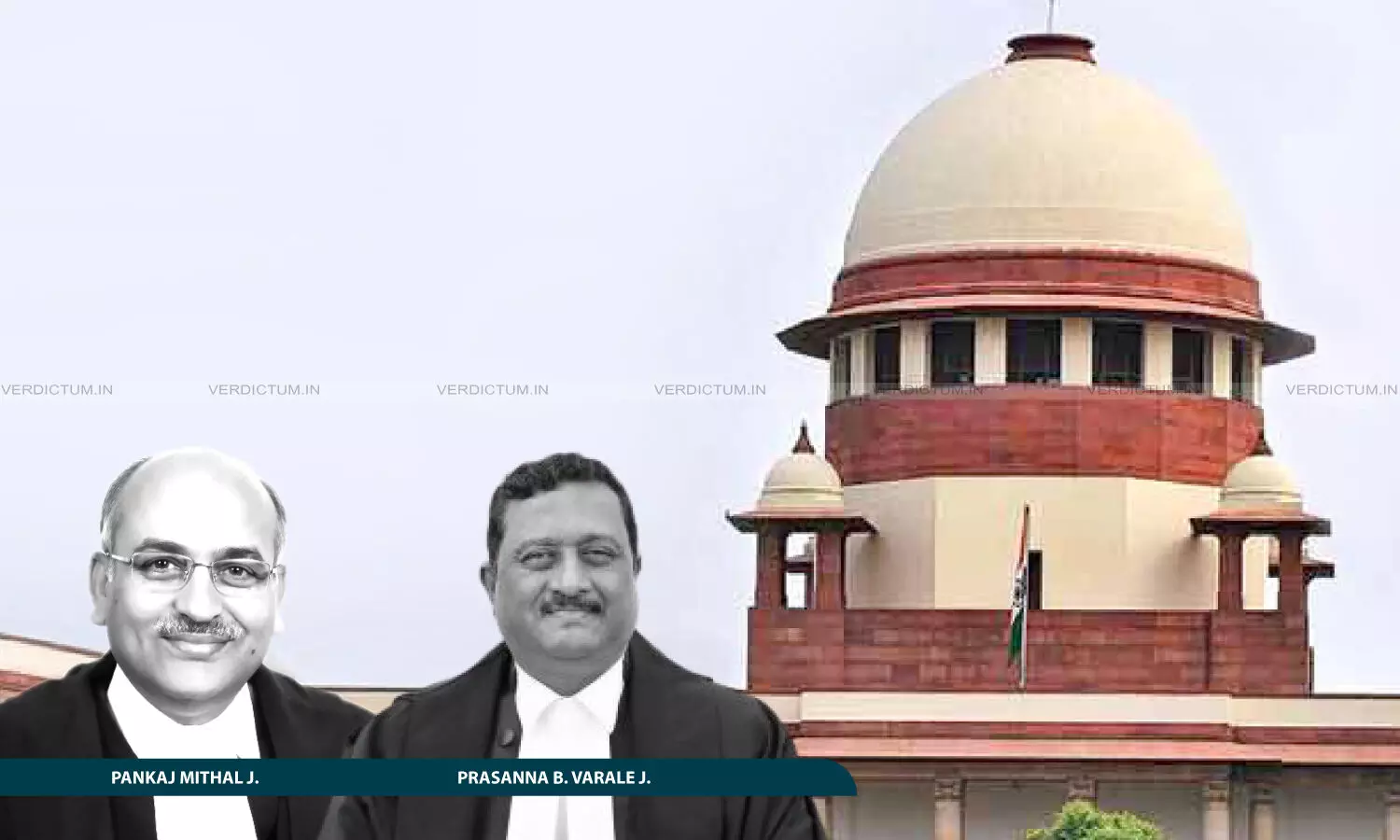
Justice Pankaj Mithal, Justice Prasanna B. Varale, Supreme Court
Peer Specialist In Expert Medical Panel Absent: Supreme Court Quashes Criminal Case Against Anaesthetist Accused Of Medical Negligence
 |
|The Court held that prosecution for criminal medical negligence cannot be sustained based on an expert opinion rendered by a panel lacking a peer specialist competent to assess the technical aspects of the relevant branch of medicine.
The Supreme Court has quashed criminal proceedings initiated against a senior anaesthetist accused of medical negligence under Section 304A of the Indian Penal Code, 1860, holding that the expert panel constituted during the investigation suffered from a fundamental legal defect owing to the absence of a peer specialist capable of evaluating the technical aspects of epidural anaesthesia and catheter management.
The Court held that the continuation of criminal prosecution in such circumstances would violate the safeguards evolved by the Supreme Court to protect medical professionals from unwarranted criminal prosecution.
The Court was hearing an appeal challenging the judgment of the Kerala High Court refusing to quash criminal proceedings arising out of the death of a patient following piles surgery conducted at a private hospital in Kannur. The prosecution alleged that improper administration of the epidural Sencoraine injection after surgery led to the patient’s death and sought to prosecute the anaesthetist along with other medical personnel under Sections 304A and 34 IPC.
A Division Bench of Justice Pankaj Mithal and Justice Prasanna B. Varale observed: “The appellant has also raised a ground pointing out to a legal flaw, namely non-inclusion of the anaesthetic in the four-member expert medical panel constituted to review the case. The absence of a peer specialist renders the panel inherently incompetent to evaluate the technical nuances of epidural anaesthesia and catheter management. The panel's conclusion that the appellant was 'grossly negligent' for not waiting to see the drug's effect, despite her shift ending hours prior to the emergency, was highlighted as medically absurd. The prosecution's reliance on this flawed expert report violates the protective legal safeguards laid down by the Supreme Court to prevent the harassment of medical professionals”.
Senior Advocate R. Basant appeared for the appellant.
Background
The prosecution case arose from the death of a patient who underwent surgery for piles, where the appellant was serving as a senior anaesthetist. According to the prosecution, after surgery, the patient experienced severe post-operative pain, following which a nurse contacted the appellant over the telephone and administered an epidural sensorcaine injection. Shortly thereafter, the patient’s condition deteriorated, and he died.
The postmortem examination revealed approximately 80% blockage in the left coronary artery and recorded the cause of death as “acute coronary insufficiency.” Initially, the FIR was registered only against the surgeon. However, after the constitution of a four-member medical expert panel, the police filed a charge-sheet against the appellant, the surgeon and the attending nurse under Sections 304A and 34 IPC. The appellant unsuccessfully sought discharge before the Magistrate, Sessions Court and Kerala High Court.
Meanwhile, consumer proceedings instituted by the deceased’s family culminated in the District Consumer Redressal Forum exonerating the appellant and holding only the hospital, surgeon and nurse liable. The complainants did not challenge the appellant’s exoneration before the appellate consumer forum. Aggrieved by the refusal to quash the criminal proceedings, the appellant approached the Supreme Court.
Court’s Observation
The Supreme Court extensively examined the law governing criminal prosecution of medical professionals and reiterated that criminal negligence under Section 304A IPC requires a degree of negligence substantially higher than mere civil negligence. Referring to Jacob Mathew v. State of Punjab (2005), the Court observed that the prosecution of doctors requires strict adherence to judicial safeguards so that medical professionals are not exposed to criminal proceedings for mere errors of judgment or inadvertent acts committed during treatment.
Quoting Jacob Mathew, the Court observed: “For negligence to amount to an offence, the element of mens rea must be shown to exist. For an act to amount to criminal negligence, the degree of negligence should be much higher i.e. gross or of a very high degree. Negligence which is neither gross nor of a higher degree may provide a ground for action in civil law but cannot form the basis for prosecution.”
The Court further reiterated: “The act must be of such a nature that no medical professional in his ordinary senses and prudence would have done or failed to do”
Examining the material collected during the investigation, the Court found that the prosecution's case substantially rested upon the opinion rendered by the medical expert panel, yet none of its members was a specialist in anaesthesia or epidural pain management. The Court held that such omission struck at the root of the prosecution because the allegations specifically concerned epidural anaesthesia and catheter administration, which necessarily required assessment by a competent peer specialist familiar with the technical nuances involved.
The Supreme Court also found significant contradictions in the statements of the nurse who administered the injection. In her earlier statements, the nurse attributed instructions regarding the administration of the injection to the surgeon, whereas in a later statement, she alleged that the appellant had personally instructed her while physically present in the ward. The Court noted that even the surgeon’s version before the expert panel only referred to a telephonic consultation with the appellant and did not support the prosecution’s later version.
The Bench further observed that the appellant’s duty hours had already concluded, and she had left the hospital after ensuring that the patient was stable. Other doctors, including an on-duty anaesthesiologist, were physically present in the hospital at the relevant time. The Court held that even assuming the appellant advised administration of sensorcaine over the telephone, such advice constituted standard post-operative pain management and could not amount to gross criminal negligence attracting criminal liability.
The Court observed: “The prescribed medicine, sensorcaine, was undisputedly the correct and necessary analgesic for the situation, …even assuming that the injection was wrongly administered by the nurse, the same cannot automatically fasten criminal liability upon the appellant who was admittedly not physically present and had no role in administering the injection.”
The Supreme Court also attached significance to the fact that the Consumer Forum had already exonerated the appellant after evaluating evidence on merits and that such a finding had attained finality. Referring to Radheyshyam Kejriwal v. State of West Bengal (2011), Videocon Industries Ltd. v. State of Maharashtra (2016) and Prem Raj v. Poonamma Menon (2024), the Court reiterated that where exoneration on merits takes place in civil proceedings on identical allegations, continuation of criminal prosecution may amount to abuse of process.
The Court further noted that the postmortem conclusively established severe coronary artery blockage and acute coronary insufficiency as the immediate cause of death. It held that even if the injection failed to alleviate pain, the resulting stress triggering a cardiac event could not legally be attributed to the appellant, particularly when she was off-duty and not physically administering the injection herself.
Conclusion
The Supreme Court held that the prosecution failed to disclose any material establishing gross rashness or criminal negligence attributable to the appellant and that the expert panel itself was fundamentally defective owing to the absence of a peer specialist competent to evaluate the technical issues involved in the case.
Holding that the continuation of criminal prosecution against the appellant amounted to abuse of process of law, the Court allowed the appeal, quashed the judgment of the Kerala High Court and set aside the criminal proceedings pending before the Judicial Magistrate First Class-I, Kannur. The Court consequently discharged the appellant from all offences alleged against her.
Cause Title: Supriya Kumari MC v. State of Kerala & Ors. (Neutral Citation: 2026 INSC 537)